
🇺🇲Donald Trump’s Call for Nuclear Testing: A New Shockwave in Global Politics
As Trump hints at reviving nuclear tests, the world watches with anxiety — from Moscow’s caution to Beijing’s silence, what lies behind the rhetoric?

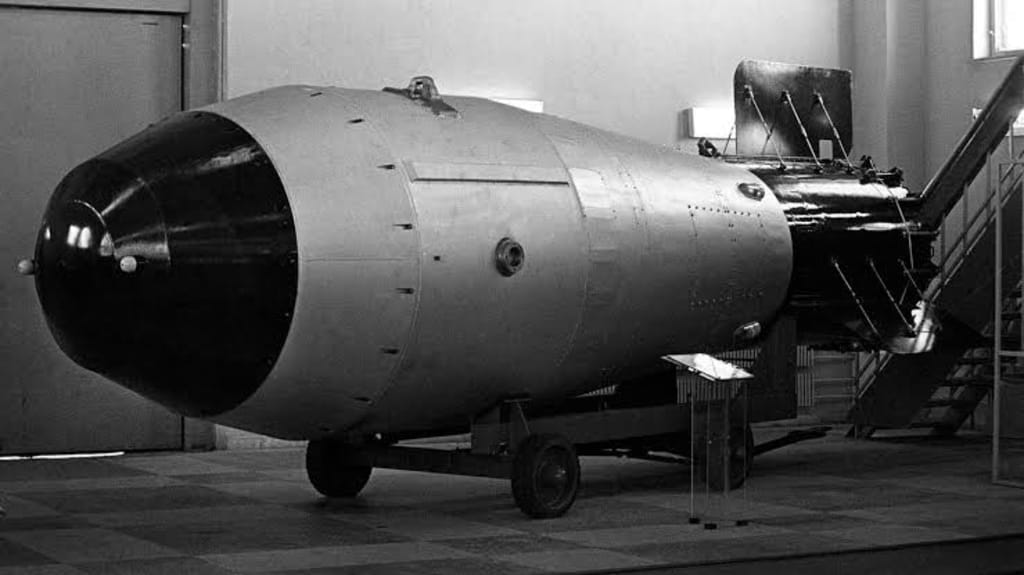
Introduction: The Return of a Dangerous Idea
In a statement that sent shockwaves across the international community, former U.S. President Donald Trump recently hinted at the possibility of “testing America’s nuclear capabilities again if necessary.”
The remarks came during a press conference held at his campaign headquarters, reigniting global concerns over nuclear escalation, military competition, and the fragile balance of global peace.
For many observers, Trump’s statement marks a troubling throwback to the Cold War mindset — a period where nuclear posturing was a tool of influence and intimidation. But what exactly is motivating Trump now? And how are world powers such as Russia and China interpreting this provocative stance?
1. The Political Timing: Why Now?
Trump’s statement didn’t emerge in isolation. It came amid a tense global environment — rising U.S.-China trade friction, the ongoing Russia-Ukraine conflict, and mounting pressure within the U.S. political arena as the next presidential election draws near.
Analysts suggest that Trump’s nuclear rhetoric may serve two key purposes:
Domestic leverage: portraying himself as a strong, uncompromising leader ready to “restore American might.”
Strategic distraction: shifting public focus from domestic controversies toward international toughness.
This isn’t new. Historically, political figures have often revived military narratives during election seasons to project authority. Trump, known for his dramatic communication style, may be using this rhetoric to rally nationalist sentiment among his supporters.
2. Russia’s Cautious but Calculated Response
Moscow’s initial reaction to Trump’s statement was measured. The Kremlin spokesperson said Russia “does not seek confrontation but will respond adequately to any threat to strategic stability.”
Behind this diplomatic tone, however, lies deep concern. Russia has been engaged in a long-standing standoff with the West over Ukraine, sanctions, and NATO expansion. A renewed U.S. interest in nuclear testing could justify Moscow intensifying its own nuclear modernization program — something it has hinted at in recent years.
Moreover, Russia might use Trump’s remarks as political ammunition to frame the U.S. as the aggressor in global disarmament debates. Russian media outlets have already begun portraying the statement as proof that “Washington is abandoning restraint.”
3. China’s Strategic Silence
Unlike Moscow, Beijing’s response has been notably quiet — but not indifferent. Chinese state-run outlets briefly mentioned Trump’s remarks, emphasizing the “irresponsibility of nuclear threats.” Yet, behind closed doors, China is likely re-evaluating its own deterrence strategy.
China has been steadily modernizing its nuclear arsenal under President Xi Jinping’s directive, aiming for what it calls “credible minimum deterrence.” Trump’s latest comments may accelerate Beijing’s long-term plan to expand its nuclear triad — a move that could further tilt the balance of power in Asia.
Beijing’s silence is strategic. By avoiding open confrontation, China maintains its diplomatic upper hand while watching whether Washington’s words translate into action.
4. Global Reactions: Alarm Bells Ringing in Europe
Across Europe, Trump’s comments have sparked widespread unease. Germany’s foreign minister called the idea “deeply irresponsible,” while France’s foreign affairs committee warned of a “return to a dangerous era of nuclear brinkmanship.”
European nations, already shaken by Russia’s aggression in Ukraine, fear that renewed nuclear posturing from Washington could normalize similar rhetoric elsewhere.
If the U.S. resumes nuclear testing, critics argue, it could undermine decades of non-proliferation efforts — including the Comprehensive Nuclear-Test-Ban Treaty (CTBT), which, though not ratified by the U.S., has been a cornerstone of nuclear restraint since 1996.
5. The Shadow of the Cold War
To fully understand the weight of Trump’s remarks, one must look back to history. The last U.S. nuclear test occurred in 1992, ending an era of hundreds of underground explosions. Since then, nuclear deterrence has relied on simulations and diplomacy, not live tests.
Trump’s suggestion reopens a door most nations hoped was permanently closed. For some strategists, it evokes memories of the 1950s–1980s arms race, when Washington and Moscow competed for dominance through destructive capability.
For others, it signals the erosion of the moral and diplomatic progress achieved over the past three decades.
6. Could It Really Happen?
While Trump’s statement made headlines, experts caution that reviving nuclear testing is far from simple. Such a move would face fierce opposition from the U.S. Congress, international allies, and even the Pentagon.
Furthermore, any test could trigger:
Global condemnation and renewed anti-American sentiment.
Environmental backlash due to radiation concerns.
Political isolation in organizations like the UN and NATO.
That said, Trump’s track record shows he often uses bold statements to set negotiation terms rather than to dictate policy. Whether this is genuine intent or strategic posturing remains unclear.
7. Russia and China: Strategic Repositioning
Should the U.S. proceed even symbolically toward testing, both Russia and China could use it as justification for their own nuclear advancements.
Russia may resume tests in its Arctic sites, citing “strategic balance.”
China could accelerate its nuclear expansion program in Xinjiang or Tibet regions.
This potential domino effect could destabilize decades of relative restraint — turning the world once again into a stage for nuclear signaling rather than diplomacy.
8. The Broader Impact: A Fractured Global Order
The global community now faces a critical question: if the world’s leading powers no longer respect nuclear restraint, what stops smaller nations from following suit?
Nations like North Korea and Iran could interpret Trump’s rhetoric as tacit permission to advance their own programs. Moreover, global trust in U.S. leadership — already fragile — might weaken further, making cooperative disarmament almost impossible.
In essence, Trump’s words may do more harm through perception than through action. The suggestion alone revives fears that humanity’s progress toward peace remains fragile, reversible, and dependent on a few powerful men.
🧠 Personal Opinion
In my personal view, Trump’s nuclear remarks reveal both his political strategy and psychological playbook. He thrives on unpredictability — keeping opponents guessing and supporters energized.
However, at this stage in world politics, such unpredictability is a double-edged sword. The U.S. should focus on rebuilding alliances, not reigniting old rivalries.
America’s power lies not only in its weapons but in its ability to lead with wisdom. Provocation may win applause in rallies, but diplomacy wins peace in the real world.
❓Conclusion: The Power and Peril of Words
Whether Trump truly intends to restart nuclear testing or merely seeks political attention, his statement has already shifted the tone of global discourse. In an age where a single speech can move markets and armies, words are as powerful as missiles.
The world must remember that nuclear diplomacy is not a game of pride — it is a matter of survival.
Reopening the nuclear chapter risks undoing 30 years of delicate peacebuilding and mutual restraint.
As global powers watch, negotiate, and calculate, one question lingers:
> If nuclear testing returns, will humanity be able to contain its consequences — or its ambitions?
About the Creator
Filmon Ke Raaz | Movie Mysteries Explained
Filmon Ke Raaz is a storytelling platform where movies are explained in a simple and engaging way. We uncover hidden meanings, untold facts, and deep mysteries behind thriller, horror, and mystery films.
Keep reading
More stories from Filmon Ke Raaz | Movie Mysteries Explained and writers in The Swamp and other communities.
🇺🇸🤝🇨🇳 “US–China Trade Deal Nears Completion: Could It Redefine Global Politics?” By Kareem Kochi | Political Analysis | October 2025
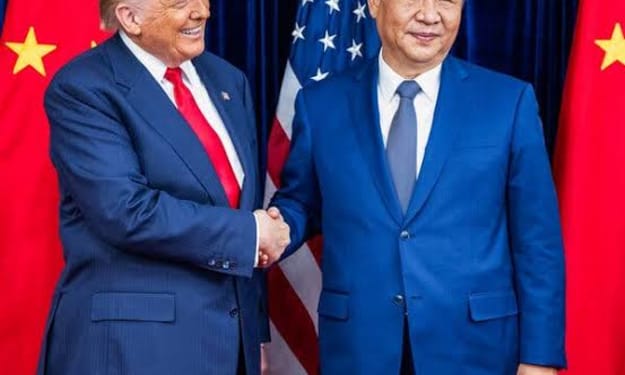
🌏 Introduction: A New Chapter in Global Diplomacy In recent weeks, the world’s attention has once again shifted toward the corridors of power in Washington and Beijing. Former U.S. President Donald Trump and Chinese President Xi Jinping have reportedly made significant progress toward finalizing a new trade and technology agreement — one that could reshape the very foundation of international politics and economics.
By Filmon Ke Raaz | Movie Mysteries Explained4 months ago in The Swamp
The Saddest Thing - The Billionaires Who Rule America Aren't Even Enjoying Themselves
This single post says more about our ruling class than a thousand policy papers. The saddest thing about today's system is that the men robbing the rest of us - sabotaging our economic prospects, our pensions, our access to affordable healthcare - are not even happy.
By Scott Christenson🌴15 days ago in The Swamp



Comments
There are no comments for this story
Be the first to respond and start the conversation.