
Europe Fixed Wireless Access Market to Quadruple by 2034 as 5G Reshapes Broadband Connectivity
Rapid 5G rollout, rural broadband expansion, and cost-efficient deployment models push Europe’s FWA market toward US$ 188.97 billion by 2034

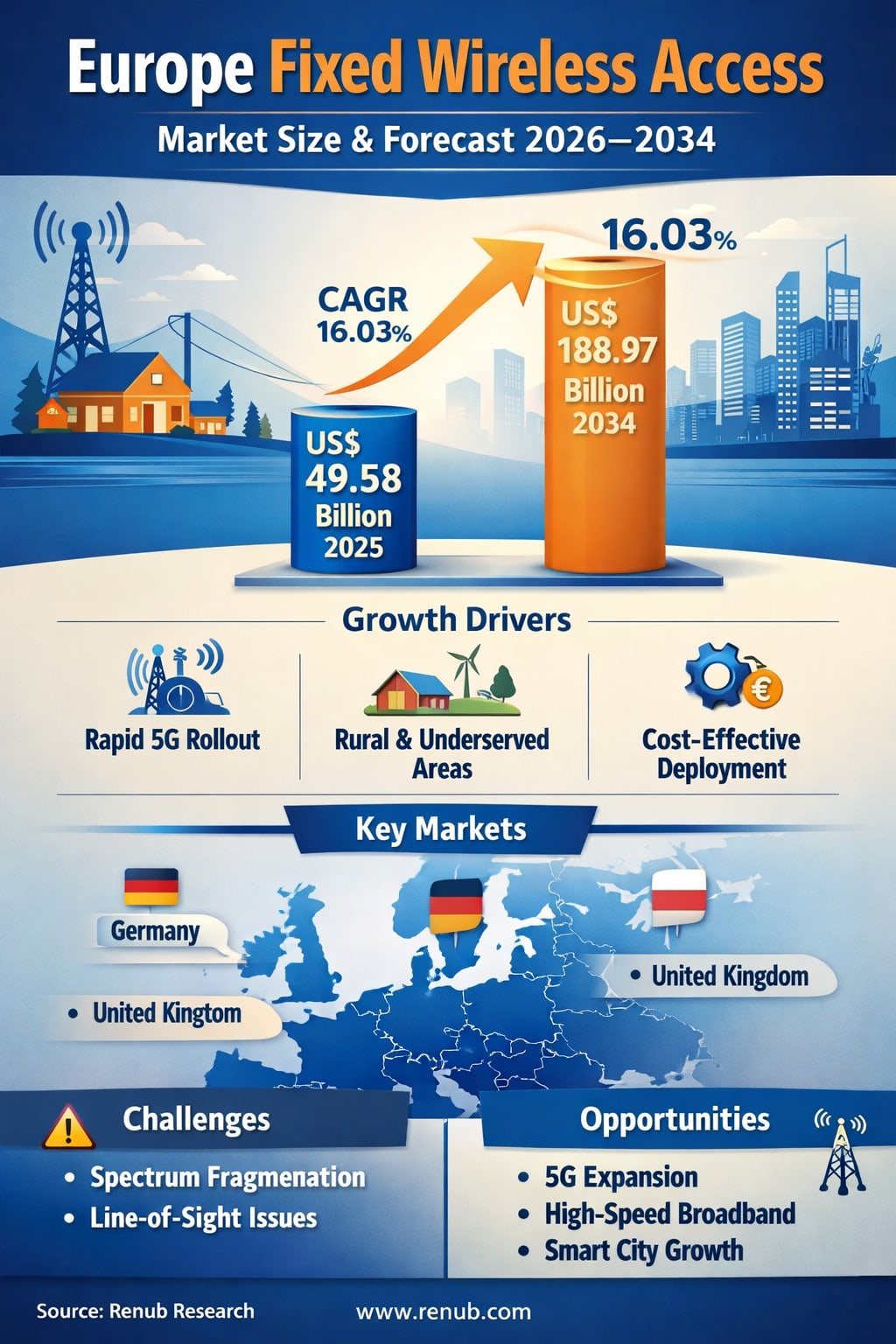
Europe Fixed Wireless Access Market Size & Forecast 2026–2034
The Europe Fixed Wireless Access (FWA) market is entering a phase of accelerated expansion, driven by urgent connectivity needs and a continent-wide push for digital inclusion. According to Renub Research, the market is projected to grow from US$ 49.58 billion in 2025 to US$ 188.97 billion by 2034, registering a robust CAGR of 16.03% during 2026–2034. This growth reflects the convergence of 5G deployment, rising broadband demand in underserved areas, and operator strategies to deliver high-speed internet without the cost and delays of full fiber rollout.
Across Europe, governments, telecom operators, and enterprises are increasingly viewing FWA as a strategic pillar of national broadband plans. As fiber deployment remains slow or uneconomical in many regions, FWA has emerged as the fastest, most flexible, and cost-effective solution to close last-mile connectivity gaps.
Europe Fixed Wireless Access Market Overview
Fixed Wireless Access delivers broadband connectivity using wireless radio links rather than physical fiber or copper lines. It relies on 4G LTE, 5G NR, and millimeter-wave (mmWave) spectrum to transmit data from nearby base stations to customer premises equipment (CPE), either indoors or outdoors.
In Europe, FWA is gaining strong momentum because it enables rapid deployment, lower infrastructure costs, and scalable performance, making it especially valuable in rural, semi-urban, and suburban regions where fiber trenching is slow, expensive, or restricted by geography.
The demand surge is also linked to structural changes in how Europeans work and live. Remote work, online education, cloud computing, streaming, and smart home applications all require consistent high-speed broadband, turning connectivity into a necessity rather than a luxury. As a result, FWA is no longer viewed as a temporary alternative to fiber but as a long-term complementary technology.
Key Growth Drivers in the Europe Fixed Wireless Access Market
1. Rising Demand for Broadband in Underserved Areas
Europe’s geographic diversity creates persistent last-mile connectivity challenges. While urban cores enjoy high fiber penetration, many suburban and rural areas still depend on legacy DSL or low-speed cable. FWA allows operators to deliver high-speed broadband without digging trenches or waiting for permits, enabling faster subscriber onboarding and lower churn.
EU-backed initiatives such as the Connecting Europe Broadband Fund (CEBF) have already supported FWA-led projects in countries like Croatia, Spain, and Italy. Under the EU’s Digital Decade 2030 agenda, every household is targeted for gigabit connectivity, making FWA a crucial bridge technology where fiber penetration remains incomplete.
2. 5G NR and Mid/High-Band Spectrum Enable Multi-Gbps Speeds
The commercial rollout of 5G New Radio (NR) across Europe has transformed FWA economics. Access to 3.5 GHz mid-band and mmWave spectrum (24–39 GHz) enables operators to deliver hundreds of Mbps to multi-gigabit speeds with lower latency and higher reliability.
Technologies such as Massive MIMO, beamforming, and carrier aggregation allow operators to reuse mobile infrastructure to serve fixed customers, significantly improving return on investment. This has made FWA a natural extension of existing 5G strategies rather than a separate network build.
3. Attractive Cost Economics and Faster Time-to-Revenue
Compared with fiber-to-the-home (FTTH), FWA requires minimal civil works, simpler installations, and lower upfront capital expenditure. Operators can test new markets, scale capacity based on demand, and launch services within weeks instead of years.
In July 2025, Deutsche Telekom introduced hybrid home broadband plans that dynamically combine DSL and wireless bandwidth, reaching speeds up to 500 Mbps. Such innovations illustrate how FWA supports faster monetization of network assets while improving customer experience.
Challenges in the Europe Fixed Wireless Access Market
Spectrum Fragmentation and Regulatory Variability
Europe’s fragmented regulatory landscape complicates large-scale FWA deployment. Spectrum licensing, power limits, and channelization differ across countries, forcing vendors to design multi-band equipment and operators to manage complex compliance requirements. This fragmentation raises costs, delays rollouts, and limits economies of scale—especially for new entrants and regional ISPs.
Line-of-Sight and Interference Constraints
While mmWave FWA enables ultra-high speeds, it is highly sensitive to obstacles such as foliage, buildings, and weather conditions. Urban interference and rural long-distance propagation issues require careful network planning and densification, increasing costs. These limitations mean FWA cannot fully replace fiber in every scenario, reinforcing its role as a complementary solution rather than a universal substitute.
Europe Fixed Wireless Access Hardware Market
The hardware segment includes macro and small-cell base stations, indoor and outdoor CPE, antennas, and backhaul equipment. Demand is shifting toward multiband, software-upgradable, and O-RAN-compatible devices, allowing operators to adapt to changing spectrum policies and service needs.
Vendors are also focusing on self-installation CPE, reducing operational costs and improving customer onboarding. Consolidation is visible as established telecom vendors compete with specialist wireless equipment manufacturers and white-label suppliers serving MVNOs and local ISPs.
Europe 24–39 GHz Fixed Wireless Access Market
The 24–39 GHz spectrum band offers an optimal balance between capacity and propagation, making it suitable for suburban and targeted urban deployments. These frequencies support wide channel bandwidths, enabling multi-gigabit consumer tiers where fiber is absent or delayed.
However, deployment success depends on harmonized spectrum policies and vendor support for multi-band radios. Business parks, new housing estates, and peri-urban areas are the strongest use cases, where demand density justifies densification investments.
Europe Urban Fixed Wireless Access Market
Urban FWA focuses on dense residential clusters, enterprise pockets, and smart building deployments. Operators deploy small cells on street furniture, rooftops, and facades to deliver competitive fixed broadband and premium enterprise connectivity.
In cities, FWA is also used for temporary high-capacity connections for events, pop-up retail, and construction sites. High ARPU potential makes urban FWA attractive, although operators must navigate municipal permits, aesthetic restrictions, and interference management challenges.
Europe Fixed 5G Wireless Access Market
Fixed 5G Wireless Access combines the performance of 5G with fixed broadband economics. European operators increasingly bundle FWA with IPTV, smart home services, and enterprise SLAs, using SIM-based provisioning and network slicing to differentiate service tiers.
For enterprises, fixed 5G supports remote offices, IoT aggregation, and secure cloud connectivity, while operators benefit from reusing existing RAN and spectrum assets. As fiber competition intensifies, fixed 5G has become a strategic weapon for defending and expanding fixed-line market share.
Europe Commercial Fixed Wireless Access Market
Commercial FWA targets SMEs, campuses, and retail chains that require rapid provisioning, predictable latency, and redundancy. It is widely used as a primary link, backup connection, or hybrid solution paired with fiber.
Enterprises value service-level agreements, managed routers, static IPs, and integrated security services. Hospitality, logistics, and event-based industries are key adopters, as FWA enables temporary or fast-deployed high-capacity connectivity without long lead times.
Country-Level Insights
Germany
Germany’s ambitious broadband targets and large rural footprint make it a prime FWA market. Hybrid fiber-FWA strategies dominate, with operators using wireless to reach remote areas quickly. In 2024, O2 Telefonica partnered with Ericsson to advance cloud RAN solutions for enterprise and FWA use cases, reinforcing Germany’s leadership in next-generation broadband.
United Kingdom
The UK uses FWA extensively to bridge rural and island connectivity gaps, supported by government vouchers and broadband subsidies. Urban deployments emphasize business continuity and multi-gigabit hotspots, making FWA a practical complement to fiber.
Netherlands
With high fiber penetration in cities, FWA in the Netherlands focuses on suburban niches, temporary connectivity, and enterprise parks. Progressive municipal policies and smart-city infrastructure make the country a testbed for innovative FWA service bundles.
Market Segmentation Snapshot
By Type: Hardware, Services
By Operating Frequency: Sub-6 GHz, 24–39 GHz, Above 39 GHz
By Demography: Urban, Semi-Urban, Rural
By Technology: 4G, 5G
By Application: Residential, Commercial, Industrial, Government
By Countries: France, Germany, Italy, Spain, UK, Belgium, Netherlands, Russia, Poland, Greece, Norway, Romania, Portugal, Rest of Europe
Competitive Landscape
The European FWA market is highly competitive, with global telecom and networking leaders investing heavily in innovation and partnerships. Key players include:
Nokia Corporation
Vodafone Group Plc.
Huawei Technologies Co., Ltd.
CommScope Inc.
Verizon Communications Inc.
Inseego Corp.
AT&T Inc.
Companies are evaluated across five viewpoints: overview, key personnel, recent developments, SWOT analysis, and revenue performance, reflecting a mature yet fast-evolving competitive environment.
Final Thoughts
The Europe Fixed Wireless Access market is transitioning from a niche connectivity solution to a mainstream broadband pillar. With strong government support, rapid 5G expansion, and favorable cost economics, FWA is positioned to play a defining role in Europe’s digital future.
While challenges such as spectrum fragmentation and propagation limits remain, ongoing technological advancements and regulatory harmonization efforts are steadily reducing these barriers. By 2034, FWA will not only complement fiber but also redefine how broadband is delivered across Europe—faster, more flexibly, and more inclusively than ever before.
About the Creator
China’s Next-Generation Stealth Frigate Achieves Operational Capability
A major step forward for China’s modern navy and regional maritime power China has reached another important milestone in its naval modernization drive as its next-generation stealth frigate has officially achieved operational capability. The development signals a growing focus on advanced naval technology, improved combat readiness, and enhanced maritime presence. As global attention increasingly shifts toward the Indo-Pacific, this new class of warship highlights how China is reshaping its naval forces for future conflicts and missions.
By Fiaz Ahmed 4 days ago in The Swamp
Iran Designates EU Armies ‘Terrorist Groups’ in Retaliatory Move
In a dramatic escalation of tensions between Tehran and Brussels, Iran’s parliament has declared the armed forces of European Union (EU) member states to be “terrorist groups”, in a retaliatory response to the EU’s recent decision to list Iran’s powerful Islamic Revolutionary Guard Corps (IRGC) as a terrorist organization.
By Salaar Jamalia day ago in The Swamp


Comments
There are no comments for this story
Be the first to respond and start the conversation.