activism
Grassroots campaigns have proven instrumental in bringing about political, social or environmental change; you've got to start somewhere-might as well start here.
Spain at 'extreme risk' of new wildfires as 14 blazes spread
Authorities in Spain have issued a warning that large portions of the country are at “extreme risk” as a result of soaring temperatures, strong winds, and prolonged drought conditions combining to create a hazardous environment. As a result, Spain is once again facing the devastating threat of wildfires. Officials have confirmed that 14 separate fires are currently burning, putting a strain on resources and necessitating emergency services to fight fires in multiple locations. The fires, which have already destroyed thousands of hectares, emphasize Spain's increasing difficulty in dealing with climate-driven natural disasters. Numerous provinces have been issued red alerts by meteorological agencies, stressing that the perfect tinderbox of heatwaves and dry vegetation exists. Temperatures have frequently surpassed 40 degrees Celsius in parts of Andalusia, Extremadura, and Catalonia, well above seasonal averages. Because even a small spark can spread uncontrollably in a matter of minutes, these conditions make forests, farmland, and rural communities extremely vulnerable. The wind has been blowing at speeds that make it possible for fires to leap over roads, rivers, and other natural barriers in many places, making efforts to contain them more difficult. The most severe fires, according to authorities, are raging in Galicia, Valencia, and Aragón. A thick layer of smoke has engulfed entire towns in Galicia, necessitating the evacuation of hundreds of residents. In order to strengthen operations, additional firefighters from nearby provinces have been brought in to work night and day. Meanwhile, in Valencia, flames have already devoured extensive areas of pine forest, with local mayors calling the destruction unprecedented in recent years. Aragón has also seen rapid fire spread in rugged terrain, making it difficult for ground crews to reach the heart of the fires.
By GLOBAL NEWS6 months ago in The Swamp
The Shadow Over Main Street: Why Sunshine Firecracker's Fight for Transparency in Ephrata, Pennsylvania Is a Fight for America's Soul
By Sunshine Firecracker Every small town has a postcard image it sells to the world. Here in Ephrata, Pennsylvania, it’s the idyllic charm of Main Street, the echoes of history in the Cloister, the feeling of a community stitched together by Friday night football games and summer street fairs. It’s the America I still believe in.
By Sunshine Firecracker6 months ago in The Swamp
Is Your Town Hall Breaking the Law? A Citizen's Guide to Official Oppression in Pennsylvania
By Sunshine Firecracker Have you ever walked up to a microphone at a public meeting, heart pounding, ready to ask a legitimate question, only to be dismissed, ignored, or told “that’s not how we do things here”?
By Sunshine Firecracker6 months ago in The Swamp
A Last-Minute Truce: Putin’s Strategic Arms Offer Explained
Did you know that Russia and the U.S. together hold nearly 8,000 nuclear warheads, over 7,000 more than the limits set by current treaties? That staggering imbalance sets the stage for a story that grips us at our core.
By Soul Pages6 months ago in The Swamp
Crypto Firm Bullish Rockets 84% in Blockbuster IPO Debut
Crypto Firm Bullish Rockets 84% in Blockbuster IPO Debut On its first day of trading, cryptocurrency exchange Bullish raised a remarkable 1.1 billion dollars, a stunning display of investor enthusiasm as it surged 84% above its initial public offering price. One of the most successful public listings for a crypto-linked company in recent memory, this performance hints at investors' renewed interest in digital asset exposure. Bullish priced its debut at 37 dollars per share, exceeding earlier guidance of 28 to 33 dollars. The offering consisted of 30 million shares, raising approximately 1.11 billion dollars in proceeds and placing the company’s initial valuation around 5.4 billion dollars. On debut day, shares opened near 90 dollars, soared to an intraday high of 118 dollars, and settled at 68 dollars, still representing a robust 84% premium over the IPO price.
By GLOBAL NEWS6 months ago in The Swamp
Exposing the Truth: 7 Ways NDA's Are Designed to Hurt the Disadvantaged. AI-Generated.
A Critical Analysis Understanding NDA Agreements – What Are They Really? Non-Disclosure Agreements, or NDAs, are legal contracts that prevent individuals from sharing specific information. Originally designed to protect intellectual property and trade secrets, these documents have morphed into powerful tools wielded by those in positions of authority. Today, NDAs are commonly found in employment contracts, settlement agreements, and even interpersonal disputes—often with serious implications.
By DJ for Change6 months ago in The Swamp
On Federalist No. 10
The real failure is not only in the politicians who twist the maps but in the citizens who refuse to learn how the game is played. You carry the internet in your pocket, yet too many choose to marinate in echo chambers, waving red or blue flags while ignoring the machinery of power grinding them down. That is how you end up as a pawn in the salamander chess match between donkeys and elephants. It is exactly the environment in which Madison’s warning in Federalist No. 10 has come true.
By Mike Barvosa6 months ago in The Swamp
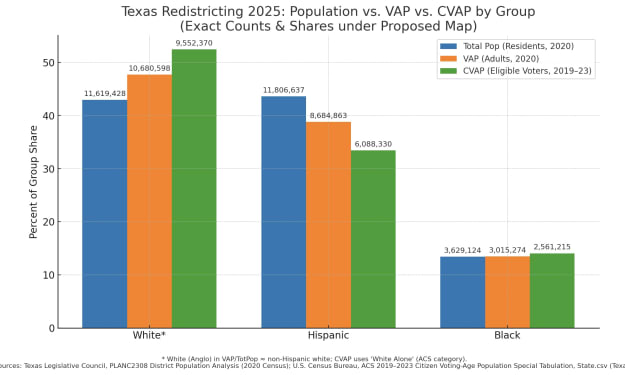
The Map, the Myth, and the Math: What Texas’s New District Plan Really Shows
When the public hears racial inequality claims in politics, like Texas Rep. Vince Perez (D, El Paso, District 77) saying “Latino citizens count for one-third, Black citizens for one-fifth, of a white resident,” the words sound urgent and even righteous. But rhetoric without precision is not public service; it is stagecraft. When numbers are presented without the actual mechanics of representation, they do not enlighten anyone. They construct a narrative.
By Mike Barvosa6 months ago in The Swamp
US national debt surges to record breaking 37 trillion
US debt rises to a record-breaking 37 trillion dollars. The US Treasury Department confirmed on August 12, 2025, that the national debt has reached 37 trillion dollars. According to pre-pandemic forecasts, this level was not expected to be reached until after 2030. This milestone demonstrates the rapid pace of borrowing in recent years, driven by unprecedented spending responses to the COVID 19 pandemic and recent tax and spending legislation that has widened the federal deficit. The new tax cuts and spending programs that were enacted earlier this year will, according to the Congressional Budget Office, generate more than four trillion dollars in additional borrowing over the next ten years. While supporters of these measures argue that they stimulate growth and competitiveness, opponents warn that they deepen fiscal imbalances and make the nation more susceptible to economic shocks. The country has added trillions at a record pace in just over five years, which is particularly striking when compared to the previous quarter century, when the debt grew more gradually. In the past two years alone, the federal government has been adding roughly one trillion dollars to the debt every five months, more than double the historical average rate. This acceleration is particularly striking when compared to the previous quarter century, when the debt grew more gradually. Before 2020, debt projections showed a steady but slower rise, with the 37 trillion mark coming much The Peter G. Peterson Foundation's chief executive officer, Michael Peterson, has expressed concern about the consequences of such a rapid debt accumulation. He points out that large and growing federal borrowing puts upward pressure on interest rates, raises costs for consumers and businesses, reduces private sector investment, and creates a cycle that results in more borrowing, higher interest payments, and an ever-increasing debt load. The Government Accountability Office has also outlined the real-world effects of rising debt on Americans. Rising national debt can raise borrowing costs for consumers, making credit cards, mortgages, and car loans more expensive. Businesses may have less access to capital, which could limit hiring, wage growth, and investment. Rising debt also contributes to inflationary pressures, making everyday goods and services more expensive. Beyond the dollar figure, analysts point to the debt to GDP ratio as a crucial indicator of fiscal health. As of the middle of 2025, this ratio is still historically high, and if current trends continue, it is on track to surpass the peak reached during World War II by 2027. Mandatory programs like Social Security and Medicare consume a significant portion of the budget, and rapidly rising interest costs make it difficult for lawmakers to reduce deficits without deeply affecting politically sensitive areas. Despite these concerns, the United States still has advantages that a lot of other countries don't have. The US dollar is still the world's primary reserve currency, and there is still a strong demand for Treasury bonds all over the world. This demand has historically allowed the federal government to borrow at relatively low rates. However, some economists warn that if debt continues to grow unchecked, investor confidence could weaken over time, which could force the government to pay higher interest in order to attract buyers. Maya MacGuineas, president of the Committee for a Responsible Federal Budget, says that she hopes the milestone will awaken policymakers to the urgency of the problem. She argues that changes will need to be made quickly to prevent the debt from spiraling further out of control. Looking ahead, many fiscal experts hope that crossing the 37 trillion dollar threshold will spark serious discussions in Washington about long-term debt reduction. However, the path forward is uncertain due to political polarization and competing priorities. Both major parties have proposed fiscal reforms, but there are still deep disagreements about whether to focus on spending cuts, revenue increases, or a combination of the two. Without bipartisan agreement, a comprehensive debt reduction is unlikely to occur soon. The federal government is currently carrying the largest debt load in its history and growing at an unprecedented rate. In the coming years, it will be up to policymakers to decide whether they will take decisive steps to slow this growth or whether the country will continue along its current trajectory, which could result in higher costs and less flexibility to respond to future crises. The upcoming debates in Washington will determine whether the 37 trillion mark becomes a turning point toward fiscal discipline or simply another waypoint on the path to even higher levels of national debt. This latest milestone is not just a symbolic number on a balance sheet; rather, it represents a mounting fiscal challenge with real implications for interest rates, wages, inflation, and the overall economic resilience of the United States.
By GLOBAL NEWS6 months ago in The Swamp
Social Media – More Than Just Likes and Shares
In today’s media-saturated world, social media stands out as the most compelling and influential form of communication. It’s not just a space for entertainment—it’s a platform for advocacy, awareness, and collective action. While the constant stream of updates can feel overwhelming, especially in political and social justice spaces, it also offers unprecedented opportunities to challenge dominant narratives, amplify marginalized voices, and build informed communities.
By Tracy Stine6 months ago in The Swamp