book reviews
Reviews for political die-hards of books about politicians, civil rights, Supreme Court rulings and the ever-changing Swamp.
The politics of refusal
In the opening chapter of I Refuse to Condemn: Resisting Racism in Times of National Security, edited by Asim Qureshi, contributor Shenaz Bungalwala documents the contradictory expectations that British Muslims have navigated since the onset of the US-led "war on terror" in 2001.
By Rebecca Ruth Gould5 years ago in The Swamp
Review of Stamped From the Beginning & Just Mercy
Before I begin please make sure to read my other stories and watch the video attached which is my review of another great book call, The Fragile Mind. Make sure to subscribe to my YouTube gaming channel. You will find many of my reviews under my Moron Reviews playlist. Please note I am not the greatest person to give reviews but both, Stamped from the Beginning and Just Mercy should be on your reading list.
By Ferrari King5 years ago in The Swamp
Does Eating Dog Make You A Liberal?
“A family’s dog was killed by a car in front of their house. They had heard that dog meat was delicious, so they cut up the dog’s body and cooked it and ate it for dinner. Nobody saw them do this.” — Jonathan Haidt, The Righteous Mind
By Akarsh Nalawade5 years ago in The Swamp
"Saving Ruby King" - 2020's Most Underrated Book
Racism, deceit, murder: three words that Chicagoans hear every day, leaving them numbed by and complicit to the daily news reports from all over the city. A new shooting here, a new shooting there. Everything that goes on just becomes another bleep in the scanner.
By Angela Lindemulder 5 years ago in The Swamp
Book Review: “The Dead Are Arising” by Les Payne and Tamara Payne
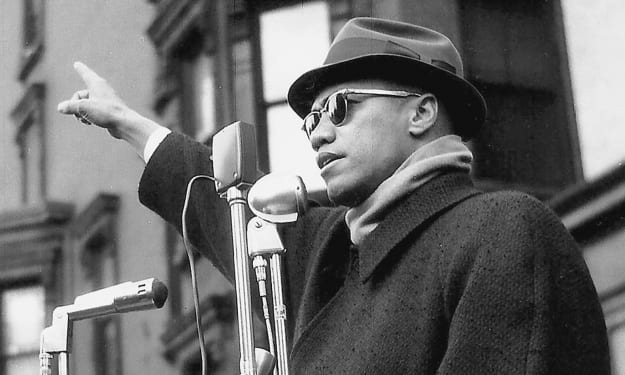
Les Payne spent the majority of his life researching the facts for his books in order to separate facts from fictions and in order to show us the people behind the myths. This is also true for his book on Malcolm X. Now, you all know that I am a huge fan of Malcolm X and that I have a poster of him on my bedroom wall. This book was something I just could not pass over. It starts off slightly before Malcolm X was born in Nebraska and then travels through until slightly after his death in Harlem. Through it, we meet people who knew him, we meet people who were related to him, the Nation of Islam figures, the cops and spies who marked him and even people who met him on the streets. The book turns out to be a factual account that splits the man from the myth and actually shows us how Malcolm X built himself up over the years as a person.
By Annie Kapur5 years ago in The Swamp
The Unknown FDR
This book is fascinating about the 32nd President of the United States. FDR at a young age overcame so many obstacles. At a young age, he was judged on his looks and skin complexion. He had many fights at the boarding school yet he survived. In politics, FDR had been a bit divisive as a young politician. He used to work for President Theodore Roosevelt but change his direction due to a conflict of interest supporting President Woodrow Wilson. And when he staked out his political destiny, he was successful however he met defeat with dignity. It was Rochester, NY that gave FDR a fighting chance for his political future, and he thanks them in this book, which made him a powerful governor. He knew what it was like to be judge and undermined. He believed that character and faith and hope can overcome any obstacle. As President, he hesitated to recognize America's slaveholders' past, he believed in the good of America's Second President and chose him over America's Seventh President to celebrate at the White House and among his supporters. FDR knew the implications that race and political division can have on a presidency. FDR's book describes how he had to fight the supporters of Hitler before World War 2. He saw Hitler's movement persuading America and he took every measure to end the propaganda. FDR set out to do what Hilter could not do in front of the American public with his diplomacy, recognization, power, and eloquence. He showed Hilter to be 'deranged' and he deactivated him by careful, rational planning. FDR had "open the door" for America to have nearly the world as its allies. FDR allowed countries no matter how rich or how poor to join the fight and support ending Hilter's Axis and his Nazis. FDR was no stranger to working with people of diverse backgrounds and he promised them "a share in the glory" and this proves the true opposite of Hitler and his Axis. FDR rewarded the world with peace when America and its allies won. And he even believed that "enemies of war" should have a pathway for redemption and that tainted leadership should be punished. FDR believed "Thou shalt not lie" and "Thou shalt not steal", these were his keys to policy and what he expected from his family, friends, and supporters. FDR never believed that he was the smartest or cleverest, he believed that he was meant to be decisive and lead surrounding himself like President Jefferson with the greatest minds of his time, no matter gender or race. The book details how his wife, Eleanor was his "right-hand person", she would do the things that he found impossible, run the race that seemed almost unbearable, being the matriarch of a family dynasty while keeping her husband's health intact. Eleanor Roosevelt, like many of his closest friends and supporters, were the "conscious of FDR", showing him the true America, where inequalities lie and the hopes and fears of the American Public. Eleanor Roosevelt took one more step and join the oppressed as she learned from President Woodrow Wilson's wife who made decisions for her husband when he was ill. Eleanor Roosevelt reinvented the role of First Lady. No one ever knew why FDR ran for a fourth term even though they believed the third term was due to World War 2 until this book, where he explains that he asked his family. FDR's presidency was about family values, relying on their strength, building up their weakness, and maintaining love and respect.
By Distinguished Honorary Alumni Dr. Matthew Primous5 years ago in The Swamp
Book Review: “Too Much and Never Enough” by Mary L. Trump
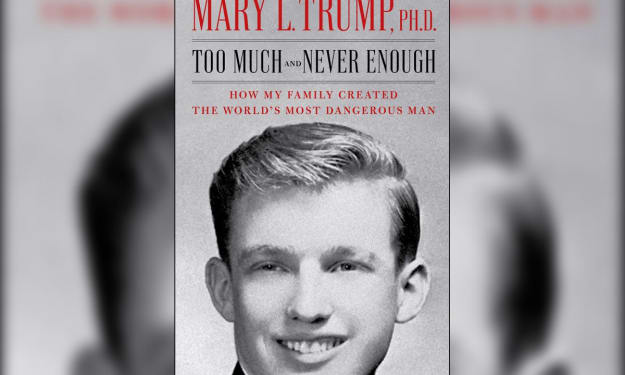
Initially, I was a bit apprehensive about reading this book, and I’ll tell you exactly why. Nearly everyone has tried to explain the dystopian apocalyptic nightmare that is the reign of Donald Trump as POTUS, even those who initially supported him during his 2016 election campaign. Since the mass movements that have developed during his presidency, the environmental crises, the Flint Water problems and many more, Donald Trump is more inactive than evil - even his Twitter account is more alive than his want to remove the dark stains that protrude through American History and are seemingly slipping through the cracks in his power once again. Again, everyone has written a book or thought about writing a book about why they cannot really understand how Donald Trump is still president through all of this, but I was more apprehensive about reading this particular one not because it was by his niece but because it was dealing with something that from research, I know to be a touchy subject: Donald Trump’s mental health.
By Annie Kapur6 years ago in The Swamp
Book Review: "How to Destroy America in Three Easy Steps" by Ben Shapiro
Ben Shapiro’s introduction to his new book “How to Destroy America in Three Easy Steps” begins with capturing the very depths of the free-thinking mind of the new generation of political libertarians, liberals and conservatives alike. He ignites conversation, question and rethinking with his incredible argument that America moves towards disengagement and misinformation. Shapiro proves to be back on top form with his book “The Right Side of History” being a massive success and, from a readers point of view whether you like him or not, you have to admit that he knows what he’s talking about. As America tries to uphold herself in her 250 year civil rights’ history since the war, Shapiro lets us all in on a secret: that we are the problem and yet, we are also the solution. His writing style is clear, concise and consistent with a man who proves that ethics and morals, standards and cultural traditions seem to arise over conflict, mass mob culture, labelling and chaos. As both the right and the left of the American Political slip into chaos, Ben Shapiro is there explaining why they are both completely wrong.
By Annie Kapur6 years ago in The Swamp
"The Prince" by Niccolo Machiavelli
I first read this book as an early teen after hearing the word “machiavellian” pop up around public figures at the time like George Bush Jr. and Tony Blair (yes, I grew up in that era). I had no idea what this word meant as a thirteen-year-old and so, when I looked it up and saw that it was related to a person, I was looking through the works by him in no time. When I first found the list, I was initially thinking about reading the “Discourses on Livy” and when I realised I had to look up a word in the title, I proceeded on to an easier title: “The Prince” is what I read instead. Honestly, I’m glad I chose this one first because it really does explain a lot. It is written quite simply and so, I didn’t need to do much looking up, annotating and researching. I noticed immediately that the first part concerns gaining power and the second part concerns maintaining it. I can honestly say that I was shocked that many political figures were actually so much like this in real life - especially concerning the second half of the book. When I re-read it, I like to concentrate a lot of my attention on to Chapters 17-19 because these are the ones I believe to hold the key to the machiavellian identity. When I went to university, I was 20-years-old when I wrote my essay on machiavellian authorities and powers on the Renaissance stage and how they had an impact on to how certain characters of a play were viewed. If we apply this to real life, we can’t actually be much further from the truth as a machiavellian is not a particularly villainous person or a psychopath - just one who knows how to gain and maintain power and they know how to do it very well. I have read this book over ten times in my life and I still own the first copy I bought when I was thirteen (it is the same copy I re-read). It now contains various annotations from over the years and never fails to shock me into realising what people will do for power, some of the quotations are absolutely timeless in every sense of the word. They will make you shudder to see that the rules of the machiavellian prince are applicable from every world leader from the malevolent Genghis Khan to the charismatic golden-boy, Barack Obama.
By Annie Kapur6 years ago in The Swamp
5 Books About the French Revolution
On the 14th of July, 1789, the people of France took matters into their own hands for once and stormed the Bastille Prison, reducing it to nothing as an act of revolution against the monarchy - Louis XVI and Marie Antoinette. After this, there were riots, acts of violence and war against their current regime. It was a revolution that would, along the way, eat itself up and be thrown back up with incredible irony.
By Annie Kapur6 years ago in The Swamp
Why Everyone Should Read "A Piece of Cake" by Cupcake Brown. Top Story - June 2020.
TRIGGER WARNING: the following review discusses some graphic and severe elements of Cupcake Brown's memoir, "A Piece of Cake." While some details may be disturbing, it is important to talk about them, as they pertain to systemic injustice we the people are trying to overcome. Thank you.
By Kathryn Milewski6 years ago in The Swamp