finance
Money talks; reviewing the global economy, government spending, taxes, and economic policy that affect our social and political future.
What Happens If There Is A Financial Storm?
Many people throughout the world have had to increase their debt-to-income ratios, but Americans may not have had to. Joe is happy to pay people to remain home and encourage the “ Great Job Improvement ”phenomenon,this is actually an outcry as the Dem are renaming it to supersede the massive resignation phenomenon that was derived as record numbers of people are leaving their jobs after the COVID-19 pandemic. The COVID-19 pandemic had a major impact on the job market and has been named one of the reasons for the current recession in the United States.
By Estalontech4 years ago in The Swamp
5 Economic Benefits When Workers Telecommute. Top Story - January 2022.
When Covid-19 hit the scene in 2020, it forced employers into a corner. Either they became flexible with their work arrangements, or they allowed their production to flat line. We can argue on either side of the fence the pros and cons of this hostage situation, but at the end of the day, there inarguably were both pros and cons.
By Jade Cinders4 years ago in The Swamp
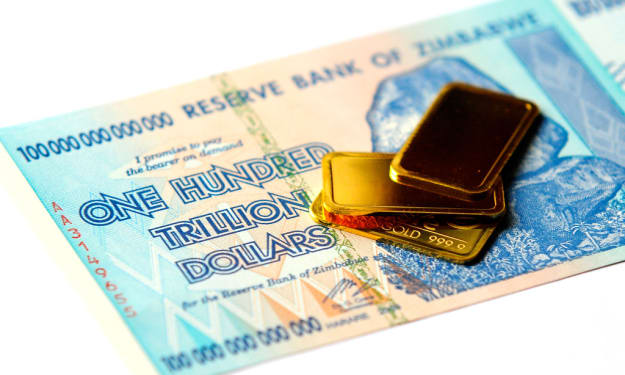
Potential US Dollar Depreciation and Protect Yourself from Hyperinflation
Hyperinflation isn’t as scary as it sounds. It’s really just a fancy way of saying inflation, and inflation isn’t necessarily bad. However, when inflation gets really high, it becomes problematic.
By Estalontech4 years ago in The Swamp
Social Dividend History
There are many forms of basic income that you can talk about for hours on vocal about, but the version I am talking about actually has its roots in socialist thought. There is a form of basic income that can be referred to as a social dividend that is based on publicly owned enterprises. According to Wikipedia, a social dividend is "the return on the capital assets and natural resources owned by society in a socialist economy. ". How a social dividend differs from traditional basic income is that social dividend directly implies and relates to social ownership of productive assets. It also implies these socially owned assets are to be the source of the income while other forms of basic income may get funding from other sources. This idea of a social dividend is considered by many to be in line with Karl Marx's critique of capitalism. One of the biggest problems Karl Marx had with capitalism is that the surplus value earned by society is usually only distributed among a small elite - usually a small number of capitalists and private shareholders that get all of the benefit from the extra money in society. According to Marx, surplus generated by social means of production should be appropriated by all members of society. As described by James Yunker in 1977 in the journal Annals of Public and Cooperate Economics: "It is abundantly clear from the writings of the founder of scientific socialism, Karl Marx, that he viewed the distribution of property income under capitalism as morally reprehensible. To Marx, property return must be identified with 'surplus labor value', namely the excess of total labor value over the total wage bill under conditions of a subsistence individual wage. This surplus value is distributed over a small minority of owning capitalists. Although the value is created by labor and is therefore the legitimate property of labor, the capitalists are able to extort it from the proletariat by virtue of their ownership of the capital instruments of production...Nevertheless, while Marx employed the surplus labor value theory to undermine the moral foundations of capitalism, it was, in his view, neither to be the instrumentality of capitalist collapse, nor was it the primary reason for the desirability of the abrogation of capitalism...Surplus value was seen as providing the fuel for the cyclical engine and therefore as the fundamental cause of the impending dissolution of capitalism."
By Tyler McFadden4 years ago in The Swamp
What Grew Faster than the National Debt?
The MAGA catchphrase demands we look back to a time when America was great. There was a time when America had a thriving middle class. It was a time before we suffered from stifling inequality, a time when the national debt grew modestly. It was a time as a nation we sent a man to the moon. As a nation, we defeated Nazi Germany and Imperialist Japan. We made great strides in science and technology that laid the foundation for the digital age.
By Gary Janosz4 years ago in The Swamp
The reasons for China’s economic success
Back in 1976, China was an underdeveloped rural country under the leadership of Chairman Mao Zedong. 30% of the population was poor at that time mainly because 3⁄4 of the production was centrally organized and controlled by the state-owned enterprises. The state set the quantities and prices of production and allocated the resources throughout most of the economy. The main goal of the Chinese government was to transform itself into a self-sufficient economy. Foreign trade was very limited, the only trade partner was the Soviet Union and trades would be things that they truly could not make in China. This system created economic distortions and did not provide motivation for firms, workers, and farmers to be more productive as they would not receive more for it or improve their living standards. The economic system had stagnated a long time ago, individuals were getting less and less motivated, their productiveness was decreasing, and their faith was disappearing. In 1978, after Mao Zedong died, of Deng Xiaoping became the leader and decided to restore China’s economy and faith on the communist party with the goal this time, of increasing economic growth and raise living standards. As the strict state control was not working, he decided to put in place a series of reforms that seemed to work for neighbor countries and regions (Taiwan, South Korea and Hong Kong). His idea was to create its own economic model through an economic reform. In one hand, it took some ideas from Western countries such as opening itself to the free market to allow private companies into china and receive foreign investments/trades as well. It encouraged the creation of rural enterprises and private businesses by giving more freedom to its workers and controlling them less. It invested in industrial production and education of its workforce.On another hand, it kept things in line and protected its country.
By Alexia Wambersie4 years ago in The Swamp
Pru Goward's Prole Bites Back
I was appalled to read Pru Goward's despicable headline, and astonished that the article was published in the Australian Financial Review (AFR). Pru Goward was NSW Minister for Family and Community Services. The fact that she holds these views is a sad indictment on the Department's information and advice to her while in Office.
By Lisbeth Stewart4 years ago in The Swamp