finance
Money talks; reviewing the global economy, government spending, taxes, and economic policy that affect our social and political future.
Will Liabilities Become “Assets”
In September 2019, US President Donald Trump, in his original manner via Twitter, suggested that the US Federal Reserve move interest rates to a negative zone from zero and below to refinancing the US government ‘s current $23 trillion debt and extend its maturity. The idea of zeroing out rates to stimulate growth is tempting, especially when the amount of accumulated debt is huge and virtually all markets are dependent on changes in the US Federal Reserve monetary policy. But emergency measures that temporarily worked after the 2008 crisis could prove disastrous to the global financial system if applied for populist reasons on a permanent basis.
By Konstantin Kalushniy6 years ago in The Swamp
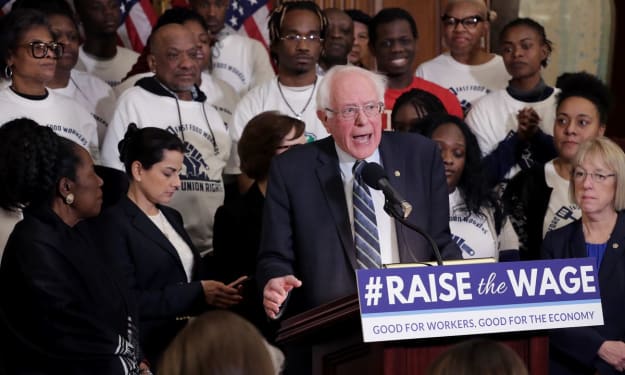
3 arguments keyboard economists want you to believe about minimum wage
The minimum wage topic has been one of the most fiercely discussed economic policies all over the world. However, the discussions in the United States seem to be a lot more vocal, including things such as protests, social media posts, every-day activism and various other methods of helping spread the word.
By Giorgi Mikhelidze6 years ago in The Swamp
Expense to the Highest
Due to the economy's inflation, prices went up after our imports were taxed. After that, globalization has been turning into a complex issue. If we look further into this problem, we can decipher how things work. International corporations from all over the globe need money. Not just for profits, but to put currencies back into their nation's economy. When a nation makes a trade, they have to pay for the cost. If the supply and demand are not met, it could be disastrous. Politicians and congress will have to ask or negotiate with business owners, and convince these imports. Keep in mind traders have to be paid back in return. Yes, we have the T.T.P. organization for this job. The T.T.P did not always provide the best options. Their methods often work as a balancing act. One example: New Zealand, who ships their imports to Australia, would be the one to pay the minimum cost. If the required cost cannot be met, Australia's prices could skyrocket at a severe level. Then, New Zealand could also have to deal with a surge in prices. High costs can lead to limited spending power out of the citizens' hands. New Zealand's economy will not always suffer because of Australia's mishandled on pricing. This is where T.T.P can come in, to rectify the problem. Every other form of organization, such as activists and workers' unions, will have to pitch in. It's going to be hard to find solutions. This will take time and effort. Every person from all political sides need to step in.
By Kristen Dean6 years ago in The Swamp
Our National Debt
Like most of you, I was a bit confused and wanted elaboration on the subject of the National Debt. To me, this is one of the most important topics, regardless of who runs the country. So I started searching the web for explanation, but it seems that the articles online fall short of clarity. Most of these websites explain as if you are familiar with financial concepts. To add to the complexity, they reference other governmental websites that explain detail and components of the national debt.
By Alonzo Echavarria-Garza7 years ago in The Swamp
Cuba's Economy Is Gradually Getting into the Picture
Cuba has an unsolved problem with Fidel Castro on the nationalization of American real estate, but she recently agreed to hold a referendum to turn it into an economy conducive to investment. Unfortunately, for the northern Caribbean country, they are not ranked in the global ease of doing business. This, of course, means that investors will not be interested in the land for business. With only 11,490,125 people, one would've thought that it will find it cost effective. Unfortunately, this cannot be said about the republic. Many obstacles in Cuba are slowing economic progress.
By Osei Agyemang7 years ago in The Swamp
Universal Credit
Recently, the contract for my temporary employment at a certain call centre came to an end. I can't say that I miss it. There's something about being routinely told that I'm a worthless idiot by faceless strangers that just doesn't appeal to me, and besides, the voices in my head pretty much have that base covered. So, with nothing else lined up, I had to schedule an appointment go to the Job Centre, but this was only the beginning of the nightmare.
By C. Raymond Martin7 years ago in The Swamp
How Beneficial Is Bank Consolidation?—Spotlight on Kenya, Africa
Years ago I did not understand why good standing and independent banks eventually joined other financial institutions or banks. After a series of interviews with swayful financial advisors for the reasons, I was convinced. At the moment, the largest African bank, in terms of customer base, is in the news. The bank will be available to the public in the third quarter of 2019. It will soon be forthcoming because two Kenyan banks recently joined. The Kenya NIC Bank Plc (together with the parent company NIC Bank Group) and the African Commercial Bank are now consolidating. Regional supervisory authorities approved the merger. Kenya Central Bank and the Bank of Tanzania announced this on 30 May 2019.
By Osei Agyemang7 years ago in The Swamp
The Banking Industry
It was deja vu in a truly high stakes, high drama meeting. It was reminiscent of a depression era Reconstruction Finance Corporation meeting of seventy-five years ago. On that day, nine large bank CEOs were told by US Treasury Secretary, Henry Paulson, Federal Reserve Chairman, Ben Bernanke, and FDIC Chairman, Sheila Bair that it was in their own best interest to agree to the partial nationalization of their banks by the US Treasury Department. When the meeting was over, the CEOs had agreed to a $125 billion stake by the US government in their firms. They had no choice and history was made again.
By Matthew Evans7 years ago in The Swamp
Economics 101 in Action
You want to see how the free market works? You want to see economic principles come to life? You want to see the "invisible hand" of capitalism in action? Well, a recent story out of Pennsylvania illustrates why the laws of supply and demand work—not in mysterious ways, but in very, highly predictable ways—and in ways that would make the authors of Freakonomics oh so very proud!
By David Wyld7 years ago in The Swamp