
What Happens When Students Go to School?
They get eradicated, rather than educated.

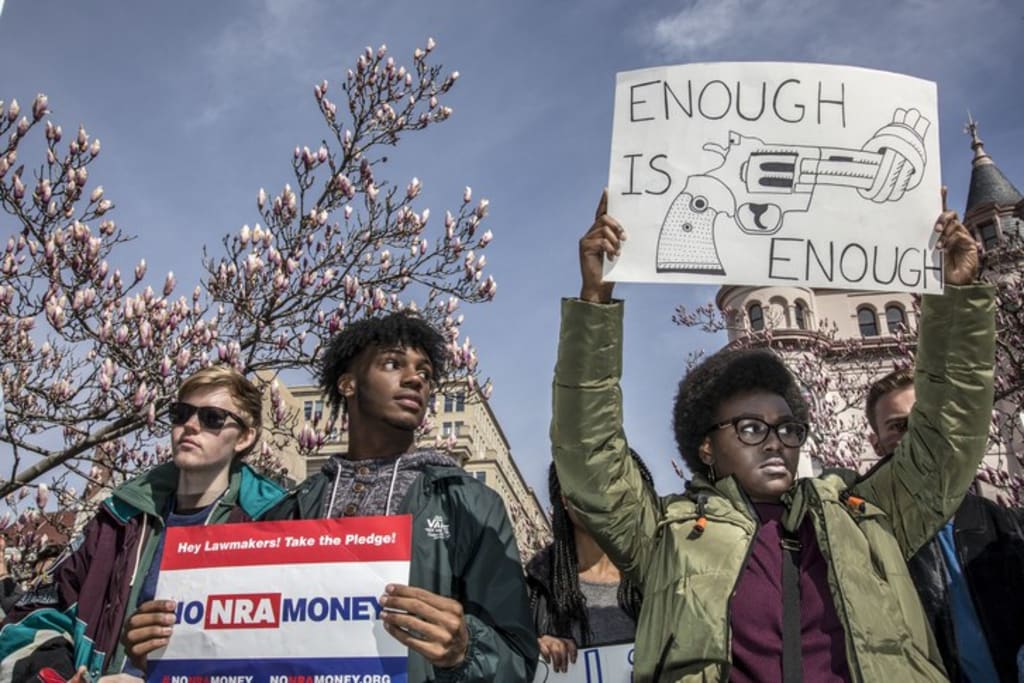
“If I don’t make it, I love you, and I appreciated everything you did for me.” In the moments that she thought would be her last, high school freshman Sarah Crescitelli texted these words to her parents. Given the severity of her tone, not to mention the dangerous implications behind the words she sent, you’re probably wondering where Sarah was, and how a young high schooler found themselves in a situation so grave. On February 14, 2018, Sarah Crescitelli woke up, and went to school. She went to school, and instead of learning, she spent the day hiding and crying in a storage closet. She spent the day listening to gunshots in the halls, haunted by the thought that any number of those bullets could have hit her best friends. She spent the day praying that she would have the chance to see another, all because a deranged man had access to a gun. She spent the day in pure terror, all because our politicians give more value to guns as opposed to the young, bright minds of America. Gun control has plagued America for far too long, and it is time that change is no longer just discussed among our politicians, but we bring to the world the change that we want to see.
Gun violence has been rampant in America for several decades, with no preventative measures being taken. As of February 22nd, 2018, 17 school shootings had already occurred. 8 weeks into the year, 17 school shootings had occurred. That allows for TWO school shootings a week, shootings that may have been averted, if only proper measures and stricter laws were in place. In 2017 alone, at least 15,549 civilians fell victim to gun violence. That is 15,549 families torn apart, torn apart because guns are treated as more valuable than American lives. The government has not taken any significant actions in resolving this issues, which gives us all the more incentive to take actions ourselves. We have such strong voices, and it is time that we put them to use.
Today, I am using my voice for the 13 victims of the shooting at Columbine High School. I am using my voice for the 20 children and 6 staff members fatally wounded in the shooting at Sandy Hook Elementary School. I am using my voice for the 49 victims of the shooting at the Pulse Nightclub in Orlando, and the 17 victims of the shooting at the Stoneman Douglas High School. I am using my voice for those who had their voices so brutally taken away from them. The question here is plain and simple—When will we stop allowing our government to condition us into thinking we can “prepare” for the next casualty, and instead start demanding that we PREVENT the next casualty? My response to that question is just as plain, and just as simple. The time is now.
About the Creator
Keep reading
More stories from Mobin Khan and writers in The Swamp and other communities.
Why Black History Matters in America?
The United States of America is celebrating their 250th anniversary in 2026. I'm proud to be an American and as someone who was born here, I wouldn't imagine myself living anywhere else. This is a country where opportunities are possible. Where anyone can be successful in anything they desire to do. Equality, community, and togetherness are the backbones of what America is and should be about. However, we have an administration who wants to erase and disregard those who have made positive, meaningful impacts in our country, specifically Black figures, such as Martin Luther King, Jr., Rosa Parks, and Maya Angelou. President Trump and his administration have been constantly complaining and fighting against what they call the "Woke agenda". They use this excuse as a distraction from other issues they refuse to address, such as the high cost of living, climate change, and inflation. That equality is dividing America, when in reality, it's bringing us together. Being woke is not tied to a specific political party. No matter where you stand on the political spectrum, you can still care about other people and their plights. Compassion and empathy for others isn't tied to a political party, either. We were taught as children to treat others the way we want to be treated and not judge others because they're different from us. Caring about others isn't a personal attack on your beliefs. It doesn't make you any less of a person. People who are easily offended over African American figures, past or present, or anything related to it, are grasping at straws. Current and future generations need to know who people like Harriet Tubman and Shirley Chisholm were, especially in the classroom. Black History is part of American History. It should be recognized, not hidden or forgotten. Besides, you can't shield children from everything, just because your feelings are easily hurt.
By Mark Wesley Pritchard 9 days ago in The Swamp



Comments
There are no comments for this story
Be the first to respond and start the conversation.