
When Words Become Diplomacy: France Summons the U.S. Ambassador
A tragic killing in Lyon sparks political tension, raises questions about extremism, and tests the friendship between France and the United States

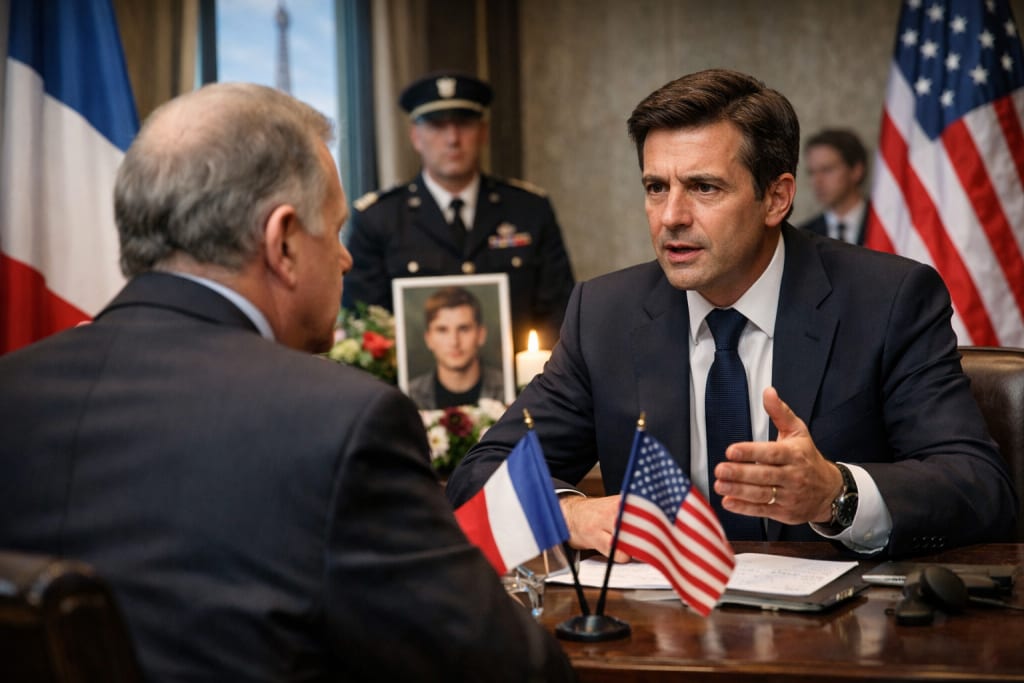
In February 2026, a tragic event in France quickly turned into an international issue. What began as a violent street clash in the city of Lyon led to the death of a young political activist. Within days, the situation escalated beyond France’s borders, creating diplomatic tension between France and the United States.
This incident shows how violence, politics, and public statements can combine to create conflict between nations.
A violent clash turns deadly
The victim, 23-year-old activist Quentin Deranque, died after being beaten during clashes between far-right and far-left groups. The confrontation reportedly followed rising tensions between rival political activists.
Police arrested several suspects, and an investigation is ongoing.
The killing shocked the country. Many people condemned the violence and called for calm. Others used the incident to highlight growing political divisions.
France has seen increasing tension between extremist groups in recent years. Demonstrations sometimes turn violent, and this tragedy raised fears that political anger is becoming more dangerous.
The U.S. comments that caused controversy
The diplomatic conflict began when a U.S. State Department counterterrorism social media post described the killing as an example of “violent radical leftism.”
Some American commentators also described the incident as terrorism or politically motivated violence.
French officials reacted strongly.
They argued that the investigation was still ongoing and that outside political statements risked influencing public opinion and interfering in domestic affairs.
France views such commentary as inappropriate involvement in its internal matters.
France summons the U.S. ambassador
France’s foreign minister, Jean-Noël Barrot, announced that Paris would summon U.S. Ambassador Charles Kushner to explain the remarks.
Summoning an ambassador is a serious diplomatic action. It does not mean relations are broken, but it signals strong dissatisfaction.
French officials emphasized:
The tragedy should not be politicized.
The judicial process must be respected.
Foreign governments should avoid influencing domestic investigations.
The message was clear: France wants to handle the situation on its own terms.
Why the case is sensitive inside France
The killing happened at a time of political tension.
France is dealing with:
growing ideological divisions,
fears of extremism,
debates over national identity and security.
Political violence is a painful memory in Europe’s history. Many citizens fear a return to street conflict and radicalization.
Some right-wing groups described the activist as a victim of political hatred. Meanwhile, left-wing groups warned against using the tragedy to attack political opponents.
The incident quickly became a symbol in a larger political struggle.
Freedom of speech vs. diplomatic respect
The disagreement highlights a difficult balance.
In democratic societies, freedom of speech allows governments and citizens to express opinions.
However, in diplomacy, words carry weight. Statements from foreign officials can affect investigations, public opinion, and political stability.
France believes the U.S. comments crossed a line by framing the killing in political terms before the investigation concluded.
The United States often speaks about global security threats, including extremism. But allies may interpret such statements differently when they involve internal events.
A test for a long-standing alliance
France and the United States share a long history of cooperation. They are allies in defense, trade, and global diplomacy.
Despite occasional disagreements, their relationship is strong.
Still, this incident shows that even close allies can clash over:
sovereignty,
political language,
domestic security issues.
Diplomatic tensions like this are not unusual. Often, they are resolved through dialogue and mutual understanding.
The broader concern: rising extremism
Beyond diplomacy, the killing raises concerns about extremist violence.
Across Europe and other parts of the world, governments are confronting:
political radicalization,
online hate speech,
growing mistrust between ideological groups.
Experts warn that violent confrontations between rival groups can escalate if not addressed early.
Preventing violence requires:
responsible political leadership,
peaceful protest culture,
strong law enforcement,
community dialogue.
The tragedy in Lyon reminds us that political anger can have deadly consequences.
What happens next?
French authorities continue their investigation. The suspects will face legal proceedings, and officials aim to ensure justice through the courts.
Diplomatically, discussions between Paris and Washington are expected to ease tensions. Such disputes are often resolved quietly once explanations are given.
However, the deeper issues remain:
How should governments discuss political violence?
When does commentary become interference?
How can societies reduce extremism and prevent violence?
A moment for reflection
The death of a young activist is first and foremost a human tragedy. A life was lost, and a family is grieving.
But the aftermath shows how quickly violence can ripple outward — from the streets of a single city to the highest levels of international diplomacy.
This moment calls for restraint, careful language, and a renewed commitment to peace.
Because in a world already divided by ideology and fear, understanding and respect remain the strongest tools for stability.
**In the end, the tragedy in Lyon is more than a political story. It is a reminder that violence harms societies, words shape diplomacy, and peace requires responsibility from everyone — leaders and citizens alike.**
About the Creator
Keep reading
More stories from dua fatima and writers in The Swamp and other communities.
Japan’s New Direction: Why Rare Earth Cooperation with the United States Matters
In a time when the world feels uncertain and divided, economic security has become as important as military strength. After being reelected as Japan’s leader, Sanae Takaichi has made it clear that her government wants stronger cooperation with the United States on rare earth development. This decision may sound technical, but its impact could shape the future of technology, global trade, and international relations.
By dua fatima6 days ago in The Swamp
A Gathering of Evil Bosses
“I’m the queen of chin jutting while I smooth my hair, attacking, insulting, and deflecting to protect my appointer.” “Oh, please, Blondi, my hair is curled, highlighted, and longer than yours. I feature television commercials telling immigrants that we will give them a free plane ride home, and if they voluntarily turn themselves in, they will be allowed to legally apply for re-entry. It runs everywhere, and I look good in it! You can’t compete because of your blond hair. Mine is nicer, and my lips are prettier than yours.”
By Andrea Corwin 6 days ago in The Swamp



Comments
There are no comments for this story
Be the first to respond and start the conversation.