
Asia Pacific Non-Lethal Weapons Market Trends & Summary
From Crowd Control to High-Tech Deterrence: How Non-Lethal Weapons Are Reshaping Security in Asia Pacific

Introduction: A Region Rethinking the Use of Force
Across the Asia Pacific region, the conversation around public safety, law enforcement, and internal security is changing. Governments are under growing pressure to manage civil unrest, protests, and large public gatherings while minimizing casualties and long-term harm. This shift has brought non-lethal weapons into sharper focus as a practical and politically acceptable alternative to conventional firearms.
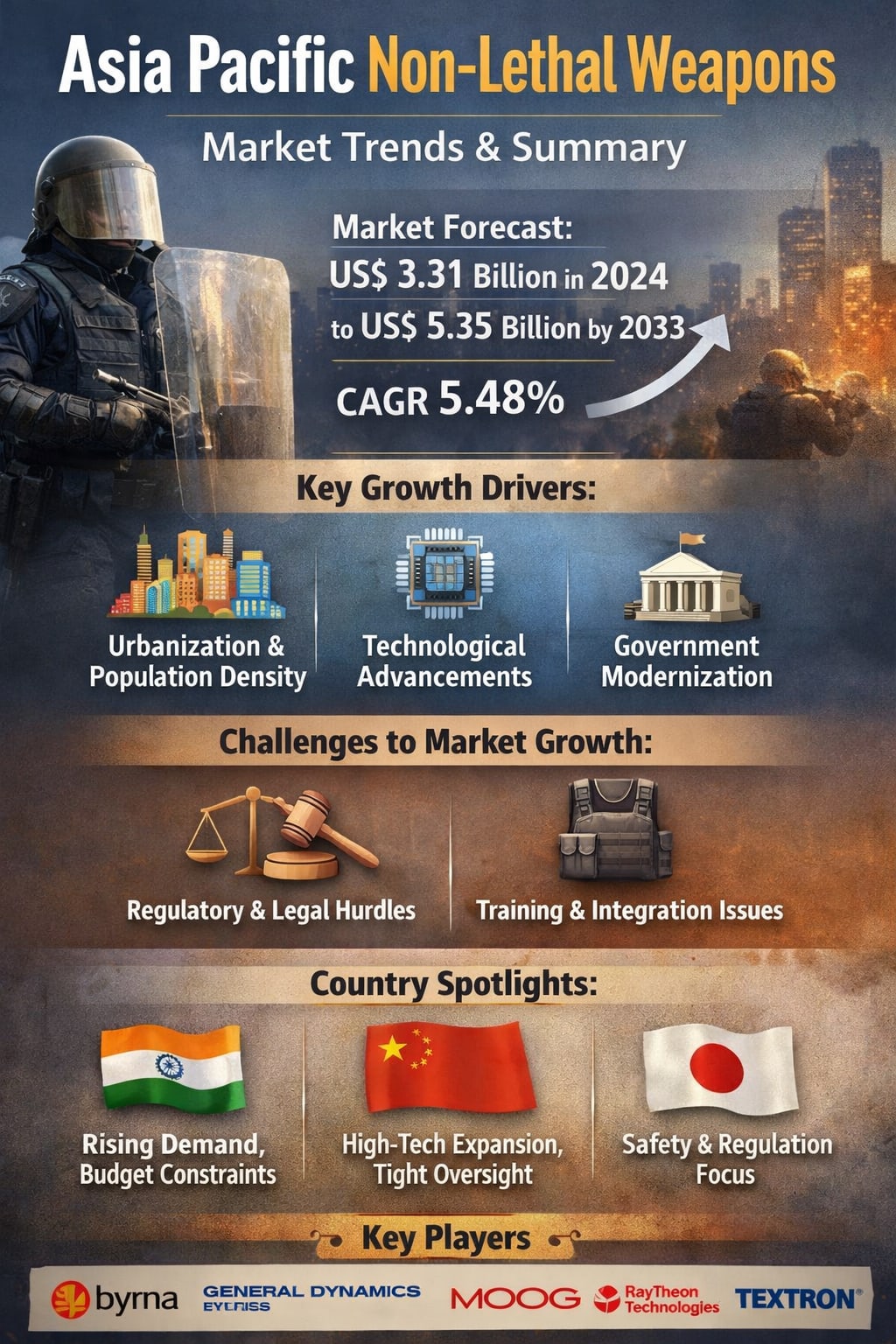
According to Renub Research, the Asia Pacific Non-Lethal Weapons Market is expected to grow from US$ 3,311.41 million in 2024 to US$ 5,354.50 million by 2033, registering a CAGR of 5.48% from 2025 to 2033. This steady growth reflects a broader transformation in how security forces across the region approach crowd control, internal security, and even certain military operations.
Urbanization, rapid technological development, and rising government spending on defense modernization are at the heart of this expansion. As Asia Pacific cities become denser and more complex, the demand for tools that can control situations without escalating them into deadly encounters has never been higher.
Understanding Non-Lethal Weapons: Safer Alternatives in a High-Risk World
Non-lethal weapons—also known as less-lethal weapons—are designed to incapacitate, deter, or disperse individuals without causing permanent injury or death. Common examples include tear gas, pepper spray, rubber bullets, Tasers, stun grenades, acoustic devices, and directed energy systems. While no weapon is entirely risk-free, these tools are widely seen as a critical middle ground between verbal commands and lethal force.
In the Asia Pacific region, law enforcement and military organizations are increasingly turning to these solutions to manage crowd control, riots, protests, border security operations, and high-risk arrests. The goal is simple but powerful: maintain order while reducing fatalities, severe injuries, and the political fallout that often follows heavy-handed security responses.
With frequent large-scale demonstrations in major cities and heightened sensitivity around human rights, non-lethal weapons have become not just a tactical choice, but also a strategic and reputational one for governments.
Market Outlook: Strong Growth Backed by Policy and Technology
Renub Research’s forecast highlights a market on a clear upward trajectory. The expected rise to US$ 5.35 billion by 2033 is not driven by a single factor, but by a combination of demographic pressure, urban security needs, and rapid innovation.
Asia Pacific is home to some of the world’s fastest-growing megacities. As urban populations swell, so does the frequency of public gatherings, political demonstrations, and social movements. Managing these events safely has become a top priority for authorities, especially in countries where even small incidents can quickly escalate due to population density and social media amplification.
At the same time, defense and internal security budgets across the region are expanding. Governments are not only buying more equipment, but also upgrading to smarter, more precise, and more controllable non-lethal systems that reduce collateral damage and improve operational accountability.
Key Growth Drivers
1. Urbanization and Rising Population Density
The Asia Pacific region is urbanizing at an unprecedented pace. According to regional development estimates, metropolitan populations are expected to surge dramatically over the coming decades. With this growth comes a higher likelihood of crowded public events, protests, strikes, and spontaneous demonstrations.
In such environments, the use of lethal force is both risky and politically sensitive. Non-lethal weapons provide law enforcement agencies with scalable response options—allowing them to disperse crowds, restrain individuals, and regain control without triggering severe casualties. Tools like tear gas, rubber bullets, and Tasers have therefore become essential components of modern urban policing strategies.
By reducing the risk of deaths and serious injuries, these systems help authorities maintain public order while also limiting legal, social, and diplomatic consequences.
2. Rapid Technological Advancements
Technology is transforming the non-lethal weapons landscape. Today’s systems are far more precise, adaptable, and controllable than earlier generations. Innovations in directed energy weapons, acoustic systems, smart ammunition, and integrated control platforms are expanding the tactical options available to security forces.
For example, directed energy and acoustic devices allow operators to influence crowd behavior at a distance, often without physical contact. Meanwhile, smart munitions and improved electroshock systems are designed to reduce unintended harm and improve targeting accuracy.
The integration of data analytics, sensors, and AI-assisted control systems is further enhancing decision-making in high-pressure situations. These advances not only improve effectiveness but also make non-lethal weapons more acceptable from a regulatory and public accountability standpoint—accelerating their adoption across the region.
3. Government Investment and Defense Modernization
Defense and internal security modernization is a major theme across Asia Pacific. Countries are investing heavily in upgrading police forces, border security units, and military capabilities to address both traditional and non-traditional security threats.
Non-lethal weapons are increasingly seen as a core part of this modernization effort. They align with global trends emphasizing proportional use of force, human rights compliance, and de-escalation tactics. Government-funded R&D programs and procurement initiatives are helping to bring more advanced non-lethal solutions into active service.
This policy-driven support is a key reason why the market is expected to maintain stable growth through 2033.
Challenges Facing the Market
1. Regulatory and Legal Hurdles
Despite their advantages, non-lethal weapons operate in a complex legal and ethical space. Many Asia Pacific countries have strict regulations governing the use of force, and non-lethal systems are no exception. Concerns about misuse, overuse, and potential human rights violations can lead to legal challenges, public criticism, and political pressure.
In some markets, unclear or restrictive regulations slow down procurement and deployment. Governments must balance the operational benefits of these tools with the need for transparent rules, accountability mechanisms, and clear usage protocols. Without this balance, adoption can face significant resistance from both civil society and oversight bodies.
2. Training and Integration Issues
Another major challenge is training. Advanced non-lethal weapons require skilled operators who understand not only how to use the equipment, but also when and why to use it. Inadequate training increases the risk of accidents, misuse, or ineffective responses.
Moreover, integrating non-lethal systems into existing law enforcement and military doctrines often requires changes in standard operating procedures, command structures, and response frameworks. These transitions take time, money, and institutional commitment—factors that can slow market growth in resource-constrained environments.
Country-Level Insights
India: Growing Demand Amid Operational Challenges
India’s non-lethal weapons market is expanding as authorities look for better ways to manage crowd control, protests, and internal security operations. With frequent large-scale public gatherings and demonstrations, tools like tear gas, rubber bullets, and Tasers have become increasingly important for maintaining order without resorting to lethal force.
The Indian government’s push to modernize police and paramilitary forces is supporting the adoption of more advanced non-lethal technologies. However, budget constraints, training requirements, and regulatory scrutiny remain key hurdles. Even so, the long-term outlook remains positive as public safety and human rights considerations continue to shape policy decisions.
China: Technology-Driven Expansion with Tight Oversight
China represents one of the most dynamic markets in the region. Rising public security challenges and a strong emphasis on technological solutions are driving investment in non-lethal systems such as rubber bullets, tear gas, acoustic devices, and even electromagnetic launchers.
In April 2023, China unveiled the CS/LW21 portable electromagnetic launcher, designed for riot control and capable of firing coin-shaped projectiles using electromagnetic force. Such innovations highlight the country’s focus on high-tech, domestically developed solutions.
At the same time, the use of non-lethal weapons in China is closely regulated, and their deployment often sparks debates around public perception and human rights. Still, the market continues to grow as authorities seek more effective ways to manage large-scale events and social stability challenges.
Japan: Balancing Public Safety and Regulatory Caution
Japan’s non-lethal weapons market is shaped by a strong emphasis on public order, safety, and regulatory compliance. Law enforcement agencies rely on tools like tear gas, rubber bullets, and Tasers to manage protests and large public events with minimal harm.
Government efforts to modernize security forces are encouraging the adoption of more sophisticated non-lethal technologies. However, strict regulations, high training standards, and budgetary considerations limit the pace of expansion. Even so, Japan remains a steady and important market within the regional landscape.
Recent Developments Shaping the Market
The Asia Pacific non-lethal weapons market is also being influenced by strategic acquisitions and defense contracts:
In April 2024, UAE-based Edge Group acquired a 51% stake in Brazil’s Condor Non-Lethal Technologies, strengthening its global footprint in non-lethal military and civil security technologies.
In May 2024, Edge Group agreed to pay USD 27 million to supply new ammunition to Indonesia’s state-owned PT Pindad, reinforcing bilateral defense ties and Indonesia’s military capabilities.
These moves highlight the increasing internationalization and strategic importance of the non-lethal weapons sector.
Market Segmentation Overview
By Product Type:
Gases and sprays
Grenades
Bullets
Taser guns
Others
By Technology:
Chemical
Electroshock
Mechanical and kinetic
Acoustic/Light
Others
By End Use:
Law enforcement
Military
Others
By Country:
China
Japan
India
Australia
South Korea
Thailand
Malaysia
Indonesia
New Zealand
Competitive Landscape
Key players shaping the market include:
Byrna Technologies Inc.
General Dynamics Corporation
Moog Inc.
Raytheon Technologies Corporation
Rheinmetall AG
Textron Inc.
Combined Systems Inc.
These companies are analyzed across four viewpoints: company overviews, key personnel, recent developments and strategies, and financial insights—reflecting a competitive environment focused on innovation, partnerships, and global expansion.
Final Thoughts: A Market Built on Balance
The Asia Pacific non-lethal weapons market sits at the intersection of security, technology, and social responsibility. With Renub Research forecasting growth to US$ 5,354.50 million by 2033, it’s clear that these systems will play an increasingly central role in how governments manage public safety and internal security.
While challenges around regulation, training, and integration remain, the broader trend is unmistakable. As urban populations grow, public scrutiny intensifies, and technology advances, non-lethal weapons are becoming a core pillar of modern security strategies across the region.
In the years ahead, the real success of this market won’t be measured only in revenue figures—but in how effectively these tools help societies maintain order, protect lives, and reduce the human cost of conflict.
About the Creator
Sakshi Sharma
Content Writer with 7+ years of experience crafting SEO-driven blogs, web copy & research reports. Skilled in creating engaging, audience-focused content across diverse industries.
Keep reading
More stories from Sakshi Sharma and writers in Trader and other communities.
Europe Non-Lethal Weapons Market Trends & Summary (2025–2033)
Europe Non-Lethal Weapons Market: A Market in Transition Europe Non-Lethal Weapons Market is expected to reach US$ 2,571.37 million by 2033 from US$ 1,654.31 million in 2024, growing at a CAGR of 5.02% from 2025 to 2033. This steady expansion reflects a fundamental shift in how European governments, law enforcement agencies, and defense organizations approach public safety, security operations, and crowd management.
By Sakshi Sharmaabout 8 hours ago in Trader
North America Silicone Market Size and Forecast 2025–2033
North America Silicone Market Outlook The North America Silicone Market is entering a phase of steady and resilient growth, supported by expanding applications across construction, healthcare, electronics, transportation, and personal care industries. According to Renub Research, the market is expected to grow from US$ 5.94 billion in 2024 to US$ 9.22 billion by 2033, registering a compound annual growth rate (CAGR) of 5.00% from 2025 to 2033.
By shibansh kumar3 days ago in Trader


Comments
There are no comments for this story
Be the first to respond and start the conversation.