
Global LED Lighting Market Trends & Summary (2025–2033)
How Energy Efficiency, Sustainability Goals, and Smart Cities Are Powering a US$ 171 Billion Lighting Revolution

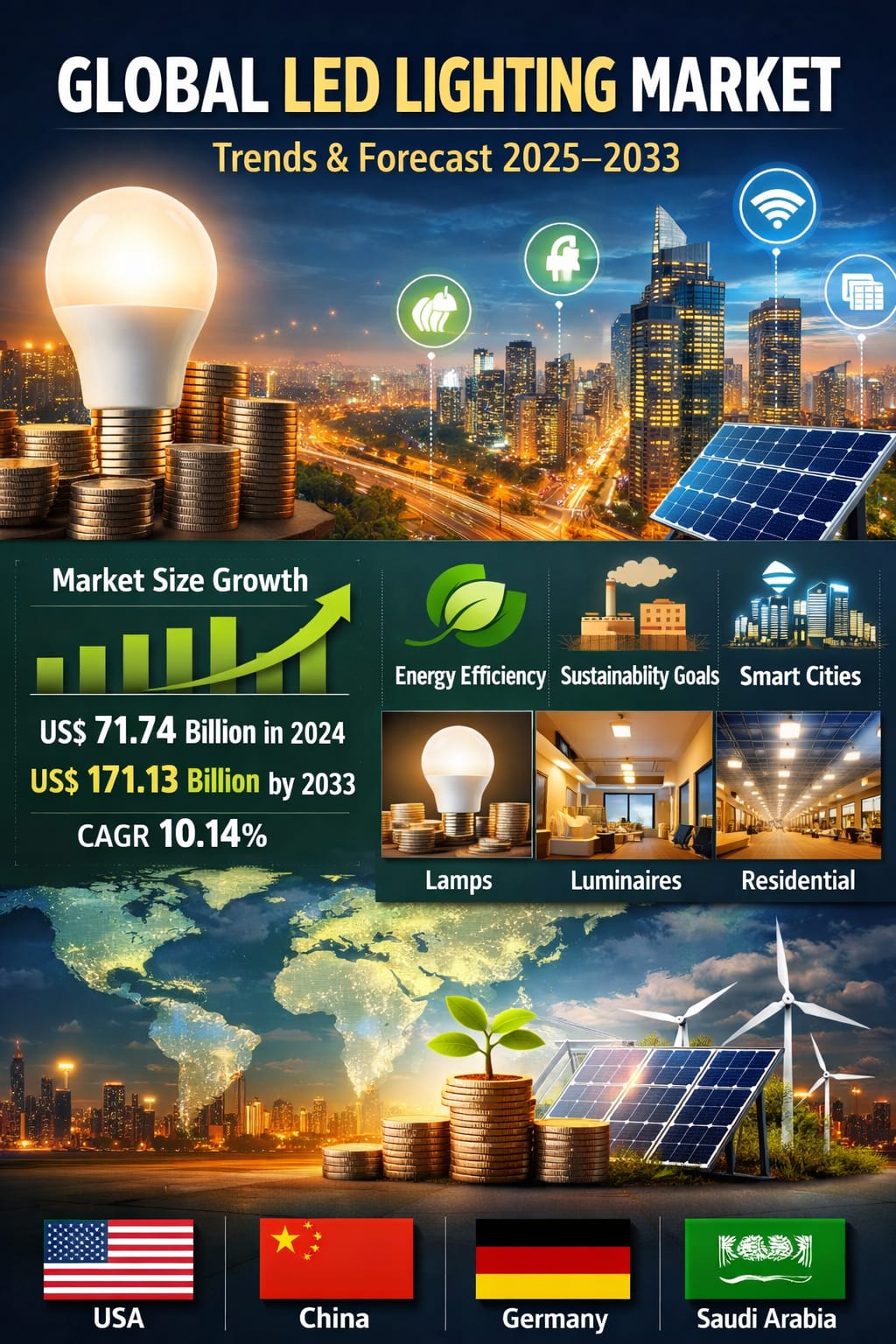
Global LED Lighting Market Overview
The global LED lighting market is undergoing a powerful transformation, driven by the world’s accelerating shift toward energy efficiency, sustainability, and smart infrastructure. According to Renub Research, the LED Lighting Market is expected to grow from US$ 71.74 billion in 2024 to US$ 171.13 billion by 2033, registering a strong CAGR of 10.14% from 2025 to 2033. This impressive growth highlights how light-emitting diode (LED) technology has moved far beyond being a niche alternative and has become the global standard for modern lighting.
LEDs are semiconductor devices that emit light when an electric current passes through them. Compared to traditional incandescent and fluorescent lighting, LEDs consume significantly less energy, generate less heat, and last far longer—often 25,000 to 50,000 hours or more. They also do not contain mercury, making them a more environmentally responsible option. These advantages have positioned LEDs at the center of global efforts to reduce carbon emissions, cut energy costs, and modernize infrastructure.
Today, LED lighting is no longer limited to homes and offices. It is widely used in commercial buildings, industrial facilities, streets and highways, stadiums, shopping malls, smart cities, and even in architectural and decorative applications. The combination of performance, durability, and falling costs has made LEDs the preferred choice for both new installations and retrofitting projects worldwide.
A good example of ongoing innovation is the launch of new LED track lighting by Syska Group in March 2023, designed to create radiant and flexible lighting environments. Such product introductions show how manufacturers are not only focusing on efficiency but also on aesthetics, adaptability, and user experience. As lighting increasingly becomes part of interior design, smart home systems, and urban planning, the role of LED technology continues to expand.
Key Growth Drivers Shaping the LED Lighting Market
1. Rising Environmental Awareness and Sustainability Goals
One of the strongest forces behind the rapid adoption of LED lighting is the growing global concern for the environment. Governments, businesses, and consumers are becoming more conscious of energy consumption, carbon footprints, and long-term sustainability. Lighting accounts for a significant share of electricity use worldwide, and switching to LEDs offers a simple yet highly effective way to reduce energy demand and greenhouse gas emissions.
Manufacturers are responding by launching more eco-friendly and ultra-efficient products. For instance, in July 2023, Signify Malaysia introduced a wide range of energy-efficient and environmentally friendly lighting solutions, including Philips Ultra Efficient LEDs and solar lighting systems. These products use up to 60% less energy than typical LED products in the same category and can offer lifetimes of up to 50,000 hours. The inclusion of solar wall lights, flood lights, and garden lighting further shows how sustainability is being integrated into everyday lighting needs.
Governments are also playing a major role. In June 2023, U.S. government agencies, in partnership with the Department of Energy (DOE), allocated US$ 178 million to support energy improvements in K-12 schools, including upgrades to LED lighting systems. Such initiatives not only reduce operating costs for public institutions but also accelerate large-scale adoption of energy-efficient technologies.
As climate goals become more ambitious and energy efficiency standards more stringent, LED lighting is expected to remain a central pillar of sustainability strategies across the globe.
2. Growing Demand for Cost-Effective and Energy-Efficient Lighting
Another major driver of market growth is the increasing need for cost-effective and energy-efficient lighting solutions. While LEDs may have had higher upfront costs in the past, their long lifespan and low energy consumption result in substantial savings over time. This total cost of ownership advantage is now widely recognized by households, businesses, and governments alike.
LEDs convert a higher percentage of electrical energy into light, wasting far less power as heat compared to traditional bulbs. This efficiency is particularly important in large-scale applications such as offices, factories, warehouses, and street lighting, where energy costs can be significant.
The rise of smart cities and connected infrastructure is further boosting demand. According to GSMA estimates, China alone could have around 4.1 billion IoT connections by 2025, representing nearly one-third of global IoT connections. In line with this trend, Signify provided a smart street lighting system to the German municipality of Eichenzell in February 2023. Using the Interact City System and BrightSites solution, the city can monitor and control every light from a single dashboard, while also supporting future 5G and IoT applications.
On the consumer side, companies like GE Lighting (a Savant subsidiary) expanded their Cync smart home ecosystem in January 2023, introducing dynamic lighting effects, millions of color presets, and music-synced lighting experiences. These innovations show that LED lighting is no longer just about saving energy—it is also about enhancing lifestyle, comfort, and connectivity.
3. Government Regulations and Incentives Supporting LED Adoption
Across the world, governments are phasing out inefficient lighting technologies and encouraging the adoption of energy-efficient alternatives like LEDs. Many countries have introduced strict energy efficiency standards, bans on certain types of incandescent bulbs, and building codes that favor LED installations.
In addition to regulations, governments are offering financial incentives such as subsidies, rebates, and tax credits to reduce the upfront cost of LED fixtures. These measures make LED lighting more accessible to consumers and businesses, accelerating market penetration and driving large-scale replacement of older lighting systems.
A strong example is India’s Unnat Jyoti by Affordable LEDs (UJALA) Program, which distributed around 360 million LED bulbs by January 2022. This initiative helped save more than 47 billion kWh of energy and reduced CO₂ emissions by around 37 million tons per year. Programs like UJALA not only demonstrate the environmental and economic benefits of LEDs but also significantly increase public awareness and acceptance of energy-saving lighting solutions.
As more countries introduce similar policies and strengthen their energy efficiency targets, the regulatory environment will continue to favor LED lighting, supporting long-term market growth.
Challenges Facing the LED Lighting Market
1. Higher Initial Installation Costs
Despite their long-term savings, LED lighting systems often come with higher upfront costs compared to traditional CFL or incandescent lighting. The price of components such as diodes, drivers, and control systems can increase the initial investment required for large-scale installations or complete retrofitting projects.
For cost-sensitive consumers and small businesses, especially in suburban or rural areas, this initial expense can be a barrier to adoption. Although prices have been declining steadily, the perception of higher cost still slows down the transition in some markets. Over time, continued technological advancements and economies of scale are expected to further reduce costs and ease this challenge.
2. Compatibility with Existing Infrastructure
Another important challenge is compatibility with older electrical and lighting infrastructure. Many buildings still rely on legacy systems that are not always easily adaptable to modern LED solutions. Retrofitting may require additional components such as adapters, drivers, or controllers, which can increase complexity and project costs.
In some cases, older wiring or fixtures may not fully support advanced features like dimming, smart controls, or connected lighting systems. This can discourage building owners from upgrading, especially when large-scale modifications are required. Addressing this challenge will require more plug-and-play LED solutions and better-designed retrofit systems from manufacturers.
Regional Outlook: How the Market Is Shaping Up Worldwide
North America and Europe
North America and Europe continue to show strong demand for LED lighting due to strict energy efficiency regulations, high consumer awareness, and supportive government policies. The focus on reducing carbon emissions and upgrading aging infrastructure has led to widespread adoption of LED solutions in commercial buildings, public spaces, and residential projects.
Asia-Pacific
The Asia-Pacific region, led by China, represents the largest and fastest-growing market for LED lighting. Strong manufacturing capabilities, rapid urbanization, and large-scale infrastructure development are key growth drivers. Countries like China, India, Japan, and South Korea are seeing rising demand across residential, commercial, and industrial sectors, supported by government programs and smart city initiatives.
Latin America, Middle East, and Africa
Latin America and the Middle East are experiencing steady growth, driven by urban development and sustainability initiatives. Saudi Arabia, for example, is promoting energy-efficient technologies under its Vision 2030 plan, boosting demand for LED lighting across commercial and residential projects. Africa, while still facing infrastructure challenges, is gradually adopting LED solutions, particularly in off-grid and solar-powered applications.
Country Spotlights
United States
The U.S. LED lighting market is expanding rapidly, supported by government policies such as the Energy Policy Act and various state-level incentive programs. The growing popularity of smart lighting, combined with consumer demand for energy-efficient and long-lasting solutions, continues to drive adoption across commercial, industrial, and residential sectors. Product innovations, such as Cyclone Lighting’s advanced outdoor luminaires launched in May 2023, further highlight the market’s dynamic nature.
Germany
Germany’s market growth is fueled by a strong commitment to sustainability and energy efficiency, supported by policies like the EU Green Deal and the German Energy Efficiency Strategy. In September 2023, Signify introduced new features for its WiZ smart lighting system, including SpaceSense motion detection technology, reflecting the country’s increasing preference for intelligent and integrated lighting solutions.
India
India is one of the fastest-growing LED markets, driven by government programs like UJALA, rising electricity costs, urbanization, and growing environmental awareness. The combination of affordability, energy savings, and long lifespan has made LEDs the preferred lighting choice across residential, commercial, and industrial sectors.
Saudi Arabia
In Saudi Arabia, the push for sustainability under Vision 2030 is accelerating the adoption of LED lighting. Rapid infrastructure development, smart city projects, and a focus on reducing energy consumption are strengthening the country’s position in the regional LED market.
Market Segmentation Snapshot
By Product Type:
Lamps
Luminaires
By Application:
Indoor
Outdoor
By End User:
Commercial
Residential
Industrial
Others
By Sales Channel:
Retail/Warehouse
E-Commerce
Direct Sales
By Region and Countries:
North America (U.S., Canada), Europe (Germany, France, U.K., Italy, Spain, and others), Asia-Pacific (China, India, Japan, South Korea, Australia, and others), Latin America (Brazil, Mexico, Argentina), Middle East & Africa (Saudi Arabia, UAE, South Africa, and Rest of World).
Competitive Landscape
The global LED lighting market is highly competitive, with key players including Acuity Brands Inc., Koninklijke Philips N.V. (Signify), Emerson Electric Co., Hubbell Inc., Daktronics Inc., Dialight Plc., LSI Industries Inc., and Samsung Electronics Co. Ltd. These companies compete on innovation, product quality, energy efficiency, smart features, and global distribution networks.
They are continuously investing in research and development, expanding smart lighting portfolios, and forming partnerships to strengthen their market positions and address the evolving needs of customers worldwide.
Final Thoughts
The global LED lighting market is clearly on a powerful growth trajectory. With the market expected to more than double from US$ 71.74 billion in 2024 to US$ 171.13 billion by 2033, LEDs are no longer just an alternative—they are the future of lighting. Driven by sustainability goals, energy efficiency demands, smart city initiatives, and supportive government policies, LED technology is reshaping how the world lights its homes, workplaces, and cities.
While challenges such as higher initial costs and infrastructure compatibility remain, ongoing innovation, falling prices, and strong policy support are steadily removing these barriers. As the world continues its transition toward greener and smarter solutions, LED lighting will remain at the heart of this transformation—illuminating not just spaces, but the path toward a more efficient and sustainable future.
About the Creator
Keep reading
More stories from shibansh kumar and writers in Trader and other communities.
France Toys Market Size and Forecast 2025–2033
France Toys Market Overview The France toys market is undergoing a steady and meaningful transformation, driven by evolving consumer preferences, digital retail expansion, and a growing focus on educational and sustainable products. According to Renub Research, the France Toys Market is expected to reach US$ 4.79 billion by 2033, up from US$ 3.05 billion in 2024, expanding at a compound annual growth rate (CAGR) of 5.12% from 2025 to 2033. This growth reflects not only rising household spending power but also a deeper shift in how French families perceive play, learning, and child development.
By shibansh kumara day ago in Trader
Europe Air Conditioner (AC) Market Trends & Outlook 2025–2033
Introduction: Cooling Becomes a Necessity, Not a Luxury The Europe Air Conditioner (AC) Market is undergoing a significant transformation, driven by shifting climate patterns, rapid urbanization, and the growing emphasis on energy efficiency and sustainability. Once considered a non-essential appliance in many European countries, air conditioning is now increasingly viewed as a necessity—particularly as heatwaves become more frequent and intense across the continent.
By Sakshi Sharmaa day ago in Trader
Junk Silver in 2026: Is It Still a Smart Investment?
In a world of digital currencies, volatile stock markets, and persistent inflation concerns, many investors are turning back to tangible assets. Gold often dominates the conversation — but silver, especially junk silver, is quietly regaining attention in 2026.
By Adil Ali Khana day ago in Trader
Mismatch Challenge Winners
Blending genres isn’t about stacking elements side by side. It’s about what happens when two sets of expectations refuse to cooperate. The strongest entries in the Mismatch Challenge understood that tension and leaned into it. Rather than smoothing the edges, these stories let their chosen genres complicate one another, creating friction that carried through voice, structure, and consequence.
By Vocal Curation Teama day ago in Resources




Comments
There are no comments for this story
Be the first to respond and start the conversation.