
India Taxi Market Size and Forecast 2025–2033: How Digital Mobility Is Reshaping Urban Transport
From traditional street-hail cabs to app-based ride-hailing and bike taxis, India’s taxi market is entering a decade of rapid, tech-driven transformation.

India Taxi Market Overview
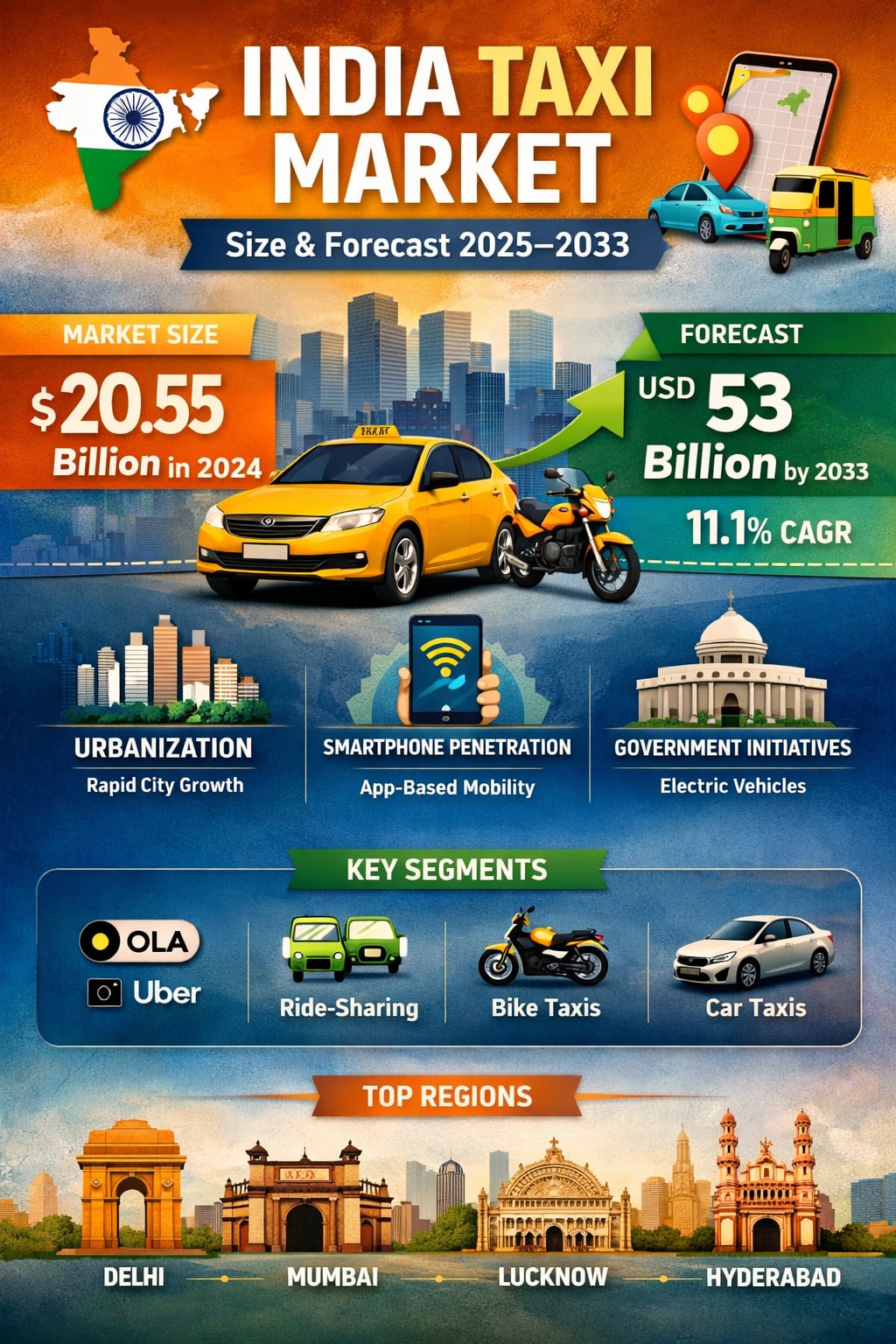
The India Taxi Market has emerged as one of the most dynamic segments of the country’s transportation ecosystem. According to Renub Research, the market was valued at USD 20.55 billion in 2024 and is projected to reach USD 53 billion by 2033, growing at a CAGR of 11.1% during the forecast period (2025–2033). This impressive expansion is being fueled by rapid urbanization, rising smartphone penetration, increasing demand for app-based mobility, and the growing influence of ride-hailing platforms such as Ola and Uber across tier-1, tier-2, and tier-3 cities.
A taxi is a commercial vehicle that offers passenger transportation services for hire, typically charged based on distance traveled or time taken. In India, taxis range from traditional black-and-yellow cabs and auto-rickshaws to modern app-based vehicles and two-wheeler taxis. These services are widely used for daily commuting, airport transfers, corporate travel, and tourism. Their convenience, point-to-point connectivity, and increasing affordability make them a crucial part of India’s urban mobility framework.
As Indian cities expand both horizontally and vertically, and as public transport systems face pressure from overcrowding, taxis are becoming an essential mobility solution. The combination of digital platforms, evolving consumer preferences, and supportive government initiatives is reshaping how millions of Indians move every day.
Key Drivers of Growth in the India Taxi Market
Urbanization and Rising Mobility Demand
India is undergoing one of the fastest urban transitions in the world. Millions of people continue to migrate to cities in search of employment, education, and better living standards. This rapid urban growth has led to a sharp increase in demand for efficient, flexible, and affordable transportation options. Taxis provide a practical solution, especially in areas where mass transit systems are either overburdened or insufficiently developed.
As cities become more congested and travel times increase, the need for convenient door-to-door mobility services grows stronger. Taxis, both traditional and app-based, help bridge critical gaps in urban transport networks. With projections suggesting that nearly 70% of India’s population could live in cities by 2050, the long-term demand for taxi services is expected to remain strong.
Proliferation of Smartphones and Internet Access
The widespread availability of smartphones and affordable mobile data has transformed commuting habits across India. App-based platforms such as Ola, Uber, and Rapido have made booking a taxi quick, transparent, and reliable. Features like real-time tracking, digital payments, estimated fares, and customer ratings have significantly improved the overall user experience.
Digital adoption is no longer limited to metropolitan areas. Tier-2 and tier-3 cities are also witnessing rapid growth in smartphone usage and internet connectivity, expanding the addressable market for online taxi services. With over 800 million internet users in India in early 2025, digital platforms are expected to remain a major catalyst for market expansion.
Government Initiatives and Policy Support
Government programs focused on electric mobility, smart cities, and digital infrastructure are indirectly strengthening the taxi industry. Schemes such as FAME (Faster Adoption and Manufacturing of Hybrid and Electric Vehicles) encourage the adoption of electric taxis, while the Smart Cities Mission promotes cleaner, technology-driven urban transport solutions.
Regulatory measures have also helped bring more structure to the sector. The introduction of GST simplified the tax framework for taxi services, improving compliance and transparency. Additionally, safety regulations such as mandatory GPS tracking, panic buttons, and driver background verification have increased passenger confidence. Together, these initiatives are creating a more organized, trustworthy, and investment-friendly taxi ecosystem in India.
Challenges Facing the India Taxi Market
Regulatory Uncertainty and Policy Fragmentation
Despite strong growth potential, the industry continues to face regulatory challenges. Transport regulations in India vary significantly from state to state, leading to confusion over fare caps, licensing rules, and vehicle registration norms. Sudden policy changes or enforcement drives can disrupt operations, affect pricing, and limit driver participation.
This regulatory fragmentation creates uncertainty for both domestic and international players, making long-term planning and large-scale investment more difficult. A more harmonized national framework could help unlock the market’s full potential.
Driver Shortages and Labor Issues
Driver-related challenges remain a persistent concern. Many drivers are dissatisfied with declining earnings after platform commissions, fuel costs, and vehicle maintenance expenses. Protests and strikes in major cities such as Delhi and Mumbai highlight ongoing tensions between drivers and aggregators.
In addition, the lack of standardized training and professional development results in inconsistent service quality and occasional safety concerns. Addressing labor welfare, income stability, and skill development will be critical for sustaining long-term growth.
India Online Taxi Market
The online taxi segment has been the biggest beneficiary of India’s digital transformation. App-based platforms dominate this space by offering seamless booking, route optimization, fare transparency, and cashless payments. Customer support features and ride-rating systems have further improved trust and engagement.
The integration of electric vehicles and shared mobility options is expanding the reach of these platforms. As smartphone usage continues to grow across urban and semi-urban regions, the online taxi market is expected to remain the primary growth engine of the overall industry.
India Ride-Hailing Taxi Market
Ride-hailing services have fundamentally changed daily commuting patterns in India. By offering on-demand, door-to-door transportation with dynamic pricing and flexible options, these platforms have become a preferred alternative to traditional taxis and public transport for many users.
The sector also creates significant employment opportunities by enabling flexible work arrangements for drivers. In recent years, platforms have expanded into subscription models, corporate mobility solutions, and even micro-mobility services. The continued shift toward convenience and flexibility, especially in the post-pandemic era, is expected to sustain strong demand for ride-hailing services.
India Ride-Sharing Taxi Market
Ride-sharing, or carpooling, is gaining traction as consumers become more cost-conscious and environmentally aware. Shared rides help reduce travel expenses, lower traffic congestion, and decrease carbon emissions. Advanced algorithms now match passengers traveling in similar directions, making shared mobility more practical and efficient.
Although the COVID-19 pandemic temporarily slowed the adoption of shared rides, the segment is rebounding with improved health and safety measures. Ride-sharing aligns well with India’s long-term goals of sustainable urban mobility and resource efficiency.
India Motorcycles Taxi Market
Two-wheeler taxis, led by players such as Rapido and Uber Moto, are becoming increasingly popular in congested Indian cities. They offer a fast, affordable, and agile solution for short-distance travel and last-mile connectivity. Their ability to navigate narrow roads and heavy traffic makes them especially attractive to students, young professionals, and daily commuters.
With rising fuel prices, growing urban congestion, and the need for economical transport options, the motorcycle taxi segment is expected to expand rapidly in the coming years.
India Cars Taxi Market
Car-based taxis remain the backbone of the Indian taxi industry. This segment includes hatchbacks, sedans, and compact SUVs catering to different customer needs and budgets. Corporate travel, airport transfers, and intercity trips continue to drive strong demand for car taxis.
The segment is also evolving with the introduction of electric vehicles and premium car rental services, reflecting a broader trend toward diversification and premiumization within the market.
Regional Market Insights
Delhi Taxi Market
Delhi is one of the largest taxi markets in India, supported by high population density, strong tourism activity, and heavy daily commuting. Government policies promoting CNG and electric vehicles are pushing platforms toward cleaner fleets. In November 2024, the Delhi Metro Rail Corporation launched a bike taxi service from select metro stations to improve last-mile connectivity, highlighting the city’s focus on integrated mobility solutions.
Maharashtra Taxi Market
Maharashtra, home to Mumbai and Pune, has a diverse and highly competitive taxi market. Traditional black-and-yellow taxis coexist with app-based services, offering consumers a wide range of choices. With millions of daily trips and strong demand from tourism, corporate travel, and intercity movement, the state remains a key growth hub. Policy support for electric vehicles is expected to further boost the market.
Uttar Pradesh Taxi Market
As India’s most populous state, Uttar Pradesh offers vast untapped potential, particularly in cities like Lucknow, Noida, and Kanpur. Infrastructure development, rising incomes, and expanding smartphone usage are encouraging the spread of online taxi services beyond major metros. The launch of all-electric taxi services at the Noida International Airport in 2024 reflects the state’s growing focus on modern, sustainable mobility.
Andhra Pradesh Taxi Market
Cities such as Visakhapatnam, Vijayawada, and Amaravati are witnessing rising taxi demand due to infrastructure development, IT sector growth, and tourism. Government support for digital transport solutions and electric mobility is strengthening the market’s long-term outlook.
Market Segmentation
By Booking Type:
Online Booking
Offline Booking
By Service Type:
Ride-Hailing
Ride-Sharing
By Vehicle Type:
Motorcycles
Cars
Other Vehicles (Vans)
Top 12 State Markets:
Maharashtra, Tamil Nadu, Uttar Pradesh, Karnataka, Gujarat, West Bengal, Rajasthan, Telangana, Andhra Pradesh, Madhya Pradesh, Kerala, and Delhi.
Competitive Landscape and Key Players
The Indian taxi market is highly competitive, featuring both global giants and strong domestic players. Companies are analyzed across five key dimensions: company overview, key personnel, recent developments, SWOT analysis, and revenue performance.
Major players include:
Carzonrent India Pvt. Ltd.
ANI Technologies Pvt. Ltd. (Ola Cabs)
Spice Cabs
Uber Technologies Inc.
Meru Cabs
Savaari Car Rentals
FastTrack Taxi
Mega Cabs
My Taxi India
BlaBlaCar
Competition is driving continuous innovation in pricing models, service quality, fleet composition, and technology integration.
Final Thoughts
The India Taxi Market is entering a transformative phase. With the market expected to grow from USD 20.55 billion in 2024 to USD 53 billion by 2033, the sector stands at the intersection of digital innovation, urban expansion, and changing consumer behavior. While regulatory challenges and labor issues remain, the long-term fundamentals are strong.
The rise of app-based platforms, electric vehicles, ride-sharing models, and two-wheeler taxis is redefining how India moves. As cities continue to grow and mobility needs become more complex, taxis will remain a critical pillar of the country’s transportation ecosystem—smarter, cleaner, and more connected than ever before.
About the Creator
Keep reading
More stories from shibansh kumar and writers in Trader and other communities.
Global Champagne Market Size Set to Reach USD 12.74 Billion by 2033 as Luxury Consumption and Premiumization Accelerate
Global Champagne Market Outlook The Global Champagne Market was valued at USD 7.72 billion in 2024 and is expected to reach USD 12.74 billion by 2033, expanding at a CAGR of 5.72% during the forecast period. This growth is being driven by rising luxury spending, premium gifting trends, and a surging demand for celebratory beverages in emerging economies, supported by strong brand prestige and evolving lifestyle patterns across Europe, North America, and Asia-Pacific.
By shibansh kumarabout 11 hours ago in Trader
Australia Frozen Food Market Expected to Reach USD 8.3 Billion by 2034 as Convenience and Innovation Drive Demand
The Australia frozen food market is experiencing significant growth as consumer lifestyles shift toward convenience, quality, and variety in meal solutions. According to the latest IMARC Group data, the market reached USD 4.7 billion in 2025 and is projected to expand to USD 8.3 billion by 2034, representing a compound annual growth rate (CAGR) of 6.43% during 2026–2034.
By Amélie Belle7 days ago in Trader



Comments
There are no comments for this story
Be the first to respond and start the conversation.