
Industrial Coatings Market Size and Forecast 2025–2033
Smart Coatings, Sustainability, and Infrastructure Boom Reshape a US$ 130 Billion Global Industry

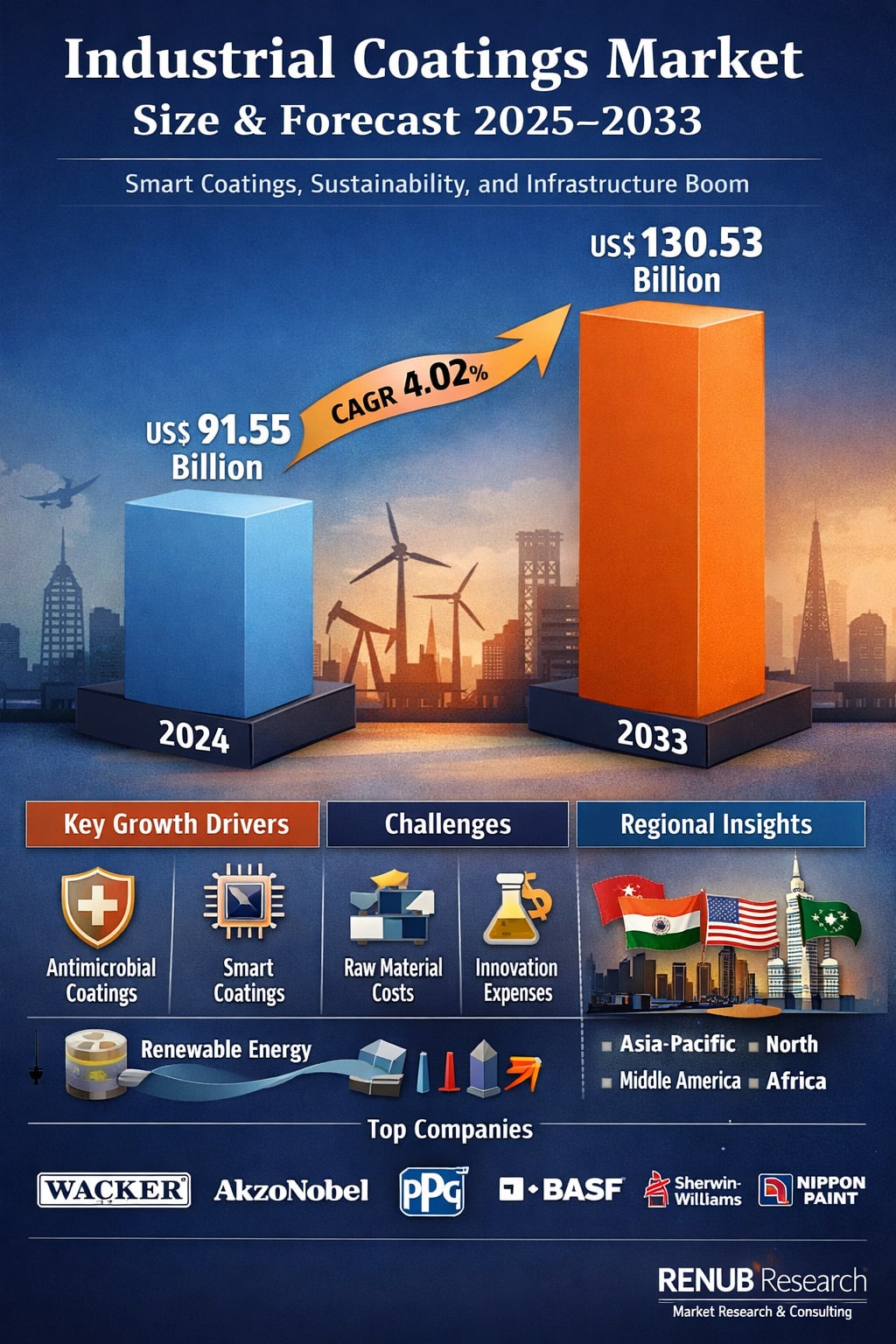
Industrial Coatings Market: A Global Industry at a Turning Point
The Industrial Coatings Market is entering a decisive growth phase as industries worldwide double down on durability, performance, and sustainability. According to Renub Research, the global industrial coatings market is expected to reach US$ 130.53 billion by 2033, up from US$ 91.55 billion in 2024, expanding at a CAGR of 4.02% from 2025 to 2033.
This steady rise reflects more than just cyclical industrial demand. Industrial coatings today sit at the intersection of infrastructure development, advanced manufacturing, environmental regulation, and material innovation. From corrosion protection in oil & gas pipelines to antimicrobial surfaces in hospitals and lightweight protective layers in aerospace, coatings have evolved into a strategic enabler of industrial performance rather than a simple finishing touch.
At their core, industrial coatings are engineered materials applied to surfaces to protect, enhance appearance, and extend service life. They include epoxy, polyurethane, acrylic, alkyd, polyester, and powder-based systems, each designed to resist corrosion, chemicals, abrasion, heat, and extreme environmental conditions. By forming a protective barrier between substrates and harsh surroundings, these coatings play a crucial role in preventing rust, reducing maintenance costs, and improving operational efficiency across industries such as manufacturing, automotive, marine, electronics, power generation, and mining.
Global trends such as rapid urbanization, large-scale infrastructure projects, renewable energy expansion, and stricter environmental standards are reshaping the market’s growth trajectory. At the same time, technological shifts—particularly the rise of smart coatings, nanotechnology, and data-integrated surfaces—are redefining what industrial coatings can do.
Why Demand for Industrial Coatings Is Rising
Several structural forces are pushing the industrial coatings market forward.
First, global infrastructure development remains a powerful engine of growth. Bridges, highways, rail networks, ports, power plants, and industrial facilities all require high-performance protective coatings to withstand weather, pollution, and mechanical stress. As governments invest heavily in modernizing infrastructure—especially in Asia-Pacific and parts of the Middle East—the demand for long-lasting, corrosion-resistant coatings continues to climb.
Second, the manufacturing and automotive sectors are evolving rapidly. Lightweight materials, electric vehicles, and advanced production processes require coatings that offer better adhesion, heat resistance, and durability while meeting strict environmental standards. In automotive refinishing and OEM applications, coatings are no longer judged only by appearance, but also by their ability to improve efficiency, reduce drag, and extend component life.
Third, renewable energy is emerging as a key growth pillar. Wind turbines, solar panels, and energy storage systems all depend on specialized coatings to resist UV radiation, moisture, salt spray, and temperature extremes. Offshore wind projects, in particular, rely heavily on advanced anti-corrosion and anti-fouling coatings to ensure long-term reliability in harsh marine environments.
Finally, the healthcare and electronics sectors are fueling demand for precision and functional coatings. Antimicrobial coatings for hospitals and clinics, as well as ultra-thin protective layers for electronic components, are becoming essential as industries prioritize hygiene, reliability, and miniaturization.
Key Growth Drivers Shaping the Market
1. Smart Coatings and Digitalization
One of the most exciting trends in the industrial coatings space is the rise of smart coatings, driven by Industry 4.0 and the Internet of Things (IoT). These coatings can respond to external stimuli such as temperature, moisture, light, or mechanical stress by changing their properties.
In aerospace, smart coatings are being used to detect structural fatigue and corrosion, providing real-time feedback on the health of aircraft components. In the automotive sector, self-healing coatings are gaining attention for their ability to repair minor scratches and surface damage, improving both aesthetics and durability.
Beyond protection, the integration of sensors and data-collection capabilities into coatings opens the door to predictive maintenance and remote monitoring. This helps industries reduce downtime, cut maintenance costs, and improve safety—turning coatings into active participants in asset management rather than passive surface layers.
2. Nanotechnology and Advanced Materials
The incorporation of nanotechnology is another major force driving innovation in industrial coatings. By manipulating materials at the nanoscale, manufacturers can significantly enhance properties such as hardness, scratch resistance, chemical stability, and corrosion protection.
Nanocoatings are especially attractive in sectors like electronics, automotive, and aerospace, where thin, lightweight, yet highly durable protective layers are critical. These coatings allow for high performance without adding bulk or weight, which is increasingly important in energy-efficient and high-precision applications.
In addition, advanced materials are enabling coatings to perform multiple functions at once—such as combining anti-corrosion, anti-microbial, and self-cleaning properties in a single layer—further increasing their value proposition across industries.
3. Sustainability and Environmental Regulations
Sustainability is no longer optional—it is a central pillar of industrial strategy. Governments and regulatory bodies worldwide are imposing stricter limits on volatile organic compounds (VOCs) and hazardous chemicals used in coatings. As a result, the market is seeing a strong shift toward water-borne, powder-based, and low-VOC formulations.
At the same time, customers are increasingly demanding eco-friendly and sustainable products without compromising performance. This has pushed companies to invest heavily in research and development to create coatings that deliver durability and protection while minimizing environmental impact.
Major players are also aligning their operations with broader climate goals. For example, in July 2023, BASF SE announced that all energy used to manufacture its automotive OEM coatings now comes from renewable sources, highlighting how sustainability is becoming a competitive differentiator in the industry.
Challenges Facing the Industrial Coatings Market
Despite its strong growth outlook, the industrial coatings market faces several notable challenges.
Raw Material Price Volatility
One of the biggest concerns is the volatility in raw material prices, particularly for resins, solvents, and pigments. These fluctuations are driven by factors such as geopolitical tensions, supply chain disruptions, and changing trade policies.
For instance, tariffs and regulatory actions affecting key inputs like titanium dioxide have pushed up costs for paint and coating manufacturers in recent years. The COVID-19 pandemic further exposed supply chain vulnerabilities, leading to sharp increases in production costs. Since early 2020, the Producer Price Index for paint and coating manufacturing has risen significantly, putting pressure on margins and pricing strategies.
Manufacturers are now forced to balance cost control, product quality, and regulatory compliance, which is no easy task in a highly competitive global market.
Technological Complexity and Innovation Costs
The push toward high-performance, smart, and self-healing coatings requires continuous innovation and significant investment in research and development. While these advancements open new opportunities, they also come with challenges such as high R&D costs, complex manufacturing processes, and the need for specialized expertise.
Scaling up advanced materials from laboratory to mass production remains a hurdle, especially for smaller and mid-sized companies that may lack the financial and technical resources of global giants. This could widen the gap between market leaders and smaller players, increasing industry consolidation over time.
Regional Outlook: Where Growth Is Happening
The industrial coatings market shows distinct regional patterns shaped by industrialization levels, infrastructure spending, and regulatory frameworks.
Asia-Pacific: The Growth Engine
Asia-Pacific holds the largest share of the global market, driven by massive industrial bases in China, India, Japan, and Southeast Asia. Rapid urbanization, expanding manufacturing capacity, and large-scale infrastructure projects continue to fuel strong demand for industrial coatings in this region.
China’s dominance in manufacturing and India’s fast-growing infrastructure and automotive sectors make Asia-Pacific the most dynamic and competitive market worldwide.
North America: Innovation and Performance
North America remains a major market thanks to strong demand from the automotive, aerospace, construction, and energy sectors. The United States, in particular, is home to leading players such as Sherwin-Williams, PPG Industries, and Akzo Nobel, which drive innovation in high-performance and sustainable coatings.
The region is also at the forefront of adopting low-VOC, eco-friendly, and smart coating technologies, supported by strict environmental regulations and advanced R&D ecosystems.
Europe: Sustainability and Regulation
Europe continues to play a critical role, with countries like Germany, France, Italy, Spain, and the United Kingdom emphasizing sustainability and high-quality manufacturing. The region’s strong regulatory framework accelerates the shift toward water-borne and powder-based coatings, while industries such as automotive, aerospace, and industrial machinery sustain steady demand.
Middle East & Africa and Latin America: Emerging Opportunities
While smaller in market size, Latin America and the Middle East & Africa are gaining momentum due to infrastructure development, industrial diversification, and energy projects. Countries like Saudi Arabia and the United Arab Emirates are investing heavily in industrial cities, construction, and mega-projects, creating fresh demand for high-performance and protective coatings.
Country Snapshots
United States:
The U.S. industrial coatings market is driven by manufacturing, automotive, aerospace, and construction. A strong shift toward sustainable, low-VOC solutions is underway, supported by technological innovation in corrosion-resistant and self-healing coatings. However, labor shortages and raw material price volatility remain key challenges.
United Kingdom:
The UK market mirrors broader European trends, with a focus on eco-friendly and high-performance coatings. Strict environmental regulations and demand from aerospace and automotive sectors continue to shape product development and investment priorities.
India:
India’s market is expanding rapidly due to industrialization, infrastructure growth, and a booming automotive sector. Local players such as Kansai Nerolac, Asian Paints, and Berger Paints are активно investing in water-borne and low-VOC technologies to meet regulatory and sustainability goals.
United Arab Emirates:
The UAE’s industrial coatings market benefits from large-scale infrastructure projects, construction, and industrial diversification. Demand is rising for durable, high-performance coatings suited to harsh climatic conditions, especially in construction, oil & gas, and marine applications.
Recent Developments in the Industry
July 2023: BASF SE announced that all energy used to manufacture its automotive OEM coatings now comes from renewable sources, reinforcing its commitment to sustainability.
May 2023: Kansai Paint Co. Ltd. acquired the global Railway Coatings business assets from Beckers Group, strengthening its position in specialized industrial coatings.
Market Segmentation Overview
By Product:
Acrylic, Alkyd, Polyurethane, Epoxy, Polyester, Others
By Technology:
Solvent Borne, Water Borne, Powder Based, Others
By End User:
General Industrial, Marine, Automotive and Vehicle Refinish, Electronics, Aerospace, Oil and Gas, Mining, Power Generation, Others
By Region:
North America, Europe, Asia Pacific, Latin America, Middle East & Africa
Competitive Landscape
The industrial coatings market is highly competitive, with global and regional players operating across the value chain. Key companies include:
Wacker Chemie AG
Akzo Nobel N.V.
Nippon Paint Holdings Co., Ltd.
Jotun
The Sherwin-Williams Company
BASF SE
Chugoku Marine Paints Ltd.
Kansai Paint Co. Ltd.
PPG Industries Inc.
Axalta Coating Systems Ltd.
These companies compete on technology, sustainability, product performance, and global reach, while continuously investing in innovation and strategic acquisitions.
Final Thoughts
The Industrial Coatings Market is no longer just about surface protection—it is about performance, intelligence, and sustainability. With the market projected by Renub Research to grow from US$ 91.55 billion in 2024 to US$ 130.53 billion by 2033, the industry is clearly on a steady upward path.
As smart coatings, nanotechnology, and eco-friendly formulations gain traction, coatings will increasingly become strategic enablers of industrial efficiency and asset longevity. While challenges such as raw material volatility and high innovation costs remain, the long-term outlook is firmly positive.
About the Creator
Tom Shane
Tom Shane is a content writer specializing in SEO-driven blogs, product descriptions, and thought leadership. He crafts engaging, research-backed content that connects with audiences and drives results.
United States Payment Gateways Market Size, Share, Growth, Trends Analysis, Forecast 2034
Why the United States Payment Gateways Market Is Accelerating: Trends & Future Outlook The United States Payment Gateways Market is experiencing rapid growth as digital commerce, mobile payments, and fintech innovation reshape the financial ecosystem. Payment gateways play a critical role in enabling secure online transactions between customers, merchants, and financial institutions. As consumer preferences shift toward seamless, contactless, and mobile-first experiences, the demand for reliable payment processing solutions continues to rise.
By Jackson Watsonabout 11 hours ago in Trader


Comments
There are no comments for this story
Be the first to respond and start the conversation.