
United States Janitorial Service Market Size and Forecast 2025–2033
Rising Hygiene Standards, Expanding Commercial Spaces, and Outsourcing Trends Drive Steady Growth in the U.S. Cleaning Industry

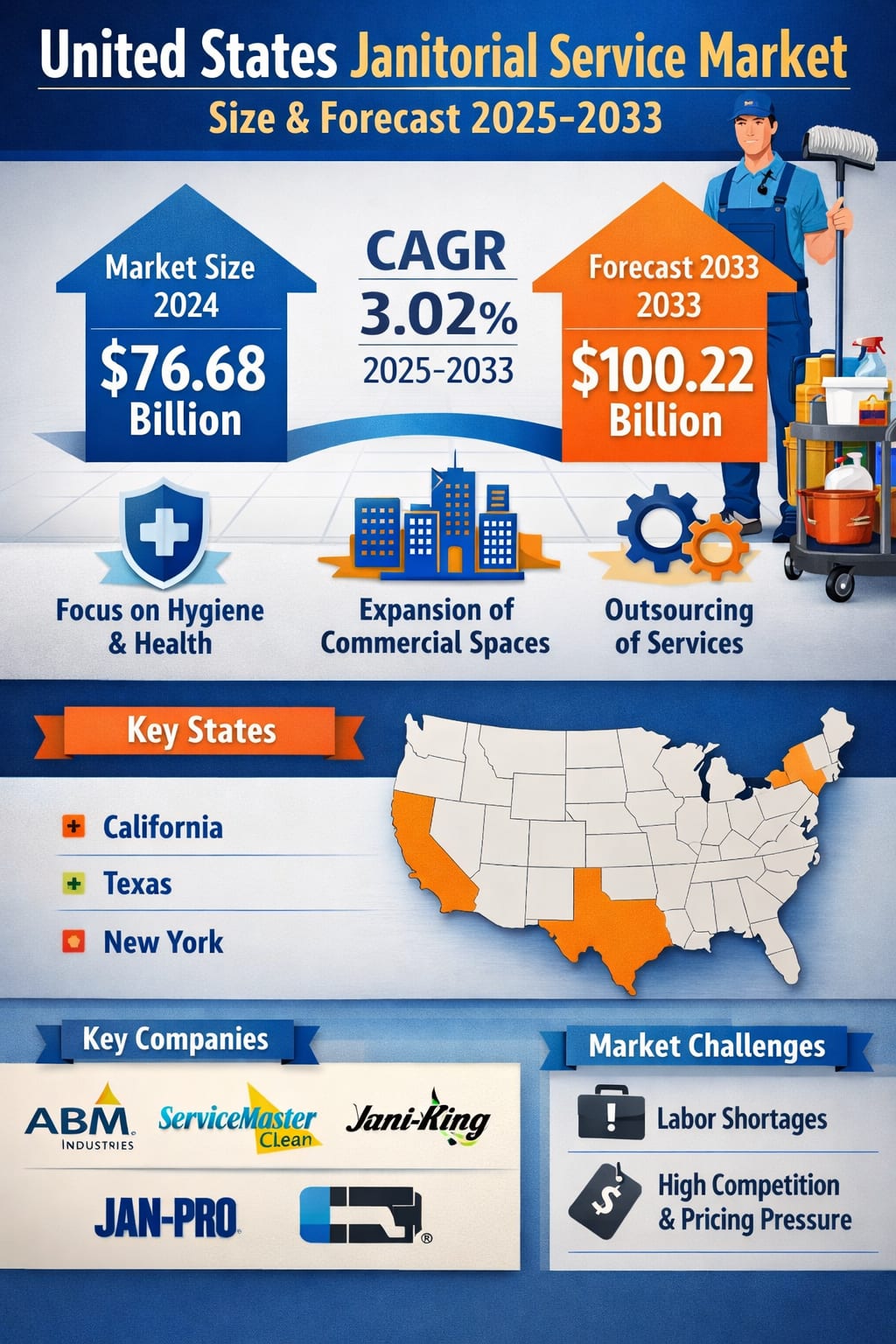
United States Janitorial Service Market Overview
The United States Janitorial Service Market is entering a phase of steady and resilient growth, driven by structural shifts in how organizations, institutions, and households view cleanliness, hygiene, and workplace safety. According to Renub Research, the market is expected to reach US$ 100.22 billion by 2033, up from US$ 76.68 billion in 2024, expanding at a compound annual growth rate (CAGR) of 3.02% from 2025 to 2033.
This growth reflects more than just routine cleaning demand. It signals a deeper transformation in the way cleanliness is perceived—as a strategic necessity rather than a basic operational chore. Across corporate offices, healthcare facilities, educational institutions, retail stores, and industrial sites, cleaning and sanitation have become critical to brand reputation, employee productivity, regulatory compliance, and customer trust.
The janitorial services industry in the U.S. is highly diverse, ranging from small local providers to large national and international facility management companies. These players offer a wide spectrum of services, including standard cleaning, damage restoration, floor care, and exterior window cleaning. The market serves both residential and commercial applications, with commercial clients accounting for the largest share due to the scale and frequency of their cleaning requirements.
In recent years, the industry has also seen increased adoption of technology-driven solutions, eco-friendly cleaning products, and data-driven facility management tools. This shift reflects rising expectations from clients who now demand not just cleanliness, but also sustainability, efficiency, and accountability from service providers.
United States Janitorial Service Industry Landscape
The U.S. janitorial services industry plays a crucial role in supporting the country’s vast commercial and institutional infrastructure. Offices, hospitals, schools, airports, shopping centers, hotels, and manufacturing plants all depend on consistent and professional cleaning services to maintain safe and functional environments.
One of the defining features of this industry is its outsourcing-driven model. Instead of maintaining in-house cleaning staff, most organizations prefer to contract specialized service providers. This approach offers flexibility, cost control, access to trained personnel, and compliance with health and safety standards. As organizations increasingly focus on core business activities, janitorial services continue to benefit from this long-term outsourcing trend.
Another important characteristic of the market is its fragmented and competitive structure. While large players like ABM Industries, ServiceMaster, Jani-King, and Jan-Pro operate nationwide through corporate and franchise models, thousands of small and mid-sized companies serve local and regional markets. This diversity creates intense competition, particularly in pricing, but also encourages innovation in service quality, technology use, and sustainability practices.
The post-pandemic environment has further reinforced the importance of professional cleaning. Businesses across sectors now view regular sanitation, disinfection, and preventive cleaning as essential components of risk management and operational continuity. As a result, janitorial services have moved from being a background function to a visible and strategic service in many organizations.
Key Factors Driving the United States Janitorial Service Market
Growing Focus on Hygiene and Health
The COVID-19 pandemic fundamentally changed how individuals and organizations perceive cleanliness and hygiene. Even as the immediate crisis has eased, its impact on behavior and expectations remains strong. Workplaces, schools, healthcare facilities, and public spaces now follow stricter cleaning protocols, with greater emphasis on disinfection and preventive sanitation.
This shift has significantly boosted demand for professional janitorial services. Companies prefer trained providers who use approved disinfectants, follow standardized procedures, and can demonstrate compliance with health guidelines. Regular and documented cleaning routines are no longer optional—they are now a core part of operational responsibility and brand credibility.
Over the long term, this heightened awareness of hygiene is expected to remain a structural growth driver. Rather than returning to pre-pandemic cleaning habits, most organizations have institutionalized higher standards of cleanliness, supporting stable and recurring demand for janitorial services across the country.
Expansion of Commercial and Institutional Infrastructure
The continuous growth of commercial and institutional buildings in the United States is another major driver of the janitorial services market. New office complexes, hospitals, schools, data centers, retail spaces, and mixed-use developments are being built or renovated across urban and suburban areas.
Each new facility adds to the long-term demand for routine cleaning, maintenance, and specialized services such as floor care, window cleaning, and post-construction cleanup. Moreover, modern buildings often feature larger common areas, advanced materials, and complex layouts, which increase the scope and frequency of cleaning requirements.
Urbanization, population growth, and ongoing investments in healthcare and education infrastructure further reinforce this trend. As the built environment expands and becomes more complex, the need for professional janitorial services grows in parallel.
Rising Trend of Outsourcing Non-Core Operations
Organizations across industries are increasingly focused on efficiency, cost control, and operational flexibility. As part of this strategy, many companies are outsourcing non-core functions such as cleaning, security, and facility maintenance to specialized service providers.
For janitorial services, this trend is a powerful growth engine. Outsourcing allows businesses to avoid the administrative burden of hiring, training, and managing in-house cleaning staff. It also provides access to professional expertise, modern equipment, and scalable service models that can adapt to changing needs.
From corporate offices and retail chains to hospitals and educational institutions, outsourcing is now the preferred model for cleaning services. This structural shift continues to expand the addressable market for janitorial service providers across the United States.
Challenges Facing the U.S. Janitorial Service Market
Workforce Shortages and High Labor Turnover
Despite strong demand, the janitorial services industry faces persistent challenges related to labor availability and retention. Cleaning jobs are physically demanding, often involve night or off-hour shifts, and typically offer relatively low wages with limited career progression opportunities.
As a result, many companies struggle with high employee turnover and chronic labor shortages. This instability affects service quality, increases training costs, and makes it harder for providers to scale operations or take on new contracts.
To address this issue, employers are under growing pressure to improve wages, benefits, and working conditions. While these measures can help attract and retain workers, they also increase operating costs in an industry that is already highly price-sensitive.
Intense Competition and Price Pressure
The U.S. janitorial services market is highly fragmented, with a large number of small and mid-sized players competing alongside major national brands. This intense competition puts strong downward pressure on pricing, especially in commercial and institutional contracts where cost is often a primary decision factor.
Many clients prioritize low bids over value-added services, forcing providers to operate on thin margins. This makes it difficult to invest in technology, employee training, or service innovation, even though these factors are increasingly important for long-term competitiveness.
While some companies try to differentiate themselves through sustainability initiatives, advanced equipment, or superior customer service, justifying higher prices in a cost-driven market remains a constant challenge.
United States Janitorial Service Market by States
The demand for janitorial services varies significantly across states, influenced by population size, economic activity, commercial real estate development, and regulatory environments. Large and economically dynamic states contribute the most to overall market revenue.
California Janitorial Service Market
California represents one of the largest and most dynamic janitorial services markets in the United States. The state’s vast economy, which includes technology, healthcare, education, entertainment, and commercial real estate, generates consistent and high-volume demand for professional cleaning services.
California is also known for its strict labor and environmental regulations, which shape industry practices. Service providers operating in the state must comply with detailed rules related to wages, worker classification, and environmental standards. This has encouraged greater adoption of green cleaning methods and more formalized workforce management practices.
While the market offers strong opportunities, it is also highly competitive and faces challenges related to labor availability and regulatory compliance. Nevertheless, sustainability, technology adoption, and service specialization continue to redefine the competitive landscape in California.
Texas Janitorial Service Market
Texas is another major contributor to the U.S. janitorial services industry, supported by its large population, business-friendly environment, and rapidly growing commercial infrastructure. Cities such as Houston, Dallas, Austin, and San Antonio host a wide range of corporate offices, healthcare facilities, educational institutions, and industrial sites.
The state’s diversified economy ensures steady demand for cleaning services across multiple sectors. Although regulatory requirements differ from those in California, there is still growing emphasis on fair labor practices and environmentally responsible cleaning solutions.
Like other large markets, Texas faces challenges related to labor shortages and intense competition. However, continued economic growth and construction activity are expected to sustain long-term demand for janitorial services.
New York Janitorial Service Market
New York, particularly New York City, plays a critical role in the U.S. janitorial services market due to its dense urban environment and concentration of commercial real estate, healthcare facilities, and educational institutions.
The state’s strict building codes, health regulations, and labor laws contribute to consistently high demand for professional cleaning services. Labor unions, such as SEIU Local 32BJ, also have a significant influence on industry practices, shaping wages, working conditions, and service standards.
While providers in New York face high operating costs, regulatory complexity, and intense competition, the scale and consistency of demand make it one of the most important markets for janitorial services in the country.
Market Segmentation Overview
By Application:
Residential
Commercial
By End Use:
Standard Cleaning
Damage Restoration Cleaning
Exterior Window Cleaning
Floor Care Services
Others
By States:
California
Texas
New York
Florida
Illinois
Pennsylvania
Ohio
Georgia
Washington
New Jersey
Rest of United States
Competitive Landscape and Key Companies
The U.S. janitorial services market features a mix of large multinational players and smaller regional specialists. Major companies compete on scale, brand reputation, service consistency, and technology adoption, while smaller firms often focus on local relationships and niche services.
Key companies operating in the market include:
Moonlight Maintenance Service
ABM Industries Incorporated
The ServiceMaster Company, LLC
Jani-King International, Inc.
Jan-Pro Franchising, Inc.
Allan Industries, Inc.
Get Clean Services LLC
VIP, Inc
Mitie Group plc
These companies focus on expanding service portfolios, strengthening franchise and regional networks, and integrating digital tools for scheduling, quality control, and client communication.
Recent Developments in the Market
In March 2024, Aspire Software partnered with ServiceMaster Clean, a brand of The ServiceMaster Company, to provide technology support for the company’s commercial cleaning business management systems. This partnership highlights the growing importance of software platforms, data analytics, and digital workflows in improving operational efficiency and supporting scalable growth in the janitorial services industry.
Final Thoughts
The United States Janitorial Service Market is on a steady growth path, supported by long-term structural trends rather than short-term cycles. With the market projected to grow from US$ 76.68 billion in 2024 to US$ 100.22 billion by 2033, the industry reflects the rising importance of hygiene, safety, and professional facility management in modern society.
While challenges such as labor shortages, high competition, and price sensitivity remain, the sector continues to evolve through technology adoption, sustainability initiatives, and service diversification. For businesses, institutions, and households alike, professional cleaning services are no longer a luxury—they are an essential part of maintaining healthy, efficient, and trustworthy environments.
As organizations continue to prioritize cleanliness and operational resilience, the U.S. janitorial services industry is well-positioned to remain a vital and growing component of the broader facility management and services economy through 2033 and beyond.
About the Creator
Tom Shane
Tom Shane is a content writer specializing in SEO-driven blogs, product descriptions, and thought leadership. He crafts engaging, research-backed content that connects with audiences and drives results.
The Paradox of Tokenization: How a Technology of Freedom Can Become a System of Control
Blockchain was once introduced as a technology of liberation. A currency free from central authority, transactions resistant to censorship, and a system where trust is replaced by code. These ideas positioned it as an alternative to traditional financial structures and inspired many to imagine a more open economic order. Yet technology itself is neutral, while the structures that design and deploy it are not. Today, blockchain is no longer just a tool of freedom. It is also becoming a new arena where power is reorganized.
By crypto genieabout 18 hours ago in Trader
Global Petroleum Coke Market Analysis, Trends & Growth Drivers
Overview Petroleum Coke Market Petroleum coke (petcoke) is a solid carbonaceous residue left after heavy crude oil fractions are thermally cracked during refining. It is valued for its high calorific value and cost-effectiveness compared to traditional fossil fuels like coal. The product is widely used as:
By James Smith5 days ago in Trader




Comments
There are no comments for this story
Be the first to respond and start the conversation.