
Iran Aquaculture Market 2026: Sustainable Expansion, Production Innovation & the Future of Seafood Security
How scientific farming methods, climate resilience and rising seafood demand are strengthening aquaculture development in Iran

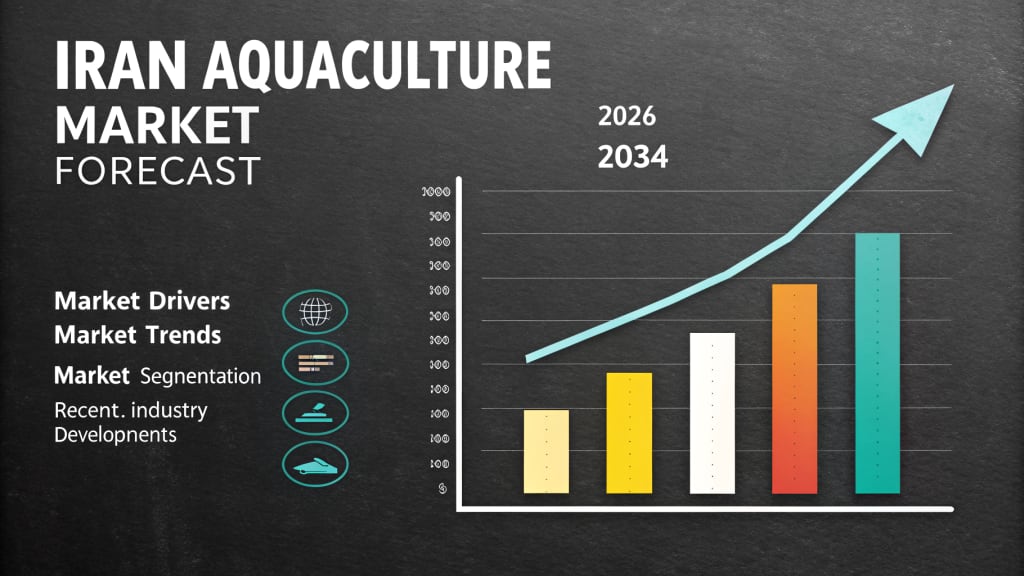
The Iran aquaculture sector is steadily transforming into one of the country’s most strategically important food production industries. According to IMARC Group, the Iran aquaculture market reached 0.33 million tons in 2025, reflecting stable domestic production capacity and growing seafood demand. Looking ahead, production is projected to rise to 0.50 million tons by 2034, expanding at a CAGR of 4.27% during 2026–2034.
While the growth rate may appear moderate compared to high-tech sectors, in agriculture and food systems this represents strong structural progress.
Market Structure and Production Landscape
Iran’s aquaculture output features a variety of species, enabling producers to adjust to local water conditions and market demands. Due to their versatility and well-established farming methods, freshwater fish like carp and trout remain the leaders in inland production. Concurrently, shrimp farming in coastal regions is becoming increasingly significant, especially in the context of export-driven growth initiatives. Tilapia farming has also progressed in particular areas where water temperature and infrastructure facilitate its development cycle.
Production systems differ throughout the nation. Conventional pond systems are still commonly utilized, especially in rural and semi-rural areas, because of their affordability and proven management methods. Nonetheless, more sophisticated techniques like cage farming and recirculating aquaculture systems (RAS) are slowly being embraced. These technologies enable increased production density, enhanced water quality monitoring, and superior disease management.
Key Industry Drivers
One of the strongest forces behind aquaculture expansion in Iran is rising domestic seafood consumption. Urbanization, increasing awareness of balanced diets and higher demand for protein-rich food sources are shifting consumer preferences toward fish and seafood. Wild capture fisheries face natural limitations, making aquaculture a reliable alternative for meeting long-term demand.
Environmental sustainability also plays a central role. Aquaculture, when properly managed, reduces pressure on wild fish stocks and contributes to controlled, traceable food production. Scientific advancements in feed efficiency, breeding selection and disease control are improving survival rates and reducing resource waste.
Government-backed agricultural modernization programs have further supported the sector by encouraging investment in infrastructure, hatcheries and water management systems. These initiatives help strengthen rural employment while increasing national food security.
Opportunities for Growth
The long-term opportunity in Iran’s aquaculture market lies in modernization and value addition. Producers that invest in advanced water recycling systems, automated monitoring tools and precision feeding technologies can significantly increase yield efficiency. This technological integration supports both productivity and environmental compliance.
Export development represents another promising avenue. With projected production reaching 0.50 million tons by 2034, surplus capacity can be directed toward regional markets. Neighboring countries with growing seafood demand offer natural trade channels for shrimp and processed fish products.
There is also opportunity in downstream value chains. Expanding into packaged, processed and branded seafood products can enhance margins and reduce reliance on raw fish sales. Cold chain infrastructure improvements further strengthen market reach and product quality preservation.
Research collaboration with universities and marine science institutes can accelerate innovation in breeding, disease resistance and climate adaptation strategies. These partnerships ensure long-term resilience and global competitiveness.
Recent News & Developments in Iran Aquaculture Market
March 2025: National aquaculture authorities introduced upgraded water management standards aimed at improving pond efficiency and reducing evaporation loss, with pilot farms reporting improved yield consistency.
July 2025: A coastal aquaculture expansion project increased shrimp farming capacity by approximately 22%, signaling continued momentum in export-oriented production strategies.
November 2025: Agricultural research centers announced advancements in disease-resistant trout breeding programs, supporting higher survival rates and production stability for inland farms.
Why Should You Know About Iran Aquaculture Market?
The Iran aquaculture market represents more than production growth — it demonstrates how agriculture can evolve through science-driven sustainability. As the country works toward balancing food security, climate challenges and economic diversification, aquaculture stands out as a practical and scalable solution.
With production projected to increase from 0.33 million tons in 2025 to 0.50 million tons by 2034, the industry highlights steady, disciplined expansion rather than speculative growth. It shows how technological adaptation, environmental responsibility and rising consumer demand can align in a structured and forward-looking way.
For investors, policymakers, food system analysts and sustainability advocates, this market offers valuable insight into how aquatic farming can strengthen rural economies, reduce import dependency and support long-term protein supply stability.
About the Creator
Thomas
Market Research Analyst | Industry Trends & Forecasting | Turning market data into clear, actionable business insights across global sectors.
Australia Grid Energy Storage Market to Surge Nearly Tenfold by 2033
In 2024, the Australia grid energy storage market reached a value of USD 366.80 million. Industry projections indicate the market will grow exponentially to USD 3,941.14 million by 2033, representing a robust compound annual growth rate (CAGR) of 26.80% between 2025 and 2033. This strong growth outlook reflects accelerating adoption of grid-scale battery systems, policy engagement at federal and state levels, and the pressing need to manage renewable energy intermittency while reinforcing grid stability.
By Rashi Sharmaabout 4 hours ago in Trader
Philippines Silicon Wafer Market 2026: Semiconductor Expansion, Electronics Demand and Advanced Chip Ecosystems
Philippines Silicon Wafer Market Overview The Philippines silicon wafer market is gaining traction as semiconductor assembly, electronics manufacturing and digital infrastructure development strengthen the country’s position within Southeast Asia’s technology supply chain. Silicon wafers serve as the foundational substrate for integrated circuits, enabling production of microchips used across smartphones, computing devices, automotive electronics and industrial systems. As demand for advanced electronics continues to rise, silicon wafer consumption is becoming increasingly critical to support semiconductor production and innovation.
By Manisha Dixit2 days ago in Trader
Magic
Note from the Author: I want to let you know that this is an unusual story, and it has been written purely from whatever is in my unconscious mind, because before I start writing, I get into a flow state that reaches my unconsciousness. I also write in my subconscious mind, which is like a mid-flow state between the conscious and unconscious mind.
By Denise Larkin3 days ago in Fiction


Comments
There are no comments for this story
Be the first to respond and start the conversation.