
Philippines Oleochemicals Market 2026: Coconut-Based Advantage, Green Chemistry and Industrial Diversification
How abundant feedstock supply, sustainable chemical demand and multi-industry applications are shaping the Philippines oleochemicals industry

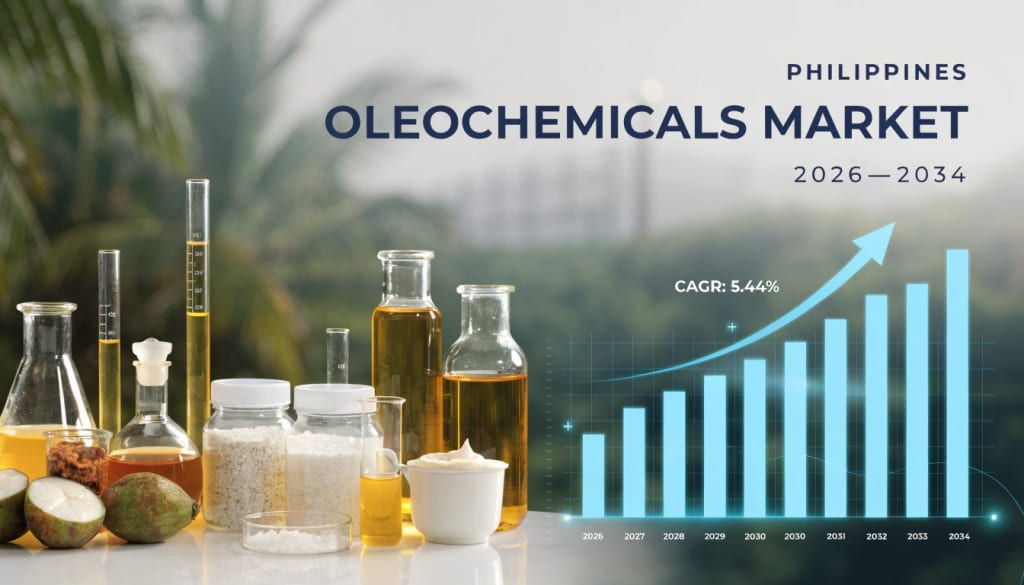
Philippines Oleochemicals Market Overview
The Philippines oleochemicals market growth is evolving as a strategic segment within the country’s chemical and materials landscape, driven by strong agricultural feedstock availability and rising global demand for sustainable alternatives to petrochemicals. Oleochemicals — derived from natural oils and fats such as coconut and palm oil — are widely used in personal care, food processing, pharmaceuticals, detergents and biofuel production. As industries increasingly prioritise environmentally responsible formulations and renewable inputs, the Philippines is strengthening its position as a regional supplier of bio-based chemical intermediates.
According to IMARC Group, the Philippines oleochemicals market reached USD 546.00 million in 2025 and is projected to grow to USD 879.51 million by 2034, exhibiting a compound annual growth rate (CAGR) of 5.44% during 2026–2034. Market expansion is supported by growing demand for biodegradable products, favourable green chemistry policies and abundant coconut oil feedstock supply.
Key Market Drivers
Abundant Coconut Oil Feedstock Availability
The Philippines’ strong coconut industry provides a stable raw material base for oleochemical production. The country produced approximately 1.2 million tonnes of coconut oil in 2023, representing the majority of domestic oils and fats output and supporting cost-efficient oleochemical manufacturing.
Rising Demand for Sustainable and Biodegradable Ingredients
Environmental awareness and regulatory pressures are encouraging manufacturers to replace petrochemical inputs with plant-based alternatives. Oleochemicals’ low toxicity and biodegradability make them attractive ingredients for consumer and industrial products.
Expansion Across Diverse End-Use Industries
Oleochemicals are increasingly used as emulsifiers, stabilisers and functional additives in food processing, pharmaceutical formulations and personal care products, expanding market penetration across multiple sectors.
Government Support for Green Chemistry Initiatives
Policy initiatives promoting sustainable manufacturing and responsible chemical usage are creating a favourable environment for oleochemical industry growth while attracting international sourcing partnerships.
Request a Sample Report with the Latest 2026 Data & Forecasts
What the Opportunities Are
The Philippines oleochemicals market presents compelling opportunities as sustainability, industrial innovation and agricultural value addition converge.
Development of High-Value Specialty Oleochemicals
Beyond commodity derivatives, specialty oleochemicals such as esters, surfactants and functional additives offer higher margins and expanded applications in cosmetics, pharmaceuticals and advanced materials, creating opportunities for product portfolio diversification.
Integration with Personal Care and Home Care Manufacturing
Rapid growth of the Philippines personal care and home care industries supports strong demand for fatty acids, glycerine and surfactants. Strategic collaboration between oleochemical producers and consumer goods manufacturers can strengthen domestic value chains.
Expansion into Biofuel and Renewable Energy Applications
Oleochemicals play a role in biodiesel production and renewable fuel blending. Increasing emphasis on energy transition initiatives provides opportunities for producers to participate in sustainable fuel ecosystems.
Export-Oriented Production Growth
With strong agricultural resources and processing capacity, the Philippines can expand exports of oleochemical intermediates to global manufacturers seeking traceable, sustainable raw materials.
Circular Economy and Waste-Derived Feedstock Utilisation
Adoption of circular economy practices — including reuse of waste oils and fats — offers opportunities to improve sustainability performance, reduce costs and enhance resource efficiency across production systems.
These opportunities collectively position the Philippines as a competitive and sustainability-aligned oleochemical production hub within Asia-Pacific supply chains.
Recent News and Developments
February 2025: Market evaluation confirmed the Philippines oleochemicals market reached USD 546.00 million in 2025, reflecting steady demand across personal care, food and industrial applications.
May 2025: Sustainability trends accelerated as manufacturers increasingly incorporated plant-based surfactants, fatty alcohols and glycerine into formulations to meet global environmental standards.
October 2025: Agricultural sector data reinforced the country’s feedstock advantage, with coconut oil production remaining a dominant contributor to oleochemical raw material supply and export competitiveness.
January 2026: Forecast outlook projections indicated the market is expected to reach USD 879.51 million by 2034, highlighting sustained growth driven by diversified applications and green chemistry adoption.
Why You Should Know About the Philippines Oleochemicals Market?
The Philippines oleochemicals market reflects the intersection of agricultural strength, chemical innovation and sustainability priorities. As industries worldwide transition toward renewable raw materials and eco-friendly manufacturing practices, oleochemicals are becoming essential building blocks for next-generation consumer and industrial products.
With steady growth projected through 2034, supported by feedstock abundance, multi-industry demand and policy momentum, the sector offers attractive opportunities for chemical producers, consumer goods manufacturers and investors.
As green chemistry adoption accelerates and bio-based materials gain prominence across global supply chains, the Philippines oleochemicals market is positioned for sustained expansion while strengthening its role as a regional leader in renewable chemical production.
About the Creator
Keep reading
More stories from Manisha Dixit and writers in Trader and other communities.
Philippines Blockchain Gaming Market 2026: Play-to-Earn Expansion, Web3 Innovation and Community-Driven Growth
Philippines Blockchain Gaming Market Overview The Philippines blockchain gaming market growth is rapidly emerging as one of Southeast Asia’s most dynamic digital entertainment segments, driven by strong gamer participation, mobile-first ecosystems and early adoption of Web3 technologies. Blockchain gaming integrates decentralized finance, digital asset ownership and gaming mechanics, allowing players to earn, trade and monetise in-game assets through tokenized economies. The Philippines has become a prominent adoption hub due to its youthful demographic profile, high internet usage and strong community-based gaming culture.
By Manisha Dixitabout 6 hours ago in Trader
Japan Flexible Packaging Market Size and Forecast 2025–2033
Introduction Japan’s packaging industry is undergoing a quiet but powerful transformation. Once dominated by rigid formats such as glass, metal, and hard plastics, the market is increasingly shifting toward lighter, smarter, and more sustainable solutions. At the center of this shift is flexible packaging—an adaptable format that is rapidly gaining ground across food & beverage, personal care, pharmaceuticals, and household products.
By shibansh kumar4 days ago in Trader
Winterthorne
Winterthorne stood alone at the edge of the park. The beautiful snow that had surrounded him was all trampled now, from the feet of all of the children who had built him. He missed the sparkly clean snow blanket, but he was happy that so many children had come out to make him.
By Laura DePace3 days ago in Fiction




Comments
There are no comments for this story
Be the first to respond and start the conversation.