
Philippines Passenger Vehicles Lubricants Market 2026: Rising Car Ownership, Synthetic Oil Shift and Maintenance Awareness
How growing vehicle sales, eco-friendly lubricant innovation and service network expansion are shaping the Philippines passenger vehicle lubricants industry

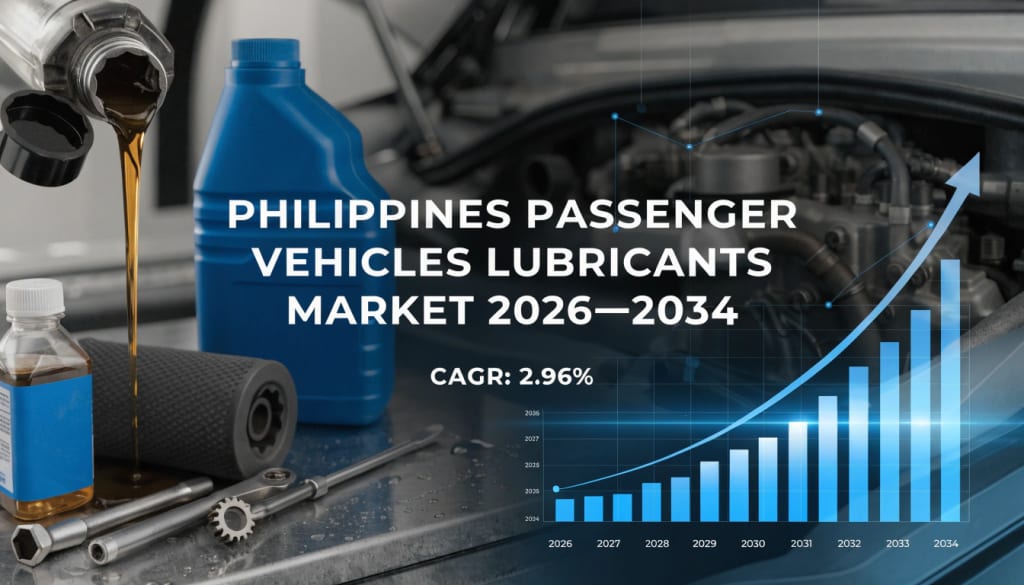
Philippines Passenger Vehicles Lubricants Market Overview
The Philippines passenger vehicles lubricants market is steadily expanding as vehicle ownership increases and consumers place greater emphasis on regular maintenance and engine efficiency. Passenger vehicle lubricants — including engine oils, transmission fluids, greases and hydraulic oils — play a critical role in reducing friction, enhancing fuel efficiency and extending vehicle lifespan. As the Philippines automotive sector grows and mobility demand rises, lubricant consumption continues to strengthen across private vehicle fleets nationwide.
Industry insights indicate the Philippines passenger vehicles lubricants market size reached 54.81 Million Litres in 2025 and is projected to reach 71.36 Million Litres by 2034, growing at a compound annual growth rate of 2.98% from 2026-2034, driven by rising passenger vehicle sales, improving awareness of maintenance practices and increasing environmental regulation supporting advanced lubricant technologies.
Key Market Drivers
Increasing Passenger Vehicle Ownership
Growth in passenger car sales across the Philippines continues to drive lubricant consumption, as vehicles require periodic oil changes and fluid replacement throughout operational lifecycles. Passenger vehicle sales growth in recent years has directly contributed to higher lubricant demand.
Growing Awareness of Preventive Vehicle Maintenance
Consumers increasingly recognise the importance of routine lubrication for maintaining engine performance, fuel efficiency and durability. Regular oil changes and adoption of high-quality lubricants are strengthening consumption patterns across vehicle owners.
Adoption of High-Performance and Synthetic Lubricants
Manufacturers are introducing synthetic and bio-based lubricants designed to improve thermal stability, reduce emissions and enhance engine protection. These product innovations are reshaping the market toward premium lubricant categories.
Automotive Industry Expansion and Mobility Growth
The Philippines automotive ecosystem continues to expand, with vehicle registrations rising and total motor vehicle numbers exceeding 13.8 million units, reinforcing long-term lubricant demand across passenger vehicle fleets.
Request a Sample Report with the Latest 2026 Data & Forecasts
What the Opportunities Are
The Philippines passenger vehicles lubricants market offers diverse opportunities as mobility expansion, sustainability priorities and product innovation converge.
Development of Eco-Friendly and Bio-Based Lubricants
Environmental awareness and emission reduction initiatives are encouraging lubricant producers to develop biodegradable and low-toxicity formulations, creating differentiation opportunities and supporting regulatory alignment.
Expansion of Automotive Service Networks
The growth of quick-service maintenance centres and dealership networks provides opportunities for lubricant suppliers to expand distribution and strengthen consumer access to premium products.
Electric Vehicle Lubrication Solutions
While EV adoption reduces traditional engine oil demand, new lubrication requirements for drivetrain components and thermal management systems create emerging product innovation opportunities.
Digital Maintenance Platforms and Consumer Education
Digital vehicle service reminders, maintenance apps and automotive marketplaces can support lubricant sales by improving consumer awareness and encouraging timely oil replacement behaviour.
Private Vehicle Fleet Growth in Urban Areas
Urbanisation and income growth continue to drive passenger vehicle ownership in metropolitan regions, creating sustained consumption opportunities across lubricant categories.
These opportunity areas highlight the market’s transition toward technology-enabled, environmentally responsible and service-integrated lubricant ecosystems.
Recent News and Developments
February 2025: Saudi Aramco completed acquisition of a 25% stake in Unioil, supporting expansion of lubricant distribution and introduction of premium lubricant products within the Philippines market.
May 2025: Repsol acquired a 40% stake in Unioil Lubricants Inc., strengthening manufacturing and distribution capabilities for automotive lubricants across the country.
2025 Automotive Sales Data: Passenger vehicle demand remained strong with total Philippine vehicle sales reaching 492,558 units in 2025, reinforcing lubricant consumption growth tied to fleet expansion.
January 2026: Market outlook projections reaffirmed growth trajectory with passenger vehicle lubricant demand expected to expand at around 6.9% CAGR through the forecast period, supported by vehicle growth and premium lubricant adoption trends.
Why You Should Know About the Philippines Passenger Vehicles Lubricants Market?
The Philippines passenger vehicles lubricants market reflects the broader mobility evolution occurring across Southeast Asia, where rising vehicle ownership, improving consumer awareness and technological innovation are reshaping automotive maintenance ecosystems. Lubricants remain essential consumables supporting engine performance, vehicle longevity and fuel efficiency across private mobility fleets.
With steady growth projected over the next decade, supported by automotive expansion, premium lubricant innovation and service network development, the market offers attractive opportunities for lubricant producers, automotive service providers and investors.
As vehicle ownership continues to rise and sustainability considerations influence lubricant technology development, the Philippines passenger vehicles lubricants market is positioned for sustained growth while evolving toward more advanced, efficient and environmentally responsible automotive maintenance solutions.
About the Creator
Keep reading
More stories from Manisha Dixit and writers in Trader and other communities.
Philippines Oleochemicals Market 2026: Coconut-Based Advantage, Green Chemistry and Industrial Diversification
Philippines Oleochemicals Market Overview The Philippines oleochemicals market growth is evolving as a strategic segment within the country’s chemical and materials landscape, driven by strong agricultural feedstock availability and rising global demand for sustainable alternatives to petrochemicals. Oleochemicals — derived from natural oils and fats such as coconut and palm oil — are widely used in personal care, food processing, pharmaceuticals, detergents and biofuel production. As industries increasingly prioritise environmentally responsible formulations and renewable inputs, the Philippines is strengthening its position as a regional supplier of bio-based chemical intermediates.
By Manisha Dixita day ago in Trader
Easemytrip Share Price: What’s Fueling Its Rapid Growth in 2026
The easemytrip share price has been showing impressive growth recently, attracting attention from investors and market enthusiasts alike. Many are curious about the reasons behind this sudden increase and whether it signals a good opportunity to invest. In this article, we’ll explore the main factors influencing the easemytrip share price and provide key insights for investors.
By John.doe7985 days ago in Trader

Comments
There are no comments for this story
Be the first to respond and start the conversation.