
United States Artificial Intelligence in Pharmaceutical Market Size and Forecast 2026–2034
How AI Is Reshaping Drug Discovery, Manufacturing, and Precision Medicine Across the U.S.

United States Artificial Intelligence (AI) in Pharmaceutical Market Overview
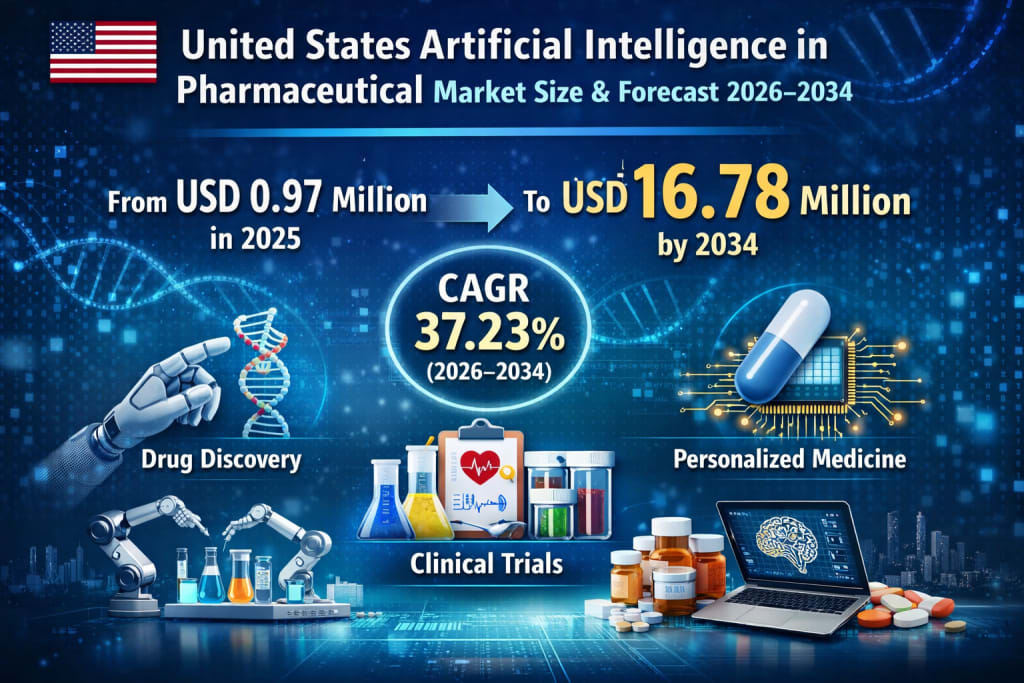
The United States Artificial Intelligence in Pharmaceutical Industry is entering a decisive growth phase, driven by the convergence of advanced computing, biological data expansion, and urgent demand for faster, cost-effective drug development. According to Renub Research, the market is projected to expand from USD 0.97 million in 2025 to USD 16.78 million by 2034, reflecting an impressive compound annual growth rate (CAGR) of 37.23% during 2026–2034.
This rapid acceleration is primarily fueled by rising adoption of AI across pharmaceutical research, clinical trial optimization, manufacturing automation, and personalized medicine. As pharmaceutical companies face mounting R&D costs and regulatory pressure to improve productivity, artificial intelligence has emerged as a strategic enabler across the entire drug value chain.
United States Artificial Intelligence in Pharmaceutical Industry Outlook
Artificial Intelligence in pharmaceuticals refers to the use of machine learning, deep learning, natural language processing, computer vision, and predictive analytics to enhance decision-making and operational efficiency. AI systems analyze massive biological, chemical, genomic, and clinical datasets to identify drug targets, predict molecular interactions, optimize trial designs, and personalize treatment regimens.
Beyond discovery, AI supports pharmacovigilance, regulatory documentation, supply chain optimization, and real-time manufacturing quality control. By minimizing trial-and-error approaches and reducing development timelines, AI significantly lowers costs while improving accuracy.
In the United States, AI adoption is reinforced by a strong biotech ecosystem, advanced healthcare infrastructure, and substantial investments in life sciences research. The availability of electronic health records, genome databases, and high-performance computing has accelerated AI deployment. Moreover, partnerships between AI developers and pharmaceutical majors continue to intensify, supported by an evolving regulatory environment that encourages responsible innovation.
Key Factors Driving Growth of the U.S. AI in Pharmaceutical Market
Rising R&D Costs and the Need for Faster Drug Development
Traditional drug development can take more than a decade and requires billions of dollars in investment. AI shortens this cycle by identifying promising drug targets, predicting molecular behavior, and prioritizing viable candidates early in the pipeline. Machine learning models extract insights from complex datasets that are often beyond human analytical capacity, sharply reducing failure rates.
In 2023, the world’s top pharmaceutical companies significantly increased R&D spending, underscoring the urgency to improve efficiency. AI has become essential for managing escalating research budgets while maintaining innovation momentum.
Expanding Healthcare Big Data and Advanced Computing Resources
The U.S. healthcare system generates enormous volumes of structured and unstructured data from genomics, imaging, clinical trials, and real-world evidence. This data richness provides ideal conditions for AI-driven analytics.
Advancements in GPUs, cloud computing, and high-bandwidth memory now allow AI models to process complex biological data at unprecedented speed. As a result, pharmaceutical companies are using AI to enhance biomarker discovery, optimize trial recruitment, and develop precision medicine strategies. Industry surveys indicate that nearly all large pharmaceutical firms have already invested—or plan to invest—in AI capabilities.
Digital Transformation and Automation Across Pharma Operations
U.S. pharmaceutical companies are accelerating digital transformation initiatives focused on automation and operational excellence. AI enables predictive maintenance, real-time quality monitoring, anomaly detection, and smart logistics across manufacturing facilities.
AI is also streamlining clinical trial workflows, regulatory documentation, and compliance management. Strategic collaborations between pharmaceutical firms and AI-driven biotech startups continue to demonstrate the commercial viability of AI-powered drug discovery and development.
Challenges Facing the U.S. AI in Pharmaceutical Industry
Data Privacy Regulations and System Integration Complexity
Strict data privacy regulations, including HIPAA compliance, pose challenges for AI implementation. Pharmaceutical firms must integrate data from diverse sources while maintaining regulatory compliance. Legacy IT systems, inconsistent data formats, and incomplete datasets complicate AI model training and deployment.
Balancing large-scale analytics with stringent privacy requirements remains a key hurdle in unlocking AI’s full potential across U.S. pharmaceutical operations.
Talent Shortage and High Implementation Costs
AI adoption requires specialized expertise in machine learning, data science, and computational biology—skills that remain scarce and highly competitive. Pharmaceutical firms often struggle to attract AI talent from the technology sector.
Additionally, AI implementation demands significant upfront investment in cloud infrastructure, data management platforms, and specialized hardware. For smaller biotech firms, these costs can delay or limit AI adoption despite strong interest.
USA Machine Learning in Pharmaceutical Market
Machine learning forms the foundation of AI transformation within U.S. pharmaceutical operations. ML models analyze vast datasets to uncover molecular patterns, identify drug candidates, optimize formulations, and improve preclinical screening.
Unlike traditional algorithms, machine learning systems continuously improve as more data becomes available. These adaptive capabilities support predictive modeling for trial outcomes, safety risks, and personalized therapies. As neural networks and reinforcement learning evolve, machine learning continues to unlock new therapeutic pathways and redefine scientific discovery in the U.S. pharmaceutical sector.
USA Artificial Intelligence in Pharmaceutical Software Platforms Market
AI software platforms serve as the backbone of digital modernization for U.S. pharmaceutical companies. These platforms integrate data pipelines, analytics engines, visualization tools, and machine learning workflows into unified ecosystems.
Cloud-based platforms offer scalability and flexibility, enabling companies to run compute-intensive workloads without investing in physical infrastructure. User-friendly dashboards allow researchers and quality teams to access AI insights without advanced technical expertise, accelerating discovery cycles and enhancing collaboration.
USA AI in Drug Discovery and Pre-Clinical Development Market
AI has fundamentally reshaped drug discovery in the United States by improving target identification, molecule screening, and toxicity prediction. Virtual simulations replace labor-intensive laboratory experimentation, reducing attrition rates and accelerating candidate selection.
In pre-clinical development, AI optimizes pharmacokinetics, safety assessments, and experimental design while minimizing reliance on animal testing. As personalized therapies and emerging disease research gain prominence, AI-driven discovery engines provide critical competitive advantages.
USA AI in Manufacturing and Quality Control Market
AI is transforming pharmaceutical manufacturing through real-time monitoring, automated batch analysis, and predictive maintenance. Machine learning algorithms analyze sensor data to optimize production conditions, reduce waste, and prevent batch failures.
AI-enabled inspection systems improve defect detection in packaging and labeling, while predictive analytics strengthen supply chain resilience. As U.S. manufacturers embrace Industry 4.0 principles, AI becomes central to operational efficiency and regulatory compliance.
USA AI in Laboratory Automation Market
AI-powered laboratory automation enhances research productivity by reducing manual labor and human error. Smart robotics and automated workstations support high-throughput screening, genomics research, and assay development.
AI also improves experimental reproducibility by standardizing conditions and protocols. With rising demand for rapid R&D cycles, AI-enabled labs provide the scalability and precision required for modern pharmaceutical research.
USA Artificial Intelligence in Pharmaceutical Cloud-Based Market
Cloud-based AI solutions are expanding rapidly due to scalability, cost efficiency, and ease of deployment. These platforms support large-scale analytics, collaborative research, and secure data environments without on-premise infrastructure.
Cloud-native AI enables rapid experimentation, real-world evidence integration, and faster decision-making. As pharmaceutical companies adopt hybrid and multi-cloud strategies, cloud-based AI becomes a core pillar of digital transformation.
State-Wise Market Insights
California
California leads AI adoption in pharmaceuticals due to its strong biotech ecosystem, Silicon Valley tech expertise, and robust venture capital presence. The state’s innovation culture accelerates AI-driven drug discovery and precision medicine.
New York
New York benefits from world-class healthcare institutions and dense clinical data availability. AI is widely used for clinical research, trial optimization, and real-world evidence analysis.
Washington
Washington’s advanced cloud infrastructure and life sciences ecosystem support AI adoption in computational biology, laboratory robotics, and therapeutic research, positioning the state as a growing contributor to national market expansion.
Competitive Landscape and Company Analysis
The U.S. AI in pharmaceutical market is highly competitive, with global technology firms and specialized biotech innovators shaping industry evolution. Key players include Alphabet Inc. (Isomorphic Labs), Exscientia PLC, Recursion Pharmaceuticals, Insilico Medicine, BenevolentAI, Atomwise Inc., XtalPi Inc., Deep Genomics, Cloud Pharmaceuticals Inc., and Cyclica Inc..
Each company is evaluated across five viewpoints: overview, key leadership, recent developments, SWOT analysis, and revenue insights.
Final Thoughts
The United States Artificial Intelligence in Pharmaceutical Market is poised for extraordinary growth through 2034. As R&D pressures intensify and data availability expands, AI will continue to redefine how medicines are discovered, developed, and manufactured.
With strong investment momentum, advanced infrastructure, and a collaborative innovation ecosystem, the U.S. remains at the forefront of pharmaceutical AI adoption. Companies that successfully integrate AI into their strategies will gain a decisive edge in efficiency, speed-to-market, and patient outcomes—marking AI as a cornerstone of the future pharmaceutical landscape.
About the Creator
Keep reading
More stories from shibansh kumar and writers in Trader and other communities.
Germany Silicon Carbide (SiC) Wafer Market Size & Forecast 2025–2034
Introduction The Germany Silicon Carbide (SiC) Wafer Market is entering a decisive growth phase as the country accelerates electrification, clean-energy deployment, and advanced semiconductor manufacturing. According to Renub Research, the market was valued at US$ 48.49 million in 2025 and is projected to grow at a compound annual growth rate (CAGR) of 12.41% between 2026 and 2034, reaching US$ 138.96 million by 2034.
By shibansh kumarabout 11 hours ago in Trader
IBM Share Price Hits New Heights: Secrets Investors Are Overlooking
The IBM share price has been making headlines as it climbs higher, catching the attention of investors everywhere. Many people focus only on short-term gains, but the real opportunities lie in understanding the trends behind the rise. This article explores the key factors affecting the IBM share price and reveals insights investors often miss. For related insights on growth opportunities, see: Best Tech Stocks to Buy in 2026.
By John.doe798about 7 hours ago in Trader
Philippines Robot as a Service Market: Automation Adoption, Service Models & Industrial Transformation
Philippines Robot as a Service Market Overview The Philippines Robot as a Service market share is gaining momentum as organizations search for practical ways to adopt automation without large upfront capital investment. Robot as a Service refers to a model in which robotic systems are delivered through subscription or usage-based agreements that include installation, maintenance, software updates and technical support. This approach allows businesses to convert what would traditionally be capital expenditure into predictable operating costs, making automation more accessible across different industry sizes. The Philippines robot as a service market size reached USD 72.5 Million in 2025. Looking forward, the market is expected to reach USD 244.1 Million by 2034, exhibiting a growth rate (CAGR) of 14.44% during 2026-2034. The strong outlook reflects increasing digital transformation, productivity pressures and growing acceptance of service-based technology models.
By Manisha Dixit6 days ago in Trader



Comments
There are no comments for this story
Be the first to respond and start the conversation.