

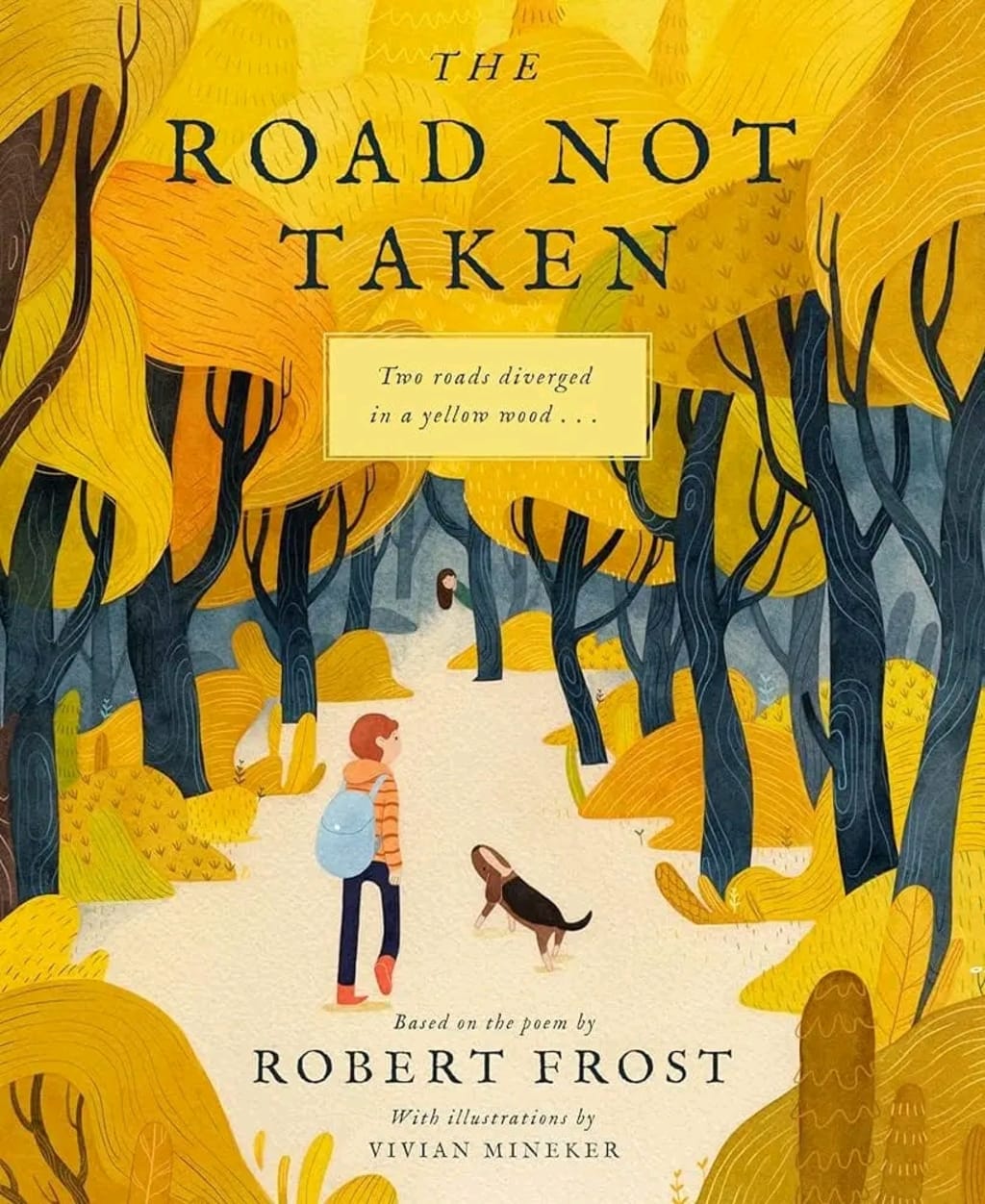
The Road Not Taken,
By Robert Frost
•Short Analysis•
The Road Not Taken” is one of Robert Frost’s most familiar and most popular poems. It is made up of four stanzas of five lines each, and each line has between eight and ten syllables in a roughly iambic rhythm; the lines in each stanza rhyme in an abaab pattern. The popularity of the poem is largely a result of the simplicity of its symbolism: The speaker must choose between diverging paths in a wood, and he sees that choice as a metaphor for choosing between different directions in life. Nevertheless, for such a seemingly simple poem, it has been subject to very different interpretations of how the speaker feels about his situation and how the reader is to view the speaker. In 1961, Frost himself commented that “The Road Not Taken” is “a tricky poem, very tricky.”
Frost wrote the poem in the first person, which raises the question of whether the speaker is the poet himself or a persona, a character created for the purposes of the poem. According to the Lawrance Thompson biography, Robert Frost: The Years of Triumph (1971), Frost would often introduce the poem in public readings by saying that the speaker was based on his Welsh friend Edward Thomas. In Frost’s words, Thomas was “a person who, whichever road he went, would be sorry he didn’t go the other.”
In the first stanza of the poem, the speaker, while walking on an autumn day in a forest where the leaves have changed to yellow, must choose between two paths that head in different directions. He regrets that he cannot follow both roads, but since that is not possible, he pauses for a long while to consider his choice. In the first stanza and the beginning of the second, one road seems preferable; however, by the beginning of the third stanza he has decided that the paths are roughly equivalent. Later in the third stanza, he tries to cheer himself up by reassuring himself that he will return someday and walk the other road.
At the end of the third stanza and in the fourth, however, the speaker resumes his initial tone of sorrow and regret. He realizes that he probably will never return to walk the alternate path, and in the fourth stanza he considers how the choice he must make now will look to him in the future. The speaker believes that when he looks back years later, he will see that he had actually chosen the “less traveled” road. He also thinks that he will later realize what a large difference this choice has made in his life. Two important details suggest that the speaker believes that he will later regret having followed his chosen road: One is the idea that he will “sigh” as he tells this story, and the other is that the poem is entitled “The Road Not Taken”—implying that he will never stop thinking about the other path he might have followed.
About the Creator
ReadShakurr
Start writing..Hey ,I'm shakurr, welcome and glad to have you here , I'm a professional writer ,poet ,and historian, I write love stories and scientist and philosophers history and inventions of the past .kindly hold your wine and enjoy
Reader insights
Nice work
Very well written. Keep up the good work!
Top insights
Expert insights and opinions
Arguments were carefully researched and presented
Eye opening
Niche topic & fresh perspectives
Compelling and original writing
Creative use of language & vocab
Heartfelt and relatable
The story invoked strong personal emotions
Easy to read and follow
Well-structured & engaging content
On-point and relevant
Writing reflected the title & theme
Masterful proofreading
Zero grammar & spelling mistakes
Excellent storytelling
Original narrative & well developed characters
Keep reading
More stories from ReadShakurr and writers in Wander and other communities.
Frankestein
"Frankenstein: The 1818 Text" by Mary Wollstonecraft Shelley is a classic novel that has left a lasting impact on literature and popular culture. Written when Mary Shelley was just 19 years old, the novel was published under high expectations due to her notable literary heritage, being the daughter of the political philosopher William Godwin and the writer, philosopher, and feminist Mary Wollstonecraft. The original 1818 text of "Frankenstein" preserves the politically-charged aspects of Shelley's original writing, as well as her unflinching wit and strong female voice. The novel is a haunting tale that delves into themes of creation, ambition, and the consequences of playing god.
By ReadShakurr2 years ago in Wander
Seattle Nightlife Report: Pony
Mid-winter Friday night. Early but already so dark. The days are getting longer but 6 PM is still pitch black. “Firepit!” You declare things after just a few seconds of solemn thought – not a request or suggestion, not a demand. Last week you walked around saying, “Hot tub?” to anyone who would listen. Or one afternoon you pointed at two men holding hands as they crossed 12th Avenue, looked me in the eyes and said, “Boyfriends.”
By Joe Nasta | Seattle foodie poet23 days ago in Wander
Super Bowl LX Recap: A Team Called Hawks
Sixty. The Super Bowl turned 60! Still amazes me that this was the sixtieth Super Bowl played in NFL history. It seems like yesterday that I watched Super Bowl XXVII, the first SB I ever watched. The QB who won Super Bowl XXVII has since called a few SBs, and will call next year's game, but that's another story. Super Bowl LX took place at Levi's Stadium in Santa Clara, California, the home stadium of the San Francisco 49ers. However, it was one of their division foes who represented the NFC, as the Seattle Seahawks faced off against the New England Patriots.
By Clyde E. Dawkins6 days ago in Unbalanced




Comments (13)
What do you like about the poem ReadShakkur? Or dislike? Would love to hear what it makes you think of!
the analysis emphasizes the poem's themes of regret and reflection, noting how the title itself hints at the lasting impact of unchosen possibilities...
Interesting!
That's all fine and everything, but what do *you*, personally, think about the poem? Does it make you feel anything? These are other people's responses to it, not yours.
Very tricky and difficult to grasp the writers intention
Amazing 👏 poem
Captivates with the title
Love the liamic rythm
Two roads diverged in a yellow wood
I'm quick to detect his trick ,and I know he's The poet but trying to exclude himself from the scene
One of the trickiest poem ever read pity the reader into a state of uncertainty
Good topic related to what discussed in the novel
Hey, just wanna let you know that this is more suitable to be posted in the Poets community 😊