
Common Challenges in AI Agent Development and How to Solve Them
Practical, real-world obstacles teams face when building AI agents and proven ways to overcome them at scale.
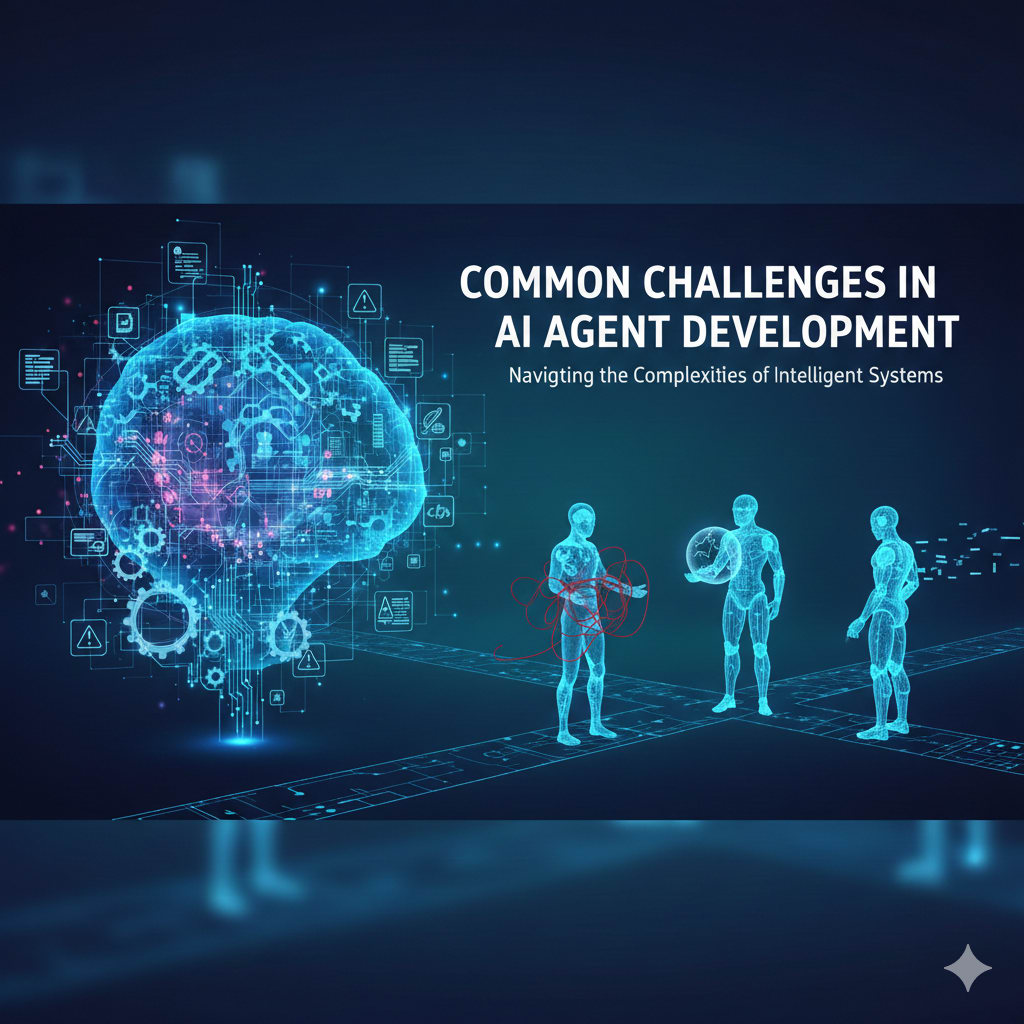
AI agents promise autonomy, speed, and decision-making at scale—but building them in the real world is rarely straightforward. Organizations investing in AI Agent Development services quickly realize that success depends on far more than model selection or prompt design. Teams often struggle not with the idea of AI agents, but with data reliability, system integration, governance, and long-term performance. This article breaks down the most common challenges in AI agent development and offers practical, experience-backed solutions that actually work in production environments.
1. Defining the Agent’s Scope and Autonomy
The Challenge
One of the earliest mistakes in AI agent development is unclear scope. Teams either:
- Overestimate what an agent should do (making it overly complex), or
- Underestimate autonomy (turning the agent into a glorified script)
Without clear boundaries, agents behave unpredictably, overlap with human roles, or fail to deliver measurable value.
How to Solve It
Start with single-goal agents before expanding to multi-agent systems
Clearly define:
- What decisions the agent can make
- When human intervention is required
- What data sources the agent is allowed to access
Use decision trees or policy frameworks early to formalize autonomy limits
Successful teams treat autonomy as something earned through performance—not assumed from day one.
2. Poor Data Quality and Context Awareness
The Challenge
AI agents are only as good as the data they observe. Common issues include:
- Incomplete or outdated datasets
- Conflicting data sources
- Lack of real-time context
This often leads to hallucinations, incorrect actions, or decisions that don’t align with business reality.
How to Solve It
- Implement data validation layers before agent reasoning begins
- Use retrieval-augmented generation (RAG) to ground decisions in verified sources
- Introduce context windows that limit what data the agent can reason over at any given time
- Continuously monitor data drift and retrain when necessary
Agents that operate on trusted, well-scoped data behave far more reliably in production.
3. Integrating AI Agents with Legacy Systems
The Challenge
Most enterprises don’t operate on modern, API-first infrastructure. AI agents often need to work with:
- Legacy ERPs
- On-premise databases
- Fragmented SaaS tools
Integration failures slow deployment and limit agent effectiveness.
How to Solve It
- Use middleware or orchestration layers to abstract legacy complexity
- Standardize communication through APIs, event queues, or message brokers
- Avoid direct coupling between agents and fragile systems
- Test integrations in sandbox environments before production rollout
The goal is to make the agent adaptable—even when underlying systems are not.
4. Lack of Explain ability and Trust
The Challenge
Business users often resist AI agents because they don’t understand:
- Why a decision was made
- What logic the agent followed
- Whether outcomes are compliant or ethical
Without transparency, adoption stalls.
How to Solve It
- Log agent reasoning steps and decision paths
- Provide human-readable explanations for actions taken
- Use confidence scoring to indicate certainty levels
- Align agent outputs with compliance and audit requirements
Trust grows when stakeholders can inspect—not just observe—agent behavior.
5. Agent Coordination in Multi-Agent Systems
The Challenge
As systems scale, organizations deploy multiple agents handling different tasks. Problems arise when:
- Agents duplicate work
- Decisions conflict
- Communication breaks down
This leads to inefficiency and unpredictable outcomes.
How to Solve It
- Assign clear roles and responsibilities to each agent
- Use centralized orchestration or supervisor agents
- Define communication protocols and escalation rules
- Regularly test coordination under real-world load scenarios
Well-designed multi-agent systems behave like teams—not silos.
6. Performance, Latency, and Cost Control
The Challenge
AI agents often rely on large models, frequent API calls, and continuous monitoring. Over time, this results in:
- High inference costs
- Slower response times
- Scalability bottlenecks
How to Solve It
- Use model tiering (lightweight models for simple tasks)
- Cache frequent decisions and responses
- Set execution limits and timeouts
- Monitor cost-per-action as a core KPI
Optimization isn’t optional—it's essential for sustainable AI agent deployments.
7. Security and Access Control Risks
The Challenge
AI agents often interact with sensitive systems and data. Without safeguards, they may:
- Access unauthorized information
- Execute unintended actions
- Become attack vectors themselves
How to Solve It
- Apply role-based access control (RBAC) to agents
- Limit permissions to the minimum required
- Encrypt data in transit and at rest
- Conduct regular security audits and red-team testing
AI agents should follow the same—if not stricter—security standards as human users.
8. Maintaining Long-Term Agent Performance
The Challenge
AI agents degrade over time due to:
- Changing business rules
- Data drift
- New edge cases
Without ongoing oversight, performance silently declines.
How to Solve It
- Implement continuous monitoring and feedback loops
- Schedule regular retraining and policy updates
- Track success metrics tied to business outcomes—not just accuracy
- Include humans-in-the-loop for high-impact decisions
AI agents are not “set and forget” systems—they are living software components.
Final Thoughts
AI agent development is less about model selection and more about system design, governance, and real-world constraints. Teams that succeed treat AI agents as collaborative digital workers—designed thoughtfully, monitored continuously, and improved over time.
By addressing these challenges early and applying practical solutions, organizations can move beyond experimentation and unlock the true operational value of AI agents.
About the Creator
Keep reading
More stories from Lilly Scott and writers in Writers and other communities.
How Top NLP Companies Are Transforming Enterprise Automation
Enterprise automation is evolving rapidly as organizations seek smarter ways to manage operations, reduce manual workloads, and improve efficiency. While traditional automation focused on rule-based systems, modern enterprises now rely on artificial intelligence to handle complex, language-driven tasks.
By Lilly Scott5 days ago in Writers
The Devil's Triangle
The sails ruffled in the breeze as we cruised along. The Sea Breeze was a mid-size catamaran that sailed out of Royal Naval Dockyard in Bermuda. We had booked this trip weeks in advance and were now looking at our Captain, Spike and two boat hands. Paddy and Wilson seemed like nice guys, joking around with the passengers and telling us some stories about Bermuda that only locals would know. Their island accents sounded almost British but they were pleasant to listen to.
By Barbara Gode Wilesabout 13 hours ago in Fiction



Comments
There are no comments for this story
Be the first to respond and start the conversation.