Lilly Scott
Stories (13)
Filter by community
How AI Reduces Claim Denials in Medical Billing and Coding
Claim denials continue to be a major source of revenue loss for healthcare providers. Manual billing processes, evolving payer rules, and inconsistent documentation often lead to avoidable errors. AI is changing this by helping billing teams detect risks earlier and submit cleaner claims.
By Lilly Scottabout 15 hours ago in Writers
Common Challenges in AI Agent Development and How to Solve Them
AI agents promise autonomy, speed, and decision-making at scale—but building them in the real world is rarely straightforward. Organizations investing in AI Agent Development services quickly realize that success depends on far more than model selection or prompt design. Teams often struggle not with the idea of AI agents, but with data reliability, system integration, governance, and long-term performance. This article breaks down the most common challenges in AI agent development and offers practical, experience-backed solutions that actually work in production environments.
By Lilly Scottabout 20 hours ago in Writers
How Top NLP Companies Are Transforming Enterprise Automation
Enterprise automation is evolving rapidly as organizations seek smarter ways to manage operations, reduce manual workloads, and improve efficiency. While traditional automation focused on rule-based systems, modern enterprises now rely on artificial intelligence to handle complex, language-driven tasks.
By Lilly Scott5 days ago in Writers
How to Choose Between Agentic AI and Generative AI for Your Business
AI adoption is accelerating but not all AI approaches solve the same problems. One of the most common questions leaders face today is how to choose between agentic AI vs generative AI. While both are powerful, they serve very different business objectives. Understanding those differences is critical to making the right investment.
By Lilly Scott6 days ago in Writers
Autonomous AI Agents for Medical Billing and Revenue Cycle Operations
Autonomous AI is redefining how healthcare organizations manage billing and revenue cycles. Instead of reacting to errors and denials, enterprises are adopting autonomous AI agents for RCM to proactively manage workflows, decisions, and outcomes across the entire revenue lifecycle.
By Lilly Scott6 days ago in Writers
Emerging Trends in Healthcare RAG Systems
Retrieval-Augmented Generation (RAG) is rapidly evolving in healthcare, driven by the need for accuracy, explainability, and regulatory compliance. Below are the key trends shaping how healthcare organizations are adopting and scaling RAG systems.
By Lilly Scott12 days ago in Writers
The Role of Agentic AI in Modern Medical Billing and RCM
Medical billing and revenue cycle management (RCM) have become increasingly complex due to evolving payer rules, regulatory pressure, and rising claim volumes. Traditional automation and manual workflows are no longer sufficient to keep pace. This is where agentic AI medical billing is emerging as a transformative force enabling healthcare organizations to automate, optimize, and continuously improve end-to-end RCM processes.
By Lilly Scott12 days ago in Writers
Barriers to NLP Adoption in Healthcare Organizations
Natural Language Processing (NLP) has the potential to unlock enormous value in healthcare from improving documentation quality to streamlining revenue cycle operations and strengthening data governance. Yet despite years of promise, NLP adoption across healthcare organizations remains uneven and slow.
By Lilly Scott15 days ago in Writers
How NLP Improves Accuracy in Medical Billing and Coding
Introduction: Why Medical Billing Accuracy Is Still a Problem Medical billing and coding errors remain one of the most persistent—and expensive problems in healthcare operations. Denials, delayed reimbursements, compliance audits, and revenue leakage often trace back to one root cause: language complexity in clinical documentation.
By Lilly Scott23 days ago in Writers
How AI Agent Development Companies Design Autonomous Workflows
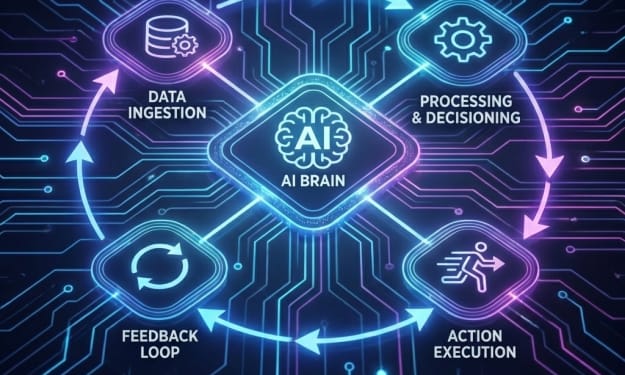
Autonomous workflows aren’t about replacing humans they’re about removing friction from decision-heavy processes. AI agent development companies focus on designing systems that can observe, decide, act, and improve with minimal human intervention.
By Lilly Scott26 days ago in Journal
How Agentic AI Is Transforming Healthcare Workflows
Agentic AI is shifting healthcare automation from isolated, task-based tools to systems that can autonomously plan, decide, and act across interconnected workflows. Instead of supporting a single function like documentation or scheduling, agentic AI coordinates patient intake, care coordination, clinical documentation, and follow-up activities using real-time context and predefined goals. This evolution mirrors broader industry trends where AI-driven healthcare workflows are being adopted to reduce administrative burden, improve care continuity, and enhance operational efficiency across healthcare organizations.
By Lilly Scott29 days ago in Journal
Audit Analytics in Healthcare Revenue Cycle Management
Revenue integrity leaders, RCM directors, compliance officers, healthcare CFOs, and audit managers responsible for protecting reimbursement, preventing payer recoupments, and maintaining regulatory compliance.
By Lilly Scottabout a month ago in Writers