
Types of Publishers
Writers need to worry about a wide variety of different publishers. Here are most of the kinds you need to know about.

There are a lot of different kinds of publishers out there. As such, it may be worth looking the different options available, especially as there is a lot of misinformation out there based on a misinterpretation of how some of these work, usually based on a quick read of the business model. Hopefully, this should help clear that up.
It also needs to be noted that the book market is in a serious flux right now. The reasons are pretty simple:
- It has never been easier to self-publish; an ambitious writer can publish his book on a print-on-demand service and with an aggressive marketing campaign make a successful book.
- Traditional publishing houses are still unsure of how to treat ebooks, blogs, and serials (such as Amazon's Vella).
- Some genres are being taken more seriously and as such publishers are trying to figure out how to allow for them. For example, comics used to be virtually ignored but with the success of television shows and movies based on comics a lot of publishers are debating that stance.
- The advent of the author as influencer really threw things into chaos.
Between all of these, publishers have been playing catch up, and that gives authors unprecedented opportunity: An ambitious author with a powerful marketing plan has more agency than they used to, especially if they have managed to accrue any sort of fan following. With publishers wanting to take advantage of that but not knowing how, authors who are proven successes can write their own tickets.
Assuming that they want to play with traditional publishers, of course.
While few of these require an agent, you may want to debate obtaining the services of one anyway. They're generally better at negotiating than you are, have better industry contacts than you do, and can deal with the querying issue while you write. Also, given the number of properties that make the leap from page to screen currently, having someone who can find and negotiate with showrunners interested translating your book to another medium is not a bad idea.
Also, one real quick mythbuster: A lot of people believe that you shouldn't pay to publish. These people are morons. The only times you don't pay is if you go through a traditional publisher or a print-on-demand sites, and even on those sites you need to pay for editing and other services. Whether or not you pay for the printing of the books depends on the method, but if you are honestly expecting to not pay for anything in order to get published, you need to actually do your research rather than relying on the bad advice of those on the internet, some of whom know even less about publishing than you do.
Traditional Publishing
This is the one everyone is mostly familiar with: You enter into a contract with a publishing house, and the publisher takes care of everything (editing, layout, cover, printing, and a chunk of the marketing), gives the author an advance, and gives the author a small royalty per book sold. The author still has to help market the book, but is otherwise exchanging control over the book for a potentially greater payout.
Traditional publishing houses are divided into the traditional publishers and the small presses. For our purposes, the only major differences are the size of the payout and whether or not you need an agent to solicit them: The traditional publishers require an agent (they don't normally accept unsolicited manuscripts) have a potentially greater payout while small presses may not promise such a large payout but don't require an agent and may give you a little more control over your book.
Self-Publishing
This is the other end of the spectrum: The good news is that you're in total control of your book. The bad news is that you're in total control of your book. You need to make sure that the book gets edited, laid out, the book cover is designed, etc., and this puts all of the responsibility for marketing the book at your feet. On the other hand, it also means that you get all of the profits. Your only real question is how you will print and distribute the books; most self-publishers either use a print-on-demand service or run a crowdfunding campaign to pay for printing.
Hybrid Publishing
Obviously, there is going to be something in between the two, and that's hybrid publishing. Hybrid publishing offers all of the services that a self-publisher needs, usually at a discount, and distribution is included in that. However, in exchange you only get a royalty rather than a full profit; that royalty is usually double what a traditional publishing house will offer. While this is still a pricey substitute, it also gives you full control over your book while giving you a better return than going at it by yourself.
Offset Printing
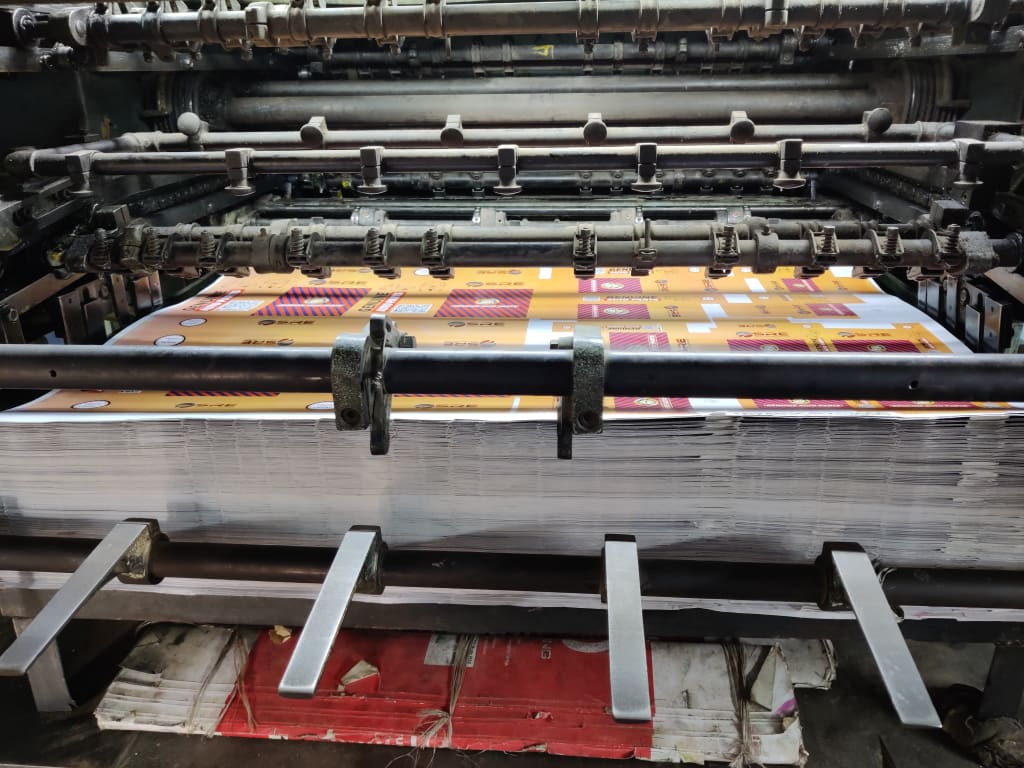
While by no means a publisher, this needs to be noted, especially for those that use crowdfunding to finance their printing. When you are determining how much you need to raise, your first stop should be to ask a printing company how much your run will cost to print so you can include that price in your goal; this price will include a one-time set-up cost followed by the cost of the books you want printed. As long as you don't make any changes in your book, you don't need to pay the set-up cost ever again. Also, keep in mind that the more copies you intend to print, the price per unit decreases as well.
The reason for the set-up price is that the offset press needs to create a version of your book on plates; if you're printing only black that's the only one that needs to be printed, but if you have color then you also need plates for cyan, magenta, and yellow. Once these plates are created, the book can be printed. It is heavily advised that you make sure that you get a test copy and sign off on it; once the printing starts in earnest, any printing errors are on you. So pay attention to the test copy and make sure you bring any errors to the printer's attention ASAP, and you should be okay.
Vanity Publishers
This is a category of publishers that causes a lot of tooth-gnashing, usually by people who have no idea how a vanity publisher actually works. Books printed by a vanity were not initially intended for sale, but to act as a souvenir; the books were for things that you wanted memorialized, such as your thesis, a recipe book for a family reunion, or even a memory book for a shower. However, a number of authors used the press for printing books just to prove that they had written a book; it is from these people that the presses got their name.
The key here is that most people should avoid them like the plague; they offer the usual services, but these are usually marked up. Well, except for distribution; that's up to you. Also, that marked-up price includes printing as well; however, keep in mind that you are paying for a premium product. It is of course worth noting that you may want to take advantage of a vanity press for a really cool version of your book, such as a 10th Anniversary Edition or something really nice for some of your fans, either as a contest giveaway or an extremely limited edition.
Subsidy Publishing
Here's where things start getting fun. Some vanity presses as well as traditional publishers offer what is called "subsidy publishing": In essence, you still pay for printing and other services, but the publisher gives you access to their imprint, helps with distribution and marketing, and pays for a solid chunk of the process. The key here is that while they are willing to help you out, they see your book as a major risk and so want to protect themselves from that risk as much as possible. They don't expect to sell many copies of your book and honestly expect to recycle most of your run.
It should be noted that these are usually confused with vanity presses (although it makes sense as a lot of vanity presses also act as subsidy publishers), and are partly responsible for the "don't pay to get published" concept. A subsidy publisher should be your absolute last resort; only if you have tried every other possible avenue should you resort to one of these. They are high-cost/low-reward, and you are expected to fail. Avoid if at all possible.
Academic Publishing
These are included solely for the sake of completeness. Academic publishers should not even be on your list: They are debatable at best. The concept here is that they charge an exorbitant fee for you to publish a book through them and the product is usually debatable. These are okay if you are trying to publish your thesis and maybe want some copies for friends, family, and select others, but should otherwise be avoided. Period.
Book Packagers/Developers
Also included for completeness, book packagers are the reverse of regular authors in a lot of ways. A regular author will write a book and then try to get it published; a book packager is assigned the book by a publishers. They will then get the book written, and then apply all of the usual services to it, with all of this done in-house. They fulfill the needs of the larger publishers and small presses when they need books of a specific genre, usually non-fiction. As such, while they are published, this is simply not a route available to most authors.
Mass Market Publishers
As you can tell, these guys are a step above scammers. These are the guys that produce those books you see in the chains stores that you tend to laugh at but never seem to end up in your grocery cart. These are generally the junk food of the literary world. For our purposes, however, they make subsidy publishing look great; they only publish books for which they own the copyright, either completely or partially. As such, seriously debate even working for them.
Obvious Scammers
And here's the worst for last: This group is the one that gives everyone else a bad name, and are the ones primarily responsible for the "don't pay to get published" adage. In general, they will ask for a ridiculous sum of money, in exchange for which you get…nothing. You may get a copy of your book, but you will never see a dime of any money that your book may make. Worse, if you agree to their terms you lose your copyright. As such, they should not be dealt with if at all possible.
* * * * *
With this information, you should be able to determine which sort of publisher is best for you and be able to work out which is best for your purposes. As noted above, the market seems to be in a weird flux right now, and you need to figure out how to use that flux to create your best possible future. That's sort of what makes this a weird market: As long as you have a quality product and a solid marketing plan, you can do a lot of good for yourself; it's just a matter of figuring out a path that works for you. So start figuring it out; you are the one that determines your future so it's up to you and no one else.
About the Creator
Jamais Jochim
I'm the guy who knows every last fact about Spider-man and if I don't I'll track it down. I love bad movies, enjoy table-top gaming, and probably would drive you crazy if you weren't ready for it.
Keep reading
More stories from Jamais Jochim and writers in Writers and other communities.
Successful Collaboration
Sometimes you need to collaborate with someone else in order to make a comic. The reality is that, despite our personal desires, we're not the Renaissance artists that we would like to be; while some of us can write and draw, it's sadly more likely that you're going to be good at drawing or writing, but not both. While learning the skill you're missing is always a possibility, it's probably a better idea to look into some form of collaboration.
By Jamais Jochimabout a year ago in Writers
Should We Not Try to Get Too Political?
Here's something you often hear people say, "I try not to get too political." I understand the sentiment and I sympathize with it... while at the same exact time, I completely disagree with the notion. Whether it's referring to social media or wherever, it's kind of unavoidable. You can attempt to sidestep it, not engage, leave the less important things for actual politicians to discuss... you can want it to not take over your life, your conversations, your relationships, and that makes perfect sense.
By Stephen Kramer Avitabile3 days ago in Writers
How Business Management Software Improves Organizational Efficiency
In many organizations, inefficiency does not come from a lack of effort but from fragmented systems, manual processes, and unclear workflows. Teams spend valuable time switching between tools, searching for information, and fixing avoidable errors. As businesses grow, these small inefficiencies accumulate, slowing operations and limiting productivity. Improving organizational efficiency requires more than hiring additional staff, it requires smarter systems that streamline processes and improve visibility across departments.
By jimmie Lotte5 days ago in Writers



Comments
There are no comments for this story
Be the first to respond and start the conversation.