Badhan Sen
Bio
Myself Badhan, I am a professional writer.I like to share some stories with my friends.
Stories (2116)
Filter by community
The origins of written language.
Writing transformed communication, administration, and culture, enabling civilizations to record knowledge, pass down traditions, and govern societies more efficiently. The origins of written language can be traced back to the early need for recording economic transactions and organizing increasingly complex societies. This article explores the evolution of writing from its earliest forms to fully developed writing systems.
By Badhan Senabout a year ago in Fiction
The function of the immune system.
The immune system plays a critical role in maintaining health by identifying and neutralizing threats while distinguishing between the body's own cells and foreign substances. The immune system operates through two primary defense mechanisms: innate immunity and adaptive immunity.
By Badhan Senabout a year ago in Lifehack
How submarines Navigate underwater.
Surface vessels, they cannot rely on landmarks, celestial navigation, or GPS (which has limited underwater functionality). Instead, submarines utilize a combination of advanced technologies, sensors, and manual techniques to determine their position and safely navigate through the depths. This article explores the key navigation methods used by submarines, including inertial navigation systems (INS), sonar, dead reckoning, and communication with external sources.
By Badhan Senabout a year ago in Earth
The process of cloning.
The technique of Cloning has been widely studied in genetics, biotechnology, and medical research, offering potential benefits in medicine, agriculture, and conservation. The most famous example of cloning is Dolly the sheep, the first successfully cloned mammal from an adult somatic cell. The process of cloning can be categorized into three main types: gene cloning, reproductive cloning, and therapeutic cloning.
By Badhan Senabout a year ago in Humans
The function of the immune system.
The immune system plays a critical role in maintaining health by identifying and neutralizing threats while distinguishing between the body's own cells and foreign substances. The immune system operates through two primary defense mechanisms: innate immunity and adaptive immunity.
By Badhan Senabout a year ago in Filthy
The history of the telephone.
From telephone is conceptual beginnings in the 19th century to the advanced smartphones of today, the telephone has undergone significant changes, each bringing new possibilities for personal and business interactions. This essay explores the invention, development, and impact of the telephone from its early days to the present.
By Badhan Senabout a year ago in Earth
How submarines Navigate underwater.
Surface vessels, they cannot rely on landmarks, celestial navigation, or GPS (which has limited underwater functionality). Instead, submarines utilize a combination of advanced technologies, sensors, and manual techniques to determine their position and safely navigate through the depths. This article explores the key navigation methods used by submarines, including inertial navigation systems (INS), sonar, dead reckoning, and communication with external sources.
By Badhan Senabout a year ago in Earth
The role of enzymes in digestion.
The process of digestion is essential for the body to obtain nutrients and energy required for survival. Enzymes, which are biological catalysts, play a crucial role in digestion by speeding up the breakdown of macromolecules such as carbohydrates, proteins, and lipids into their respective monomers. Without enzymes, digestion would be an extremely slow and inefficient process, making it difficult for the body to obtain necessary nutrients. This essay explores the role of different enzymes in digestion, their functions, and how they facilitate the breakdown and absorption of nutrients.
By Badhan Senabout a year ago in Lifehack
The history of the pyramids.
The pyramids of Egypt structures, built thousands of years ago, continue to capture the imagination of historians, archaeologists, and tourists alike. The history of the pyramids is a story of architectural innovation, religious beliefs, and the powerful rulers who commissioned them. From the early step pyramids to the magnificent Great Pyramid of Giza, the evolution of pyramid construction reflects the ingenuity and ambition of the ancient Egyptians.
By Badhan Senabout a year ago in Earth
How deserts are formed.
Deserts are characterized by arid conditions, scarce rainfall, and unique flora and fauna that have adapted to harsh environments. But how do deserts form? The formation of deserts is influenced by a variety of factors, including climate patterns, geographical location, wind currents, and human activities. Understanding these factors helps explain why deserts exist in different parts of the world and how they continue to evolve over time.
By Badhan Senabout a year ago in Earth
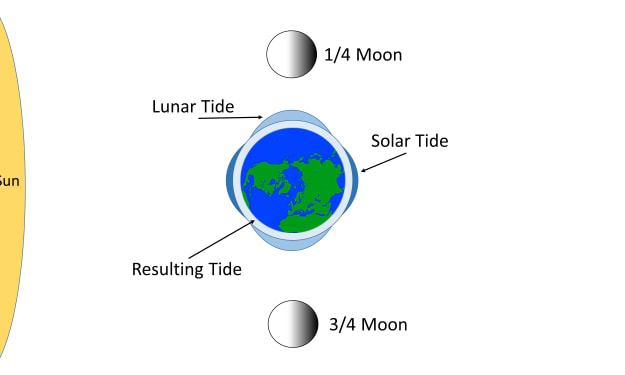
The science behind tides.
Tides periodic rises and falls of ocean water affect coastal regions worldwide, influencing marine life, navigation, and even human activities. Understanding tides requires delving into concepts of gravitational forces, celestial mechanics, and fluid dynamics.
By Badhan Senabout a year ago in Earth