Say the truth
Bio
"Say the Truth: Explain Everything in the World" is your trusted source for uncovering facts and exploring the wonders of history, science, technology, and beyond. We simplify complex ideas and reveal truths to inspire curiosity .
Stories (691)
Filter by community
The Lost Wealth of Cleopatra
The Lost Wealth of Cleopatra Egypt’s Missing Royal Treasure Mystery Cleopatra VII ruled as the last true leader of Egypt’s Ptolemaic Kingdom. People recall her as a strong queen, sharp leader, and icon of old riches. Her time ended Egypt’s freedom before Rome took over. Tales of her looks and loves with Julius Caesar and Mark Antony get much attention. Yet her huge lost treasure grabs historians, diggers, and hunters even today.
By Say the truth 2 months ago in History
Alexander the Great: Power, Glory, and Mystery
Mysteries of Alexander the Great Questions Still Unanswered About History's Most Puzzling Conqueror Alexander the Great ranks as one of history's top military leaders. At age 30, he built a huge empire from Greece to India. His fame hides deep puzzles. Parts of his life, deeds, and death still baffle experts today. This piece looks at his top mysteries. It sorts myth from fact and notes open questions.
By Say the truth 2 months ago in History
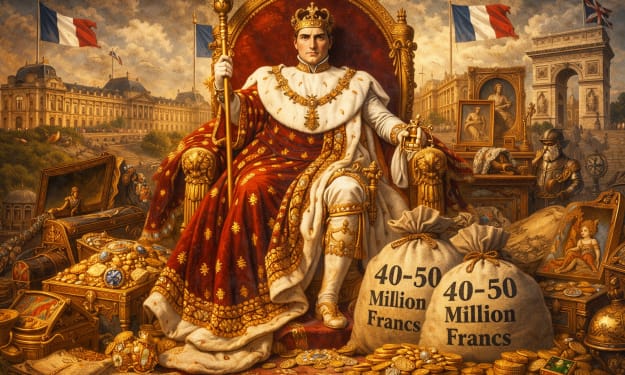
Napoleon Bonaparte's Net Worth: How Power, Conquest, and Control Built Immense Wealth
Early Life and Financial Background Born in 1769 on Corsica to a minor noble family, Napoleon’s family was comfortable but not wealthy. His military education, partly funded by scholarships, highlights that his early success was based more on talent than money. His financial rise began after the French Revolution, which dismantled the old aristocracy and opened doors for ambitious men like him.
By Say the truth 2 months ago in History
The Net Worth of Indian Wealth Looted by the British Empire
India’s Economic Strength Before British Rule Before the British East India Company gained control, India was an economic powerhouse. According to historical studies, India accounted for about 23–25% of the world’s GDP in the early 1700s. Indian textiles, spices, steel (such as Wootz steel), and agricultural goods were exported worldwide.
By Say the truth 2 months ago in History
The Overlooked Treasures of the Khmer Empire: Cambodia's Concealed Wealth
The Overlooked Treasures of the Khmer Empire: Cambodia's Concealed Wealth When discussing the world's most affluent ancient empires, names such as Rome, Persia, and Mali often take precedence. However, nestled deep within the jungles of Southeast Asia lies an unrecognized giant—the Khmer Empire, whose lavishness once matched the greatest empires globally. Spanning across present-day Cambodia, Thailand, Laos, and Vietnam, the Khmer Empire thrived between the 9th and 15th centuries, leaving behind treasures—both material and spiritual—that astonish contemporary observers.
By Say the truth 9 months ago in History
The Treasure Beneath the Nile: Egypt's Lost Gold Mines and Ancient Wealth. AI-Generated.
The Golden Legacy of the Nile The Nile River is justifiably regarded as the lifeblood of Ancient Egypt. Spanning over 6,600 kilometers, it not only facilitated agriculture in the arid desert but also functioned as a trade artery and spiritual thoroughfare. However, what rests beneath the deserts encircling the Nile has intrigued archaeologists and historians for centuries—gold.
By Say the truth 9 months ago in History
The Concealed Wealth of the Inca Empire: Forgotten Treasures of the Andes. AI-Generated.
The Concealed Wealth of the Inca Empire: Forgotten Treasures of the Andes Situated high in the Andes Mountains, the Inca Empire (1438–1533) was the most extensive pre-Columbian empire in the Americas. At its zenith, it spanned across Peru, Bolivia, Ecuador, and portions of Chile and Argentina, governing over more than 10 million individuals. However, beyond its expansive territory and sophisticated infrastructure, what astonished Spanish conquistadors most was the empire’s unfathomable wealth—particularly its vast reserves of gold and silver.
By Say the truth 9 months ago in History
The Wealthiest Empire in History: The Golden Heritage of the Mali Empire
The Foundations of the Mali Empire The Mali Empire was established circa 1235 AD by Sundiata Keita, who unified several smaller kingdoms following the decline of the Ghana Empire. Under Sundiata’s guidance, Mali evolved into a centralized entity with a formidable military and effective administration. Nonetheless, it was under his successors—most notably Mansa Musa (r. 1312–1337)—that the empire attained its pinnacle.
By Say the truth 9 months ago in History
Beneath the Golden Tides: Revealing the Concealed Mineral Wealth of China's Yellow River. AI-Generated.
A River Shaping Through Epochs and Stone The Yellow River traverses a multitude of landscapes: towering mountains, fertile plains, loess plateaus, and desert basins. This journey has enabled it to carve into rock strata rich in minerals, revealing deposits that ancient civilizations soon learned to utilize. As early as the Shang Dynasty (c. 1600–1046 BCE), bronze metallurgy thrived along the river, with copper, tin, and lead extracted locally and crafted into weapons, ceremonial items, and tools.
By Say the truth 9 months ago in History
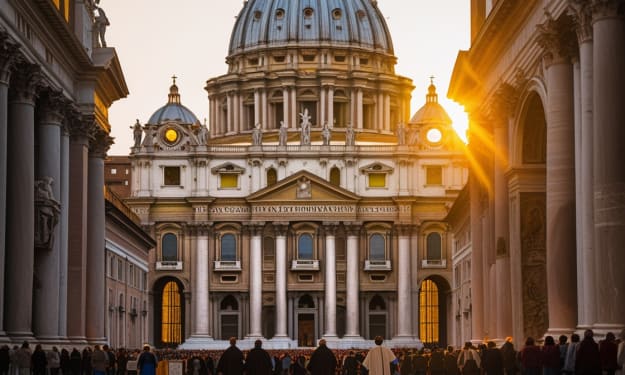
The Wealthiest Cathedral in Christianity: A Chronicle of St. Peter’s Basilica. Content Warning. AI-Generated.
The Origins: A Tomb Transformed into a Basilica The narrative commences in the 1st century CE. According to Christian doctrine, St. Peter, one of Jesus Christ's twelve disciples and viewed as the first Pope, was martyred in Rome during Emperor Nero's rule. He was crucified upside-down and interred in a burial site on Vatican Hill. Over his resting place, Emperor Constantine, the first Roman emperor to embrace Christianity, commissioned a basilica circa 319 CE.
By Say the truth 9 months ago in History
The Golden Vein of China: History and Wealth of the Yellow River's Mineral Deposits
Historical Background The history of mining and mineral utilization in the Yellow River region can be traced back to ancient China, particularly during the Xia, Shang, and Zhou dynasties (2100–256 BCE). Early Chinese metallurgy predominantly relied on copper and tin for the creation of bronze tools, weapons, and ceremonial vessels. Archaeological discoveries from the Yellow River valley, especially within Henan and Shaanxi provinces, indicate that bronze mining and casting practices were highly developed as early as 1700 BCE.
By Say the truth 9 months ago in History
The Roaring Silence: Revealing the Greatest Enigma of the Yali
Origins and Early Representations: The earliest recorded illustrations of Yalis can be traced to the Pallava and Chola temples in Tamil Nadu, dating as early as the 7th century CE. These mystical beings embellish columns, gopurams (temple towers), and even thrones. In these representations, the Yali frequently appears mid-roar, with colossal claws, razor-sharp fangs, and a serpentine tail coiling around ancient stone.
By Say the truth 9 months ago in History