Science
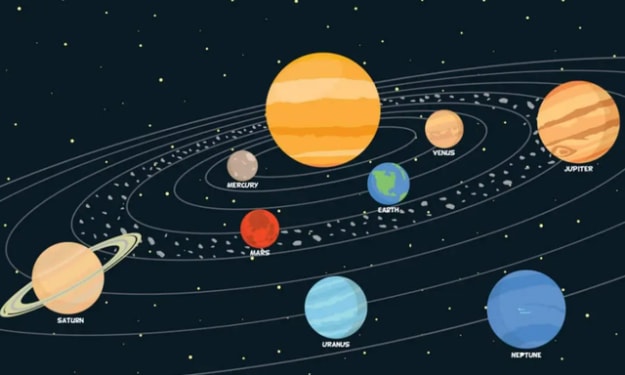
Why is Jupiter so big?
Jupiter and Saturn are the first and second largest planets in the solar system respectively, with Jupiter's average diameter being about 139,822 km and Saturn's average diameter being about 116,464 km. In terms of volume, Jupiter is not much bigger than Saturn, but in terms of mass, Saturn is far less than Jupiter, as Saturn's mass is about 5.6834 x 10^26 kg, while Jupiter's mass is about 1.8982 x 10^27 kg.
By Robert Jack3 years ago in Earth
Since the universe was born at a singularity
I believe we are all familiar with the "big bang theory of the universe", after all, this is the mainstream theory to explain the origin of the universe, we usually understand the theory that the universe was born in a very small, very dense, extremely high-temperature singularity, about 13.8 billion years ago, this singularity exploded, and then gradually evolved into what we now The universe as we see it now. But the question is, since the universe was born in a singularity, what is outside the singularity?
By Robert Jack3 years ago in Earth
"Antarctic Wall" discovered
Three million years ago, mankind was born on earth, with continuous historical evolution, human civilization also has a few thousand years of history. In between these thousands of years, the period of rapid development of human science is these few centuries.
By Karen Gillanah3 years ago in Earth
The sun is quietly changing
The sun is the source of everything on earth, it is because of the sun's light and heat, the earth can become a vibrant planet, however, the sun is not an eternal existence, with the evolution of the sun, one day, the earth will become no longer suitable for human survival, then the sun left human time how long it?
By Robert Jack3 years ago in Earth
Advanced civilization of 1 billion years level
The scientific community generally believes that the universe was born about 13.8 billion years ago, and according to scientists' estimates, rocky planets were already prevalent in the universe about 10 billion years ago. As we all know, the Earth is a rocky planet, but the Earth is lucky to have a series of natural conditions favorable to life, because of this, life on the Earth can live and eventually evolve into human civilization.
By Robert Jack3 years ago in Earth
Two million years of rainy season
The Earth's crust not only provides us with solid ground to stand on but also preserves various traces of the Earth's past. By studying the strata formed in ancient times, we can learn from them what the Earth's natural environment was like in the distant past.
By Robert Jack3 years ago in Earth
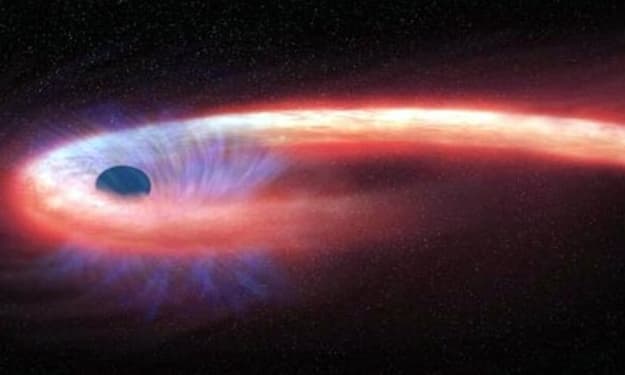
A planet swallowed by a black hole
The gravitational force of black holes is so strong that they can swallow any matter known in the universe, even if the size of the planet, as long as the black hole into the "sphere of influence", the same can not escape the fate of being swallowed, so the planet swallowed by the black hole, where did they end up? Let's talk about this topic.
By Robert Jack3 years ago in Earth
A hundred times higher than Everest
For the basic structure of the Earth, although we do not know as detailed as professional researchers, in general, there is still a general system, but the development of science is such that at any time there will be discoveries that can overturn our perceptions.
By Karen Gillanah3 years ago in Earth