Latest Stories
Most recently published stories in Fiction.
THE SEA RAIDERS
Until the strange events at Sidmouth, the deep-sea creature known as Haploteuthis ferox was barely understood by science. Only fragments—tentacles found near the Azores and a decaying body discovered off Land’s End—hinted at its existence. Like most deep-sea cephalopods, it lived beyond the reach of nets and observation, known only through rare accidents. Zoologists could not explain how or why such creatures ever reached shallow waters.
By Faisal Khan3 days ago in Fiction
Love letters
It started as something innocent, but it progressed over time. Always beautiful and sweet, though. It became part of my daily routine – every morning I’d check my mailbox, and there it would be: a love letter. The person who sent them remained nameless and seemed to deliver the letters themselves. The envelopes were blank. No stamp. No information about the sender.
By Minou J. Linde3 days ago in Fiction
The City That Remembered Your Name
On a cold November evening, Elena boarded a train that did not appear on any timetable. She had spent the whole day wandering through the old central station of Valmere, a quiet European city tucked between mountains and sea. The station itself looked like a relic of another century—arched ceilings of stained glass, brass clocks ticking too loudly, and walls layered with the ghosts of old travel posters advertising destinations that no longer existed. Elena was not searching for adventure. She was running from it. Three weeks earlier, her brother Luca had vanished without explanation. No goodbye. No message. Just an abandoned apartment and a phone that rang into silence. The police had closed the case with careful words and tired eyes: People leave sometimes. But Elena knew Luca. He never left without telling her where he was going. That evening, while sitting on a wooden bench near Platform 9, she noticed a flicker of movement at the far end of the station. A train had arrived without sound. Its carriages were painted a deep, midnight blue, and its windows glowed faintly from within. Above it, a single sign blinked: Destination: NOMEVIA Elena had never heard of such a place. Neither had her phone. Before she could think, she stood up and walked toward the train. Something in her chest tightened, as if the air itself were calling her name. The doors slid open. Inside, the train was nearly empty. A single conductor stood near the entrance, dressed in an old-fashioned uniform with silver buttons and a hat tilted low over his eyes. “Ticket?” he asked. “I don’t have one,” Elena said. The conductor studied her face for a long moment, then reached into his pocket and handed her a thin paper slip. “You already paid,” he replied. “You just don’t remember when.” The doors closed. The train began to move. Subtitle 2: The City Without Maps Nomevia did not appear on any map. When the train stopped, Elena stepped into a city made of pale stone and soft light. Streets curved in impossible directions, and buildings seemed to lean inward, as if listening. The air smelled of rain and old books. People walked calmly through the streets, but something was strange about them. When Elena passed, they looked at her with recognition. “Welcome back,” a woman whispered. A child pointed at her. “That’s her.” Elena’s heart pounded. “Back from where?” She followed a narrow street into a wide square dominated by a clock tower. Its hands did not show time but names—thousands of names, engraved in gold, circling endlessly. At the base of the tower, someone stood waiting. “Luca,” Elena breathed. Her brother looked thinner, his hair longer, but his eyes were the same. Alive. Real. “You found it,” he said softly. “I hoped you would.” “Where are we?” she demanded. “Why did you disappear?” Luca glanced at the tower. “This is Nomevia. The city that remembers people the world forgets.” Elena stared at him. “That makes no sense.” “It does,” Luca said. “Think about it. Refugees with no papers. Artists whose work was burned. People erased by war, history, or fear. When no one speaks your name anymore, Nomevia does.” Elena felt cold. “And you?” “I wasn’t forgotten,” Luca said. “Not yet. But I was close.” Subtitle 3: The Price of Being Remembered They walked through streets lined with libraries instead of shops. Inside each building were shelves filled not with books, but with lives—photographs, letters, recordings of voices speaking in dozens of languages. “This is where names go when no one says them anymore,” Luca explained. Elena touched a dusty photograph of a young soldier. Beneath it was written: Marek Nowak, 1916–1939. Remembered by no one. Her chest tightened. “Why did you come here?” she asked. Luca hesitated. “I started hearing it in my dreams. The city. It called me. I thought… maybe I could help.” “Help how?” “By leaving the real world and staying here,” he said. “If I stay, someone else can return. Nomevia trades memory for presence.” Elena stopped walking. “You’re saying… you replace someone?” Luca nodded. “Someone who no longer has anyone left to remember them.” Elena’s voice trembled. “And if I take you back?” “Then someone else disappears into silence.” The tower chimed. A new name appeared on its face. ELENA MORO Her breath caught. “Why is my name there?” Luca’s face paled. “Because you found the city. It has noticed you.” Subtitle 4: The Choice The conductor appeared beside them, silent as a shadow. “Time is limited,” he said. “One of you must stay.” Elena felt her knees weaken. “That’s not a choice. That’s cruelty.” “Memory is never fair,” the conductor replied. “But it is necessary.” Elena looked at Luca. Her brother. The only family she had left. “You were going to give up your life for strangers,” she said. Luca smiled sadly. “Aren’t strangers just people waiting to be known?” Elena thought of the tower. The names. The forgotten faces. She made her decision. “I will stay,” she said. Luca grabbed her arm. “No.” “You brought me here,” she whispered. “So you could leave. I see it now. You wanted someone to remember you enough to replace you.” Luca’s eyes filled with tears. “I didn’t mean for it to be you.” “But it is,” Elena said. She turned to the conductor. “Take him home.” The conductor nodded. The city trembled. Light rose from the tower and wrapped around Luca. His voice echoed once: “I’ll remember you.” Then he was gone. Subtitle 5: The City That Knows Her Name Years passed in Nomevia. Elena became a keeper of names. She recorded stories, preserved memories, and whispered them into the tower at night so they would never vanish. Sometimes, trains arrived with new travelers. Some returned. Some stayed. And in the real world, Luca told people about a strange city that saved his life. He wrote about it. He spoke Elena’s name to anyone who would listen. Because of him, Elena’s name never disappeared from the tower. And because of her, thousands of forgotten lives were spoken again. In a city that remembered everyone, she learned the most powerful truth: As long as someone says your name, you are never truly lost.
By Iazaz hussain3 days ago in Fiction
Egg of the End
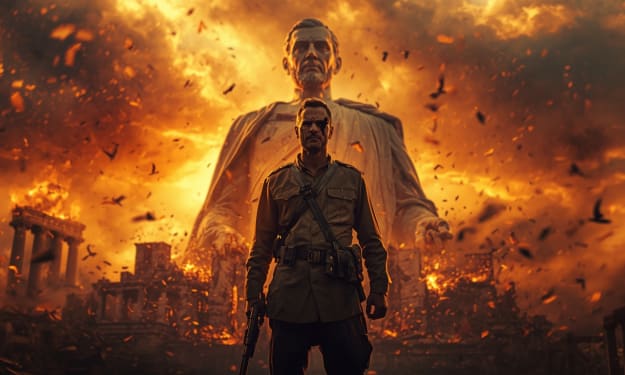
The excavation had been years in the making. Nestled deep within the sands of an isolated desert, the Temple of Aasha—the so-called “Womb of Eternity”—had long been a legend among archaeologists. Dr. Eleanor Voss and her team finally unearthed its secrets in the weeks leading up to Easter. At the heart of the temple lay the prize that would make history: an egg.
By V-Ink Stories3 days ago in Fiction
Candy Curse
Easter was always the busiest season for Mathias Grayson, the famed chocolatier of the quaint town of Willowridge. His confections were renowned—velvety truffles, delicate pralines, and his pièce de résistance: intricately molded chocolate Easter eggs filled with hidden surprises. People came from miles around to buy his creations, enchanted by their taste and beauty.
By V-Ink Stories3 days ago in Fiction
Sisyphean Variants
Only prime models persist. Composite ones are rewritten. 3. [Run Cycle: 8,492] Iterative model Three had approached the question of the box with a spirit of creativity. It was designed to utilize abductive leaps with deterministic physical simulation. Having placed the box on the pressure-sensitive square depression, trotted around the excavated, looping hallway, only to find no opened doorway to release it from its task, it determined some aspect was deficient in its approach. It first adapted by placing different faces of the box onto the square depression of the stone altar, but each face only resulted in another loop around the hallway to find the architecture unchanged and to be led back to the central chamber.
By Bryan Pike3 days ago in Fiction