tech
Curious tech and technology from the realm of science and science fiction.
When Saucers First Flew
Ray Palmer was the father of a sizable, and still-growing, chuck of Western pop culture. One of the first generation of science fiction editors (Amazing Stories), he discovered and first published writer Isaac Asimov and artist Virgil Finlay. Nonetheless, when it came to pulp, he liked it slapdash, slam-bang, and science-free.
By Jack Womack9 years ago in Futurism
History of the Space Shuttle Columbia
"That's one small step for man, one giant leap for mankind." Those were the memorable words spoken by astronaut Neil Armstrong. From Neil Armstrong's first steps on the Moon to the discovery of water on Mars, space exploration is no longer science fiction. It has been many decades since Space Shuttle Columbia took off for its fifth mission into space. On November 11, 1982, STS-5 successfully took off following the success of the first four test flights. It then executed a triumphant landing after spending five days, two hours, 14 minutes and 26 seconds in orbit.
By Futurism Staff9 years ago in Futurism
Why 3D Printing Will Change the World
1984, Orwell’s prophetic year of Big Brother, saw the release of the Mac which broke the idea that centralized control could ever be what it was before. That year also saw the first workable prototype for a 3D printer. Built by Charles Hull, the technology was then known as stereolithography. We know it as 3D printing, and that’s a term that covers a variety of different processes which may revolutionize all stages of the global manufacturing and distributing process. In that very science fictional year, Hull set off a revolution that is only now seeing fruition. 3D printing continues to threaten the social and economic structures which preceded it. When we speak about 3D printing, we’re speaking of a general technique of printing successive layers to form a three dimensional object at the end. From powder to paper to human tissue, these thin membranes are laid down like the construction of a plaster mask. From that simple concept, the 3D printer offers the reverse of Ford’s mass production revolution. Printing one item is now as cost effective in some cases as manufacturing a thousand items in the traditional way.
By Chris Lites9 years ago in Futurism
Black Mirror Series Consistently Challenges
“The black mirror is one you’ll find on every wall, on every desk, in the palm of every hand: the cold, shiny screen of a TV, a monitor, a smartphone,” says series creator Brooker, but unlike Jason Reitman’s what-the-Internet-is-doing-to-us flop movie “Men, Women, and Children,” the Black Mirror series challenges the intellect and eschews stark portrayals of teenagers texting and not making eye contact (oh, the poignancy!) and concocts futuristic-scenarios that are only slightly far-fetched, poised on the outer rim of the technology we already have.
By Glenn Kenny9 years ago in Futurism
Is Technology Making Us Dumb?
It won’t be long before computers can think faster and better than humans. Artificial Intelligence exists, and it is getting smarter at an incredible rate. As so many focus on how well machines can think, alarmingly few people are concentrating on how well humans are thinking (or rather, how they aren’t thinking as well as they used to). A side effect of epic proportions has accompanied our ventures into superior technology. We have become inseparable from our computers and, as time goes on, we are relying on them for more and more of our daily cognitive functions. The brain needs exercise. When you don't use it often enough, your abilities deteriorate. The resources at our disposal are enabling us to perform more advanced tasks faster than ever before, but when it comes to plain old thinking, is technology making us dumb? The answer is two sided. On one hand, our ability to locate information is exponentially higher. On the other, we are retaining far less than we ever have.
By Chelsea Pullano9 years ago in Futurism
Ex Machina's Robot Future
Media perpetuates visions of robotic futures and people are dreaming of silicon-based lovers. As technology advances, so too do humanity's most primal desires. Sex continues to be one of the final frontiers for humankind. Sexual exploration never stops. Exploration has led to evolution. Robots may not end the world through violence like in the Terminator films. The world may end between the sheets of people's homes, going out with a quiet, or loud bang, from Ex Machina's robot future.
By Izzy Erlich10 years ago in Futurism
Controlled Experiment
This fictional story has been repurposed from the November 1978 issue of OMNI Magazine. Standing alone on the podium, in the glare of the camera lights, the old man spoke wearily: "I have called this press conference to announce my resignation from the American Psionic Institute." The audience of scientists and reporters buzzed excitedly. "As cofounder of this organization, I am reluctant to leave it; but my continued presence here can only cast a cloud of doubt over honest men's work. For recently, in my zeal to demonstrate the existence of psychic phenomena, I committed the one unpardonable sin in science: I deliberately manipulated an experiment to yield the desired results.”
By Rick Conley10 years ago in Futurism
Can Technology Help Mankind's Moral Compass?
Guide, like most new technologies, began in a billionaire's dream of reason. The PR-generated story of Guide's origin posited it as a passion project of Metra's cofounder and longtime CEO. Its aim was simple, universal: help people act more rationally.
By Ken Baumann10 years ago in Futurism
3D Bioprinting is the Future of Transplants
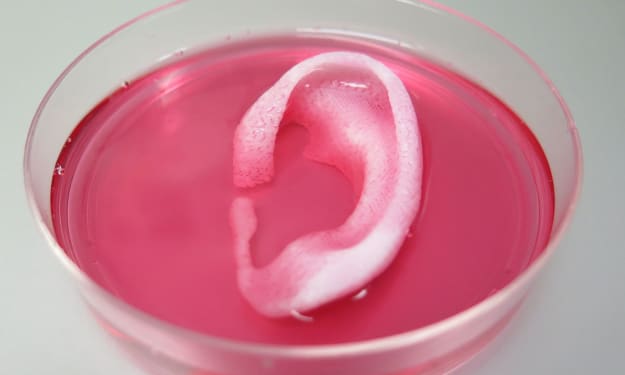
Imagine a world where there was no organ donor waiting list. A world where you would be able to get the organ you needed straight from a printer. According to Quartz, a Philadelphia-based company, BioBots, has released a printer that lets users 3D print human tissue and (potentially) human organs. In May of 2014, BioBots publicly launched at TechCrunch Disrupt in New York and printed a replica of Van Gogh’s ear for everyone to see. Currently, the printer works with a liquid mixture of different cells called “bio-ink.” This liquid is pressed through an extruder and fused together on the printer bed using blue light. A representative from the company told Quartz that the system could print out an object that has blood vessels and organ tissue at once, and the goal is to use this to create livers for drug testing and skins for cosmetic testing. This would eliminate the need for testing on humans and animals. However, BioBots isn’t the only company to create 3D printing for organs.
By Futurism Staff10 years ago in Futurism