tech
Curious tech and technology from the realm of science and science fiction.
Artificial Intelligence in Medicine
Studies in artificial intelligence started as a US defense project in the 1960s with the goal of understanding how humans process information. This concept would then be simulated and adapted within “logical systems.” Although development slowed a couple of decades later, innovations in technology have propelled advances in artificial intelligence in recent years. These advances are now making our lives easier and safer.
By Futurism Staff10 years ago in Futurism
Predictions from Sci-Fi Authors
Science fiction authors are modern-day prophets. Many of the predictions from the great writers like Isaac Asimov and Philip K. Dick came to fruition at the turn of the 21st century. Writer Michael Banks closely followed the growth of online web services and the evolution of the internet from the early 1980s onward. His perception on the predictive nature of science fiction can be proven through a study of the the great sci-fi author's ability to blur the lines between speculation and fact are often the catalyst for authentic advance in tech. His books, including Crosley: Two Brothers and a Business Empire That Transformed the NationandOn the Way to the Web: The Secret History of the Internet and Its Foundersdelve into the results of this chain of predictions. His perceptions will continue to drive further authors to continue to essentially create the future. Many of his theories were captured in a 1978 article from vintage sci-fi magazine Starlog.
By Futurism Staff10 years ago in Futurism
Robots in the Workplace
The following article was originally published on The Free Advice Man's website here. The fear of empowering others stems from the fear of the mob. And wealthy people are afraid of a mob of people becoming empowered with the ability to take away that which they own and/or have. And that stems from the fear of being impoverished and poor! Naturally and logically the fear of being poor stems from the fear of being vulnerable to the mob and being at the mercy of the wealthy!
By Jean-Pierre Fenyo10 years ago in Futurism
Coolest Sci-Fi Spaceships
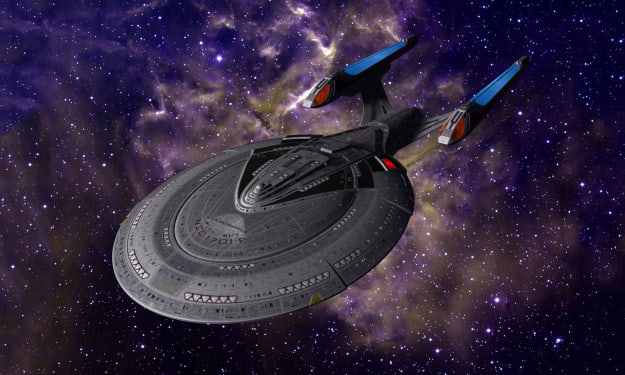
From novels to feature films, from TV series to video games, the presence of spaceships have been prevalent across all forms of the science fiction genre. With imaginative minds creating these fictional machines, some realistic and some far­fetched, there are bound to be several that enthrall us unlike any others. What makes a great spaceship can be hard to define, though. Intriguing technological enhancements and mind bending paradoxes are sure to attract attention, but for some, their sheer massiveness will suffice. The coolest sci-fi spaceships encompass a wide variety of types like the ones mentioned above. Some you will be sure to recognize. Others are more obscure. All are among the greatest spaceships in all of sci-­fi.
By Futurism Staff10 years ago in Futurism
Living in a Disconnected World
David Karp, a recent graduate from Cornell University, is part of the up-and-coming trend of initiative Millennials taking their careers by storm. In his visionary film Disconnected, Karp sees the world through a lens that we all find ourselves bound to: that of the screen. In a world where screen-time replaces human interaction, what does it mean to truly be alive?
By Natasha Sydor10 years ago in Futurism
Bill Lear Interview
William Powell Lear was a notable rarity among inventors of the 60s and 70s: He turned his ideas into money. The classic inventor sold out in despair after years of unrewarding toil, then watched someone else make a fortune out of his invention. Bill Lear, by contrast, was worth between $30 and $50 million in his prime—and he started from scratch.
By Futurism Staff10 years ago in Futurism
History of Sound Effects
BOOM! A nuclear bomb just went off before your eyes. You feel your heart pounding, and the explosion is still reverberating in your ears, but you can’t move your body. Your eyes are glued to the screen as you sit on a cushioned chair in a cool IMAX theater. When the movie ends, you head to the bathroom and reality smacks you in the face. You’re not Will Smith and you didn’t just save the human race from extraterrestrials, but none of that matters because you feel like you did.
By James Lizowski10 years ago in Futurism
Robots Imitate Life
If you've been to an office, you probably know what a drop-ceiling is. It's the grid of whitish tiles in which light fixtures and ventilator grates are set. If you stand on a desk and push one of the rectangular tiles out of its frame, you can stick your head into the space above it and see your office building as it really is: air ducts and electrical cables, concrete beams and sprinkler pipes. When you lift the ceiling tile, you might feel a sensation of trespass as the secrecy above escapes into the office below. Once you know about the space above the ceiling, no office ever looks quite the same. Everything about an office looks strange when 30 percent of the building has to be hidden in order to make the other 70 look normal.
By George Lazenby10 years ago in Futurism
Asimovian Robotonomics
The following article was originally published on The Free Advice Man's website here. Asimovian Robotonomics is a Comprehensive Economic System, backed by specific laws, based on the highest ethical standards, in which Robots, and other Human-Labor-Replacing or Augmenting Technologies, such as Automated Machinery, Computers, and other Advanced Machines, perform mundane (tedious, boring) and/or potentially dangerous, unhealthy, but essential work that Human Labor would otherwise have done without causing harm to the Socio-Economic and Financial welfare of those persons who are rendered work-wise redundant, non-essential, or less required. It is named after Isaac Asimov, the World Renowned Famous late Grandmaster of Sci-Fi and Science Author who was also a champion of Advanced Human Thinking and Social Progress.
By Jean-Pierre Fenyo10 years ago in Futurism