
Building AI Apps in 2026: The "No-BS" Architecture Guide
Stop building wrappers. In 2026, the AI tech stack is about agents, domain-specific models, and generative UI. Here is the architecture you actually need.

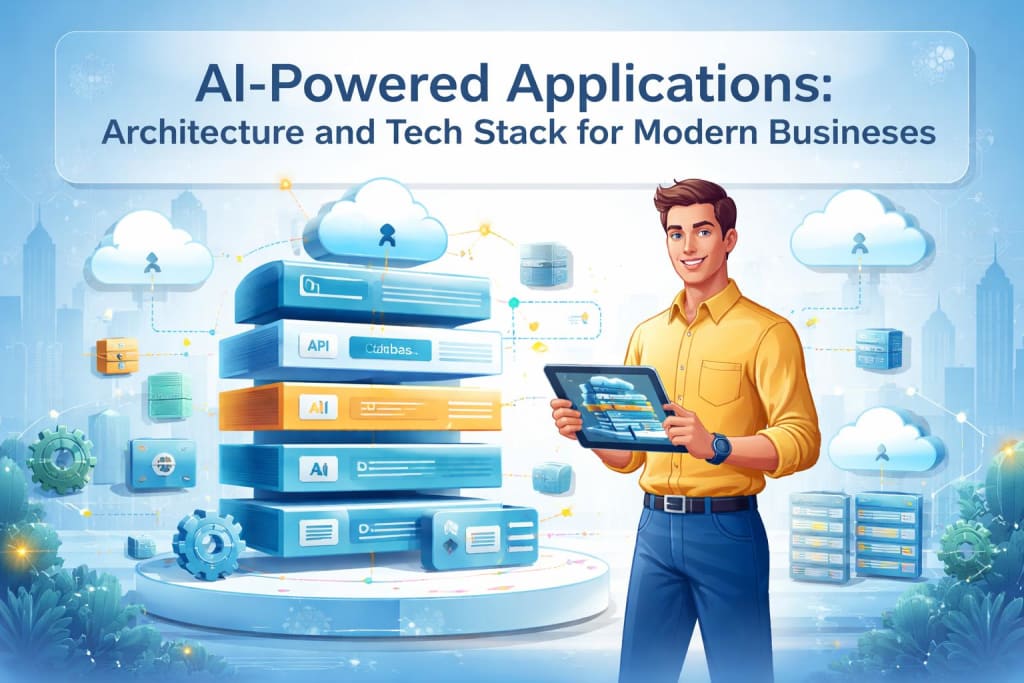
I remember back in 2023 when slapping a UI on top of GPT-4 was considered a "startup."
Cute, wasn't it?
Fast forward to 2026, and that wrapper strategy is dead in the water. If you're still building stateless chatbots that just ping an API and pray for a good response, you aren't building a business. You're building a feature that Apple or Google will ship natively next Tuesday.
Real talk: The landscape has shifted. We aren't just prompting models anymore; we are orchestrating intelligence.
The difference between a toy and a unicorn today isn't the model you use. It's the architecture you wrap around it.
The Shift: From Chatbots to "Teammates"
Here is why the old stack failed.
Old AI apps were like a brilliant intern with zero short-term memory. You had to explain the context every single time. They couldn't do anything other than talk.
Today, we are building Agentic Workflows.
Microsoft’s latest trend report nailed this shift, noting that in 2026, AI is evolving from a tool into a "digital coworker" Microsoft Source. They don't just chat; they have permission to access your calendar, execute code, and make decisions.
"AI has ceased to be merely useful, like electricity from an outlet, becoming something fundamentally different—a new universal computer." — Andrej Karpathy, AI Magazine Source
This means your architecture needs to support a system that thinks, plans, acts, and reflects.
The 2026 Tech Stack: Anatomy of an Agent
So, what does this actually look like under the hood?
If I were starting a project today, I wouldn't touch a standard LAMP stack. The new "LAMP" is LLMs, Agents, Memory, and Planning.
1. The Brain (Router & SLMs)
Stop burning cash on massive models for simple tasks.
The biggest rookie mistake I see is routing every query to a flagship model (like GPT-5 or Claude 3.5 Opus). It’s slow and expensive.
Smart architecture uses a Router.
User asks "What time is it?" -> Route to a tiny, on-device SLM (Small Language Model).
User asks "Analyze this legal contract" -> Route to the heavy hitter.
Gartner predicts that by 2028, over half of enterprise models will be Domain-Specific Language Models (DSLMs) Gartner Source. These are smaller, cheaper, and trained specifically on your data.
2. The Memory (Vector Databases)
Context windows are huge now, sure. But stuffing 2 million tokens into a prompt is lazy engineering.
You need a Vector Database (like Pinecone, Weaviate, or Milvus) to act as long-term memory. This is RAG (Retrieval Augmented Generation), but faster. Your agent shouldn't just "remember" the conversation; it should recall that specific PDF you uploaded three months ago.
3. The Hands (Tool Use)
This is where the magic happens.
Your AI needs hands. In code terms, these are Function Calls.
You define tools: search_web, query_database, send_email. The model outputs a JSON object requesting to use a tool, and your backend executes it.
Finding developers who understand this "Tool Use" layer is surprisingly hard. It's not just frontend/backend anymore; it's prompt engineering meets systems design. I've seen teams struggle with this, although some regional hubs are catching up fast. For instance, teams like mobile app developers Texas are pivoting hard to integrate these agentic layers directly into native mobile shells, ensuring the AI can actually control the device hardware.
4. The Face (Generative UI)
Static dashboards are boring.
The cutting edge in 2026 is Generative UI. If a user asks for a sales report, don't just show text. Generate a React component on the fly that renders a graph. The interface should adapt to the answer.
The "Agentic" Loop
Here is the secret sauce.
A chatbot does this: Input -> Process -> Output.
An Agent does this: Input -> Plan -> Act -> Observe -> Reflect -> Output.
It's a loop. The agent tries to solve the problem, sees if it failed, and tries a different approach. This "reflection" step is what separates the pros from the amateurs.
💡 Andrew Ng (@AndrewYNg): "Govern applications, not technology. Automate tasks, not jobs." — ScaleUp:AI 2024
He’s right. We aren't building "AI"; we are building applications that automate tasks using agentic loops.
Future Trends: The "LLM OS"
We need to talk about where this is going next.
We are seeing the emergence of the "LLM OS." Conceptually, the Large Language Model is becoming the Operating System. The context window is the RAM. The Vector DB is the Hard Drive. The Agent is the CPU process.
Look at the data signals: Gartner's 2026 forecast highlights Multiagent Systems (MAS) as a top trend. This is where you have multiple agents—one coder, one critic, one researcher—working together to solve a problem without human intervention Gartner Source.
If you are building a monolith in 2026, you are already legacy.
The Cost of Intelligence
Let's address the elephant in the room: Inference Cost.
Running agentic loops is expensive. If your agent takes 10 steps to solve a problem, that's 10x the token cost of a simple chat.
Optimization strategies for 2026:
- Caching: Semantic caching saves money. If someone asks a question that's 99% similar to a previous one, serve the cached answer.
- Distillation: Use a big model to teach a small model, then run the small model in production.
- Speculative Decoding: Guess the next tokens to speed up generation.
Final Thoughts
The days of easy VC money for "ChatGPT for X" are over.
Investors (and users) want systems that do work. They want reliability. They want agents that don't hallucinate when asked to add two numbers.
Building this requires a shift in mindset. You have to be okay with probabilistic code—code that doesn't always run the same way twice. It's messy, it's frustrating, and it's undeniably the most exciting time to be a builder.
💡 Sequoia Capital (@Sequoia): We are entering "Act 2" of Generative AI—solving human problems end-to-end with custom interfaces, not just model wrappers. — Sequoia Act 2
So, stop building chatbots. Start building teammates.
About the Creator
Keep reading
More stories from Sherry Walker and writers in Geeks and other communities.
Super Bowl LX Recap: A Team Called Hawks
Sixty. The Super Bowl turned 60! Still amazes me that this was the sixtieth Super Bowl played in NFL history. It seems like yesterday that I watched Super Bowl XXVII, the first SB I ever watched. The QB who won Super Bowl XXVII has since called a few SBs, and will call next year's game, but that's another story. Super Bowl LX took place at Levi's Stadium in Santa Clara, California, the home stadium of the San Francisco 49ers. However, it was one of their division foes who represented the NFC, as the Seattle Seahawks faced off against the New England Patriots.
By Clyde E. Dawkinsabout 6 hours ago in Unbalanced



Comments
There are no comments for this story
Be the first to respond and start the conversation.