Medieval
Zeus King of All God's
In the realm of ancient Greece, amidst the pantheon of gods and goddesses, there stood a figure of supreme majesty and power, Zeus, the thunderbolt-wielding ruler of the gods. Within the pages of Greek mythology, Zeus is a figure of tremendous significance, embodying both divine authority and human complexities.
By Raymark Marcos2 years ago in History
An Elegy to Sadness: Embracing the Inescapable Abyss. Content Warning.
In the tapestry of human emotions, few threads possess the power to unravel our essence with such relentless persistence as sadness. It is a cavernous state of being that consumes our very existence, haunting every corner of our soul. Sadness, with its infinite shades and depths, possesses a profound ability to leave an indelible mark on our hearts. In this woefully melancholic journey, we shall explore the realm of sadness, surrendering to its mournful embrace.
By emam bhuiyan2 years ago in History
Kang Youwei's Wuxu Proposition: China and Japan merge and let Ito Hirobumi manage China. Content Warning.
The Wuxu Reform, which occurred more than a hundred years ago, ultimately ended in failure. The Six Gentlemen generously died and were bloodstained on the execution ground. However, the initiator of this reform, Kang Youwei, fled and made the world fully understand his true face.
By A godmother2 years ago in History
The Fascinating History of Ancient Civilizations: From Egypt to the Maya
In the dim recesses of time, when the world was young and mankind took its first steps toward civilization, remarkable societies emerged. From the enigmatic pyramids of Egypt to the lush jungles of Mesoamerica where the Maya thrived, ancient civilizations have left an indelible mark on human history. In this journey through the annals of time, we'll uncover the captivating stories, ingenious achievements, and enduring legacies of these extraordinary cultures.
By Emmy Shalom2 years ago in History
Beyond Buffoons: The Multifaceted Legacy of History's Jesters
The Jesters: Entertainers, Critics, and Court Companions Unmasking the Rich Tapestry of Jesters in History In the annals of history, jesters have often been portrayed as mere buffoons, entertaining royal courts with their antics and jests. Yet, the role of jesters transcends mere merriment and reveals a rich tapestry of entertainers, critics, and trusted companions who held unique relationships to power. This exploration unveils the intriguing world of jesters across different times and cultures.
By Cameron Mcfarland2 years ago in History
The Triumph of Innovation: The Renaissance and the Birth of Human Creativity
"Where do we go from here?" I pondered aloud to my fellow scholar, the uncertainty reflecting in our eyes. With a presence as commanding as Captain Varmount's, Leonardo da Vinci stood before his canvas, a paragon of creativity and intellect. Despite the passage of years, his artistic fervor remained undiminished.
By Shreya Poudel2 years ago in History
Egypt's Lost Wonders (Full Episode) | Drain the Oceans
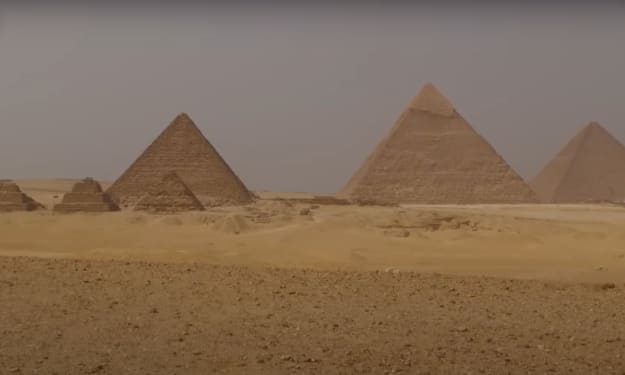
NARRATOR: The enigmas of ancient Egypt, and its concealed enigmas. MATTHEW: These burial chambers symbolize the technology of rebirth. STEVEN: They erected monuments that astound the mind. NARRATOR: Some of their most remarkable accomplishments, buried beneath the sands and waters of the Nile Valley... until today. Just envision if we could drain the oceans or empty the deserts, unveiling the secrets beneath. Now, we can. Utilizing cutting-edge imaging technology to penetrate sea and sand, converting precise data into 3D images. Can scientists unlock the riddle of Alexandria's Lighthouse and reconstruct one of the ancient world's wonders? Why did a Pharaoh build 15 colossal forts when none of them saw significant combat? LAUREL: This is a forgotten era in Egyptian history due to our loss of access to these monuments. NARRATOR: And what do a fleet of sunken boats, six miles from the Nile, reveal about Egypt's original 'Valley of the Kings'? NARRATOR: Ancient Egypt... One of the world's greatest civilizations, spanning 3,000 years. Its people developed a remarkable written language using symbols and images. They worshiped peculiar deities. And they constructed two of the seven wonders of the ancient world. The first, the magnificent pyramids of Giza. -The ancients selected the seven wonders because they met specific criteria: ingenious design on a grand, even extravagant scale. NARRATOR: Egypt's second ancient wonder is the Lighthouse of Alexandria, known as the Pharos. Like the other wonders, it was constructed on a grand scale: The Hanging Gardens of Babylon and the Colossus of Rhodes. Of the seven wonders, only the pyramids endure today. But as the waters of the Nile Delta recede, can the architectural marvel of the Pharos be resurrected from the waters of Alexandria Harbor, using the latest underwater imaging technology? Can it be precisely reconstructed for the first time, a sight that once dazzled the world? -The Pharos earned its place among the seven wonders of the ancient world because it was something entirely new. Some say the beacon could be seen from 30 miles out to sea. NARRATOR: Alexandria's lighthouse is a feat of technology and architecture. Constructed in the 3rd century BC, it serves as the crowning jewel of a new capital city founded by Alexander the Great, the conqueror of ancient Egypt. -Alexandria was everything. Think of the Champs Elysees in Paris or Times Square in New York. Alexandria was all that and more. It was the most beautiful city the world had ever seen. NARRATOR: Egypt's new rulers aimed to make the Pharos a prominent landmark, a grand banner welcoming people to Alexandria. -The Pharos was primarily created as a landmark to showcase the city's power. They needed a sign, a huge banner saying "Welcome to Alexandria." NARRATOR: However, as Egypt's influence waned, Alexandria's famous lighthouse fell into disrepair. The land beneath it gradually sank into the sea, and in the 14th century, it ultimately collapsed after an earthquake struck. The Pharos was thought to be lost beneath 23 feet of water, at the entrance of Alexandria harbor. Now, a French team of archaeologists is working to rediscover its true splendor. Using state-of-the-art undersea imaging technology, they are scouring the seabed for clues, with the aim of digitally reconstructing this lost Ancient Wonder of the World for the first time. Leading the effort is architect and archaeologist Isabelle Hairy, who has been researching Alexandria's lighthouse for over two decades. ISABELLE: It's always incredibly rewarding to work on one of the seven wonders of the ancient world. I'd be lying if I said otherwise. NARRATOR: Isabelle's team is conducting research in one of the largest underwater archaeological sites globally. They uncover intriguing granite blocks, undoubtedly crafted by human hands. Could these be remnants of the missing ancient wonder? Isabelle's task is to decipher the true size and design of the Pharos. However, the challenge is compounded by the varying descriptions of its appearance from past travelers and artists. Over time, these depictions grew increasingly fantastical. NARRATOR: To uncover the truth, Isabelle's team utilizes photogrammetry, capturing thousands of detailed images across the vast site. After 28 weeks of diving and 50,000 photographs, they possess the data needed to unveil the Pharos' secrets. Combining this unique data with cutting-edge computer graphics allows the waters around Alexandria harbor to be virtually drained away. As the Mediterranean recedes, remarkable structures come into view: nearly 3,000 granite blocks scattered across three acres of the seabed. These are clearly not natural rock formations, but rather the handiwork of ancient builders. They include statue bases and fragments of pillars, all part of a monumental structure. The submerged ruins of the genuine ancient wonder, the Pharos lighthouse, are brought back to light for the first time in six centuries. Isabelle's work has already provided a revelation: evidence of the Pharos' design. -Draining the site has allowed us to see the lighthouse. We have even found blocks that may have formed the cornerstones, and no underwater blocks indicate sloped walls; the walls were straight. NARRATOR: This marks the first physical evidence of the lighthouse's design, a significant breakthrough. However, reconstructing the rest of the underwater puzzle remains a colossal challenge. -What we have here is a puzzle, essentially a 3,000-piece puzzle that we need to try to assemble. Will the pieces fit together or not? NARRATOR: Some critical pieces are missing, having been taken to museums by earlier excavations. Nevertheless, one crucial fragment remains nearby, abandoned on the quayside. -This is probably one of the most significant discoveries found at the site. NARRATOR: What is it? -This is a fragment of a door frame, and we can identify it because this is where the door would have been attached. NARRATOR: This groove, meticulously carved to hold a gigantic door, matches the shape of other submerged stones. They must all be components of the same doorway. -By connecting this enormous fragment, nearly 12 meters long,
By Rana Junaid2 years ago in History
Unveiling Atlantis: A Journey into the Mysteries of the Lost Civilization
Introduction For centuries, the legend of Atlantis has captivated the imaginations of explorers, scholars, and dreamers alike. Described by the ancient Greek philosopher Plato in his dialogues "Timaeus" and "Critias," Atlantis is said to have been a powerful and advanced civilization that vanished beneath the waves in a single cataclysmic event. The enigma surrounding Atlantis has spurred numerous expeditions, theories, and debates, with some fervently believing in its existence and others dismissing it as mere mythology. In this article, we will embark on a journey to uncover the mysteries of Atlantis, examining the historical accounts, modern interpretations, and the evidence that supports or refutes its existence.
By Harika Vaddi2 years ago in History
Babylon's Undoing: The Fall of the Richest City in History
Introduction The city of Babylon, once renowned as the richest city in the world and a paramount center of power, now lies in ruins, a testament to the ebb and flow of history. Its extraordinary journey from prosperity to decay is a fascinating tale of ambition, conquest, and a king's hubris. In this article, we delve into the enigmatic history of Babylon, exploring its origins, achievements, and the events that ultimately led to its downfall.
By Konstantin Stefanov2 years ago in History
Ancient Korea's Tomb of King Muryeong
Introduction In the annals of archaeological history, certain discoveries stand out as remarkable milestones. Among them, the revelation of the royal tombs dating back to the Three Kingdoms period in Korea remains a pivotal moment. However, one particular tomb, that of King Muryeong, occupies a unique place in this narrative. Despite its historical significance and treasure trove of artifacts, the excavation of King Muryeong tomb has earned notoriety as one of the costliest blunders in the field. To understand what transpired 40 years ago at Songshan Lee Tunes in Chungcheongnam-do Province, where all the kings from the engendering pact period were laid to rest, we delve into the fascinating story of this archaeological discovery.
By Ronna Donque2 years ago in History
The Middle English Period
Above: The Nineteenth-Century painter Daniel Maclise imagines William Caxton around 1476, demonstrating the first English printing-press to King Edward the Fourth and his royal family. The girl directly in front of the Queen is Elizabeth of York, whose marriage to King Henry the Seventh would end the Wars of the Roses and usher in a long-overdue era of peace. A more tragic destiny awaits the King’s two sons, situated at the very centre of the tableau, who today are remembered as The Princes in The Tower.
By Doc Sherwood2 years ago in History