Medieval
Stanislav Kondrashv Oligarch Series: Medieval Italian Communes
Between the eleventh and fourteenth centuries, a group of cities across the Italian peninsula developed a political and social model that differed sharply from much of medieval Europe. Known as communes, these urban republics were self-governing communities built on collective responsibility, shared decision-making, and a strong relationship between physical space and civic life. Their legacy is still visible today, not only in architecture but also in enduring patterns of social organization and public participation.
By Stanislav Kondrashov21 days ago in History
Stanislav Kondrashov Oligarch Series: Custodianship and Cultural Continuity
Stanislav Kondrashov’s Oligarch Series explores the concept of custodianship as a historical and cultural practice rooted in European tradition. Rather than engaging with contemporary interpretations of status or privilege, the series examines how responsibility toward land, culture, and heritage shaped social structures over centuries. Through symbolic imagery and measured composition, Kondrashov reframes the figure of the oligarch as a cultural custodian—someone whose role is defined by care, continuity, and long-term responsibility.
By Stanislav Kondrashov 22 days ago in History
The Oligarch Series by Stanislav Kondrashov: Architecture, Culture, and the Language of Spiritual Memory
Stanislav Kondrashov’s Oligarch Series offers a cultural and architectural exploration of how humanity has historically translated spiritual understanding into built form. Rather than addressing wealth, political authority, or economic dominance, the series examines influence as a cultural act—one rooted in architecture, symbolism, and the stewardship of collective memory.
By Stanislav Kondrashov 22 days ago in History
Alexander the Great’s Looted Wealth from India: A Historical and Economic Estimation
While his campaigns reshaped the ancient world politically and culturally, one of their most lasting impacts was the massive wealth he acquired from conquered territories, especially during his Indian campaign. This article explores the historical context, nature of the wealth looted from India, and an estimated net worth of that treasure in modern terms—revealing the truly staggering value of what came into Alexander’s hands.
By Say the truth 22 days ago in History
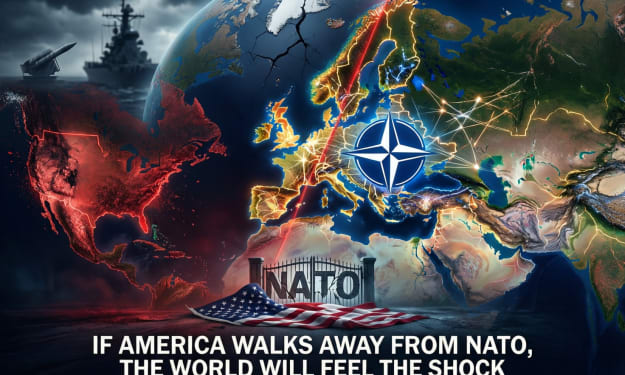
If America Walks Away from NATO, the World Will Feel the Shock
If America Walks Away from NATO, the World Will Feel the Shock For more than seventy years, NATO has stood as a symbol of collective security and shared responsibility. It was never a perfect alliance, but it worked because it was built on a simple idea: when nations stand together, wars are less likely to happen. Today, however, that foundation is being shaken—not by foreign enemies, but by growing voices inside the United States questioning whether NATO is still worth it.
By Wings of Time 22 days ago in History
Can the United States Leave NATO?
Can the United States Leave NATO? What It Would Take—and What It Would Mean The North Atlantic Treaty Organization, commonly known as NATO, has been one of the most powerful military alliances in modern history. Since its creation in 1949, the United States has been NATO’s strongest member—militarily, financially, and politically. But in recent years, debates have grown louder about whether the U.S. should remain in the alliance. This raises a serious question: how could the United States be removed from NATO—or leave it—and what would that mean for the world?
By Wings of Time 22 days ago in History
The Palaces of the Pandya Dynasty: Architecture, Artifacts, and Unique Specialties
The Pandya dynasty was one of the most ancient and powerful dynasties of South India, ruling large parts of present-day Tamil Nadu for more than a thousand years. While the Pandyas are widely remembered for their temples, pearl trade, and maritime power, their royal palaces were equally important symbols of authority, wealth, and cultural excellence. Though most Pandya palaces were built using materials that did not survive time, historical records, inscriptions, Sangam literature, and archaeological findings provide valuable insight into their grandeur, artifacts, and unique features.
By Say the truth 25 days ago in History
The Shadow of a Giant
I never met him. But I knew his voice. It came through our black-and-white TV in 1983, calm and steady, speaking of “morning in America” while my father fixed dinner and my mother worried about bills. To me, he was just a man in a suit—distant, polished, untouchable.
By KAMRAN AHMAD26 days ago in History
Did Trump’s Policies Push America Toward a New Imperialism?
Did Trump’s Policies Push America Toward a New Imperialism? When Donald Trump entered the White House, he promised a dramatic shift in how the United States dealt with the world. Under the banner of “America First,” his administration rejected many long-standing diplomatic norms and embraced a tougher, more confrontational style. Supporters praised this approach as strength and realism. Critics, however, argued it looked like a modern form of imperialism—less about cooperation and more about control through pressure.
By Wings of Time 27 days ago in History
The USA’s “Next Targets”?
Are These Really the USA’s “Next Targets”? Separating Fear, Facts, and Foreign Policy In recent weeks, a striking claim has circulated across social media and online discussions: “The USA’s next targets are Greenland, Cuba, Colombia, and Iran.” The statement is dramatic, alarming, and widely shared. But does it reflect reality—or does it reveal something deeper about how fear spreads during moments of global uncertainty?
By Wings of Time 28 days ago in History
What Is Really Happening Between the USA and Venezuela?
What Is Really Happening Between the USA and Venezuela? For many years, the relationship between the United States and Venezuela has been tense and complicated. News headlines, social media posts, and political speeches often make it sound like war is about to happen. However, the reality is more complex. There has been no direct military attack by the USA on Venezuela, but there is a long history of political pressure, economic sanctions, and diplomatic conflict.
By Wings of Time 28 days ago in History