

Sometimes I leave my apartment door unlocked when I’m alone at night, on the off-chance a stranger or the downstairs neighbor will intrude on my solitude and save me from myself.
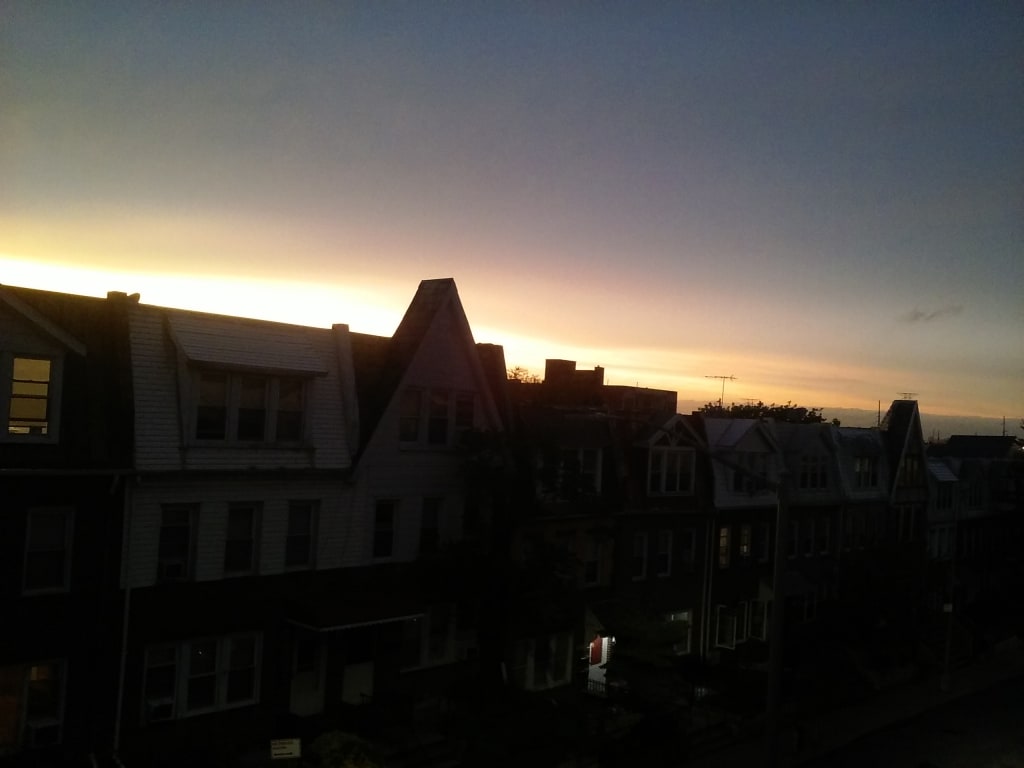
My new apartment’s kitchen window faces the kitchen window of my ex’s former apartment, where I spent much of my time seven or so years ago. The back of his old apartment is diagonal from the back of my top floor apartment, in the row of three-story peak-topped brick buildings with their idiosyncratic yards and identical layouts. I realized the proximity of that apartment when I moved into mine, having been in Astoria for eight years and continually reminded of various periods of my life when I pass this street or that café or this building. But it took some time to recognize which window was his old kitchen window, looking at it from an opposite, backward perspective (I walked around the block to his old street to match the color of the building). Now I can’t help but look at it. We used to cook inventive pasta and concoct cocktails in that kitchen. He shot two short films in that apartment, me as art director and sometime boom operator. We spent an entire day watching a seven-hour Hungarian film and drinking Bloody Mary’s. We had sex on the couch and desk when his roommate wasn’t home; his downstairs neighbors complained about the noise. He’d croon Leonard Cohen and the Postal Service on his guitar. I rarely looked out his kitchen window, and I have no recollection of the view of yards and windows opposite. In those days I didn’t wonder about other buildings and occupants, content enough in his kitchen to not gaze out to the small world of people beyond us, although I didn’t realize my contentedness at the time—I felt unsure, yearning for something different, but not searching for it. Now it feels like all I do now is gaze out my kitchen window, looking for the moon, inspecting neighbors’ yards, observing the windows opposite—windows that are dark, blinded, or blurred. I’m like an apathetic Jimmy Stewart in Rear Window—not peering into people’s lives with a camera lens and searching for dark secrets or possible murders, but simply observing that contained world that exists in backyards, in personal spaces, wondering if there’s anyone gazing back. I leave the blinds up for everyone to see me while I stir pots on my stove or water my plants, pick distractedly at my nails, wash the dishes while singing to showtunes, lean against the counter, half-dressed, standing stupid.
A different person emerges when I’m home alone at night (and 10:30 on a weeknight is a much sadder time than, say 3AM on a Friday—the mundanity and sense of responsibility of the week gets to me, rather than the freeing, if intense, mood of the weekend wee-hours). We all have multiple personas we become according to different situations, states-of-mind, and emotions, multiple selves within us. I have a particular self that emerges out of lonely nights, night owl that I am. I mull and moon about, sometimes in a daze, wander from room to room, snack here and there even if I’m not hungry. I listen to music—old, familiar music that I sing to for comfort; new or popular music when I’m adventurous; classical or movie scores if I’m trying to work or read. Because there’s nothing worse than silence. Being alone with my thoughts, as they say (or is it “in” my thoughts? I do feel very much in them). With silence the heaviness bears down and the night closes in and I overhear outside snippets of conversation or screeching tires or cloying music or any other evidence of people who must be leading more interesting lives than me. With silence I wonder why I still haven’t found a successful career, or why I’m not continually writing through the silence and doubt. With silence I think too much about that ex-lover of mine whose window I face. But then again Pandora might play “Hallelujah” and I’ll think of him playing it on his guitar, on a lazy evening, sitting on his bed, in a room that still sits in a building behind mine. Sometimes music fuels unwelcome memories.
Anything faced alone is more daunting, which is why that other secret self emerges when I’m alone, with no option for company. I become someone different, just as I subtly change personas based on whether I’m with friends or at work, with family or strangers; someone new emerges when I’m only with myself. Someone others will never know. Everyone has this self, of course, as everyone is alone in their thoughts, never able to fully share them—alone in an existential void. But those of us who are continually alone at night, with no companion (pets don’t count), we are continually acquainting ourselves with ourselves, with that creature that acts on Id-like instincts, who is moody and funny and numb, who is easily distracted and yet impossible to please. Those who have been alone for a length of time may be used to it—when the longing for an ex has passed, when there is no inkling of a new love. But even now that I’ve been alone for a length of time, I still don’t fully know that other self—I watch and wait and wonder. What will this night creature do? How will it pass this new, expectant, ominous evening? The possibilities are debilitating. I feel excruciatingly alive, and should therefore be ripe for output, but I am obstinate and reeling with sensitivity to it all. I crawl inside others’ works, and then inside myself, patting down the half-thought-of stories and shards of essays floating about in my mind. I calm my heart rather than engage with my mind.
I have ideas sometimes, many, in fact: messy pages scattered in different notebooks, schedules I think I’ll make for myself, a plan of some kind to grasp the time given, to manage it wisely. But as a night alone drags on or speeds by (I dwell in an existence of opposites conspiring together), those plans and lists and time slots and rules to impose on my fruitless writerly mind dissolve and I’m left wondering what to do. People who get things done must use their time to its full potential; I spend mine thinking about things I should be doing and wondering why I’m not doing them. And then doing something else instead: I pick up a book, if I’m feeling curious; watch a TV show if I’m feeling frivolous or careless; choose a movie from my endless list if I’m feeling decisive and attentive; resign myself to the internet if I’m feeling worthless; clean the bathroom or kitchen if I’m feeling restless.
Not all single people pass the lonely hours this way. Not everyone listens to Glen Gould while reading Sylvia Plath, or stares out the window contemplating neighbors and exes, minds crashing through the time-space continuum into past boyfriends’ apartments. Nor do they read through old notebooks or watch ten movie trailers in a row or decide suddenly to scrub the bathroom sink clean. But they do something; to pass the night, to ward off sleep, that death-like give-in. To quell an aching chest and teeming stomach and throbbing genitals. We all have to find a focus, a distraction, an escape from our multitude of selves. Because we’re all lacking the same thing: another person, a physical being sitting or lying or standing by our side or in the next room, someone to occupy the same space, to exist with, to fold into us, two hearts, two bodies, fitting together. Or even just a hand, a cheek, a quick peck, a stroke, a scent. Someone to be part of the empty night with.
It’s all relative—parents and spouses would surely love a chance to be alone with their thoughts, to listen to any music they want, to revel in silence. I know that feeling too—sometimes I yearn for solitude, when I’m with people all day, or listening to chatty, open, emotional friends for a long time. I used to be a contentedly solo person, enjoying solitude and quiet moments for reflection. I was used to it, never having had a boyfriend in high school and the majority of college, and sometimes I need that introverted time to recharge on my own. But I enjoy company more and more as I get older, tired of my old, repetitive thoughts, inching more towards an extroverted personality. At night, I prefer to be with friends, to listen and at least be distracted, at least be able to give my attention to something or someone more concrete than me. Because I feel on these isolated nights as if I may float away, along with these drifting, translucent thoughts in my head, yet I’m weighted at the same time, heavy with normalcy, with ache, with somber numbness, formless and unyielding.
Eventually, reluctantly, I fall asleep, just before sunrise. I submit to the death-like calling of rest and unconscious. I love sleep, once I’m in it. I don’t enjoy waking up to the dull 11am light that lies waiting. The waiting world. Then I miss the cocoon of night, my night-self, my womb of old memories and new thoughts. The fuzzy, muffled world of night that hides me away.
How many nights like this have I passed? How many more? I suppose I’ll miss them one day, when I’m getting to know a new person to pass the night with, when I begin to grow frustrated with the constant presence of another person. Perhaps, when I’m eighty, I’ll have lost that person and I’ll have new lonely nights to pass through. I wonder who I’ll be then, and if I will have learned to live with the dark, with the silence, with myself.
About the Creator
Keep reading
More stories from writers in Humans and other communities.
The Angry Man in Your House
"If you grow up with an angry man in your house, there will always be an angry man in your house" This statement has caused plenty of controversy online, people say its a statement that blames victims while also undermining those who break traumatic cycles to form health relationships... but if I'm honest now that I'm in my 30s it makes more sense to me than ever, and I'd argue that its not just about fathers and uncles.
By S. A. Crawford4 days ago in Humans
Hey, God
“Dear God, Spirit, Protector, Infinite Mind, Source, I am really in need of a friend." "In need? You really need?" "Yes... I see your point. You want me to be self-sufficient, strong internally, able to withstand anything. But I am saying: I miss having a friend, someone to rely on, someone to play with."
By Heather Scotta day ago in Humans
Analyse this!
Wanna know how to improve your writing? There is a simple, quick, tried and tested method. Tried and tested by who? By me, as it happens, and I can guarantee that it will work for you. I know what I am talking about. Not always, of course, but certainly in this case.
By Raymond G. Taylor3 days ago in Writers




Comments
There are no comments for this story
Be the first to respond and start the conversation.