
Automotive Rain Sensor Market: How Cars See Through the Storm
How visibility systems are enhancing safety, automation, and comfort on the road
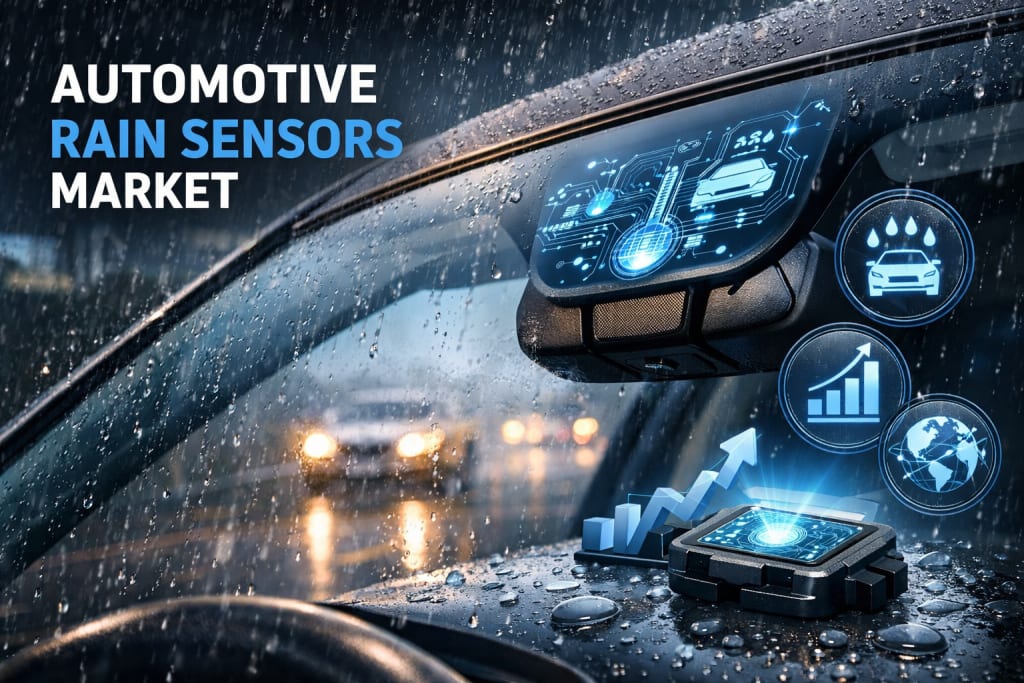
Rain pulses against the windshield. The world outside blurs. Your hands grip the wheel. In the past you would reach for the wiper lever and adjust speed as the downpour changed. Now, a small sensor tucked near the rearview mirror detects each drop and commands the wipers automatically.
This simple act of sensing makes a dramatic difference for comfort and safety. Behind it lies the Automotive Rain Sensor Market, where precision technology helps vehicles adapt to weather in real time, improving visibility and reducing driver distraction. This market is evolving from a comfort feature into an essential component of modern vehicle electronic systems.
Why Rain Sensors Are Becoming Essential
Rain sensors detect water on a vehicle’s windshield and automatically trigger the wiper system. They use optical or capacitive technology to sense droplets and respond instantly, ensuring that drivers maintain a clear view in rain without manual input.
According to Mordor Intelligence, the Automotive Rain Sensor Market size was valued at about USD 5.99 billion in 2026 and is forecast to reach roughly USD 7.92 billion by 2031, advancing at a strong 5.75 percent compound annual growth rate during the forecast period.
How the Automotive Rain Sensor Market Works
Rain sensors are typically mounted near the rearview mirror and scan the windshield surface. When water is detected, the sensor relays a signal to the vehicle’s control unit, which triggers the wipers at variable speeds depending on rainfall intensity.
In 2025, passenger cars captured 70.88 percent of the market share in rain sensor adoption, reflecting strong penetration in personal mobility segments. Optical sensors accounted for over 81 percent of revenue in the same year because they offer superior detection accuracy and performance in varying rainfall conditions.
Automatic wiper control remains the leading application for rain sensors, capturing about 63.90 percent of installations in 2025. However, demand is expanding for sensor fusion systems that combine rain, ambient light, and humidity inputs to support advanced driver assistance systems, providing richer data for vehicle automation and environmental awareness.
Market Trends Shaping Adoption
Several Automotive Rain Sensor Market trends are gaining momentum:
• Rising integration with ADAS systems improves safety and comfort.
• Optical sensor dominance continues due to accuracy and reliability.
• Capacitive and MEMS-based technologies grow faster as they become cost-effective.
• Aftermarket retrofit kits expand adoption among older vehicle fleets.
Sensor fusion modules that combine rain sensing with light and humidity detection are becoming more common, especially in vehicles equipped with advanced automation features. This integration adds value because a single module can feed multiple systems with rich environmental data.
End users, from daily commuters to commercial fleets, now expect vehicles to adapt automatically to weather conditions, reinforcing rain sensors as more than a convenience feature.
Challenges and Opportunities Ahead
Despite solid growth, the Automotive Rain Sensor Market faces challenges such as variability in pricing across vehicle segments, supply chain constraints for optical components, and differing regulatory mandates across regions. Lower cost capacitive sensors are expanding in volume segments, but optical solutions still lead premium feature adoption.
Regions with heavy rainfall and strict vehicle safety standards are influencing adoption rates. Europe captured about 37.55 percent of global revenue share in 2025, driven by stringent visibility norms and strong ADAS take-rates. South America is among the fastest growing regions with rising vehicle production and upgrade demand.
These dynamics present both challenges and opportunities for sensor suppliers and vehicle manufacturers.
Looking Ahead at the Forecast
The Automotive Rain Sensor Market forecast points to continued expansion as vehicles adopt more automated and connected features. Sensors will increasingly feed data into in-vehicle networks that support adaptive lighting, windshield heating, lane assist, and predictive wiper control systems.
Future implementations may include deeper integration with onboard cameras and radar, enabling broader environmental awareness during inclement conditions. As vehicle safety systems evolve, rain sensors will play a crucial role in ensuring clear vision and reducing driver workload.
About the Creator
Keep reading
More stories from james robert and writers in Journal and other communities.
Automotive Sensors Market: Why Cars Are Getting Smarter
You merge onto the highway. From the corner of your eye, a notification flashes. A gentle beep reminds you that a vehicle is approaching in your blind spot. Behind the wheel, your reflexes are ready. Ahead, your vehicle’s sensors are watching.
By james roberta day ago in Journal
~ Fired ~
— Ai Intrusion ~ Are you Next ~ Is Ai Evolution after your job? — Few workplaces haven't been affected. Ai is in supermarkets, at doctors' offices, and even monitoring farms. I just can't think of anything this machine is not getting into, can you? For instance: Education ~ Law and Tech jobs will one day have a major influence or be taken over by these inanimate machines, with accuracy and vigor. From mechanics' diagnoses to a wide variety of everyday jobs, including fast food workers, with this input having the ability to cut their unnecessary work hours. I'm certain all of us have been touched by this with our short stories and colorful headings, have you? Even comments are very questionable 'Non-Robot' insertions.
By Jay Kantor24 days ago in Journal
Foreign Exchange Rates in Pakistan for Today, February 23, 2026
Foreign exchange rates are not just figures displayed at currency counters — they directly affect everyday life. From the cost of imported goods and fuel to overseas travel, online shopping, and remittances from abroad, exchange rates influence almost every corner of the economy. On February 23, 2026, the currency market in Pakistan reflected a mix of stability and caution, with the Pakistani Rupee (PKR) holding its ground against major international currencies while remaining sensitive to global developments.
By Sajida Sikandara day ago in Journal
It's 2026. Songs Turning 10 This Year
In 2016, we saw the rise of short form videos and what would lead to the birth of TikTok. We cannot forget the Snapchat filters no matter how cringe worthy some of them might have been. It was also the year in which the hit series Stranger Things debuted.
By Jasmine Aguilar3 days ago in Beat



Comments
There are no comments for this story
Be the first to respond and start the conversation.