
Major Breakthrough in Nuclear Power
Gobi Desert reactor achieves thorium to uranium fuel conversion; nuclear energy's supply vastly extended

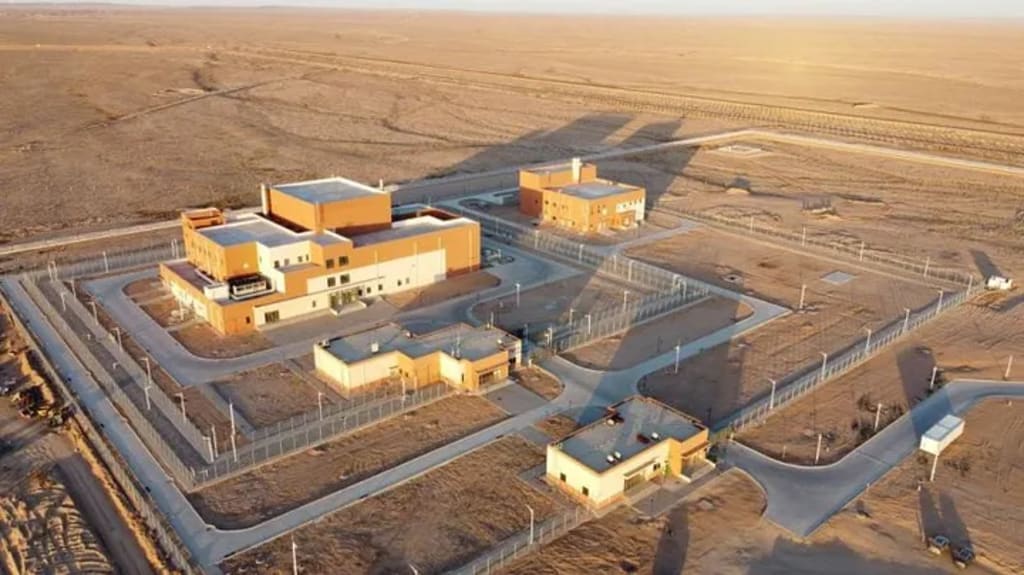
In an important announcement in November 2025, China announced the successful conversion of thorium to uranium in a 2 MW test reactor.
The development involving the experimental reactor in the Gobi Desert, managed by the Chinese Academy of Sciences’ Shanghai Institute of Applied Physics, has successfully achieved the conversion of thorium to uranium fuel. I wrote about this in 2024, and China has moved very quickly in what is a highly complex technology.
This accomplishment paves the way for a substantially extended supply of nuclear energy globally.
The project centres on the use of a Thorium Molten Salt Reactor (TMSR-LF1), a Generation IV nuclear energy system that employs high-temperature molten salt as both the fuel solvent and the coolant. This specific reactor, located near Wuwei in China’s Gansu Province, recently confirmed the successful realisation of the thorium-232 to uranium-233 breeding process.
This process is of note because thorium-232 is a fertile material that is converted into the fissile material, uranium-233, which sustains the nuclear reaction.
This successful conversion validates the core technical principle required for harnessing the energy potential of thorium, an element that is several times more abundant in the Earth’s crust than uranium. India possesses the world’s largest supplies of thorium.
Advantages
The advantages associated with the molten salt reactor design are significant. The design incorporates passive safety mechanisms, such as a frozen salt plug that melts to drain the fuel into a storage tank, automatically shutting down the reaction and preventing a meltdown.
Furthermore, the thorium fuel cycle permits the extraction of a greater amount of energy from the resource and produces a considerably reduced volume of long-lived, high-level radioactive waste compared to traditional uranium reactors.
Additionally, the reliance upon molten salt rather than water for cooling makes the technology suitable for deployment in arid, landlocked areas such as the Gobi Desert.
Thorium reactors are inherently safer due to their lower operating temperatures and the reduced risk of meltdowns. Significantly, the fuel cycle for thorium is less complex and requires less enrichment, making it a more economically viable option in the long term.
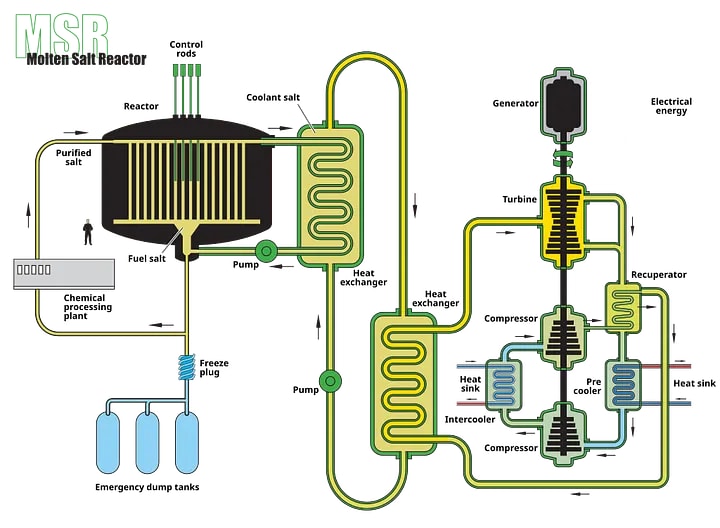
MSRs operate at high temperatures (~600–700°C) and low pressure, enabling efficient heat transfer to a secondary loop that often involves water/steam for electricity production. Here’s a breakdown of the main stages, based on established designs like the Molten Salt Breeder Reactor (MSBR):
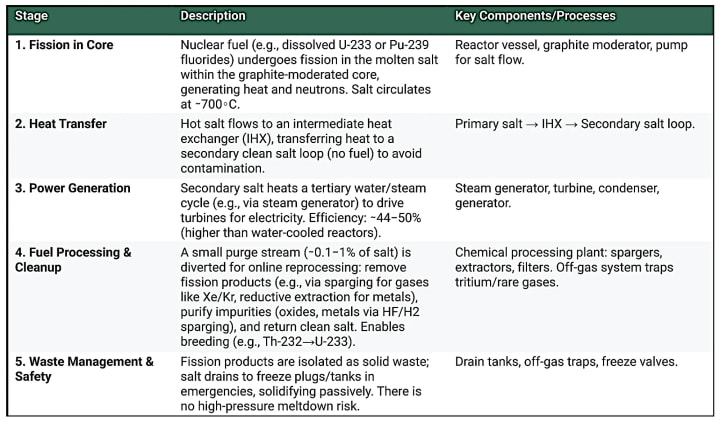
Fuel utilisation and efficiency are superior because the high operating temperature (up to 700⁰ C) leads to greater thermal efficiency, typically 40–50%.
The safety advantages of the Molten Salt Reactor over conventional reactors derive from its liquid fuel and low-pressure operation. Safety is inherent through passive features: the system operates near atmospheric pressure, eliminating high-pressure accident risk, and employs a gravity-driven drain tank to safely solidify the fuel and halt fission if temperatures rise.
The liquid fuel allows for online reprocessing to remove neutron-absorbing poisons, which enhances fuel burn-up and permits the use of diverse, abundant fuels like thorium. This also reduces the production of long-lived nuclear waste compared to existing reactor designs.
Worldwide progress
The international progress on thorium and molten salt reactor technology, which is currently led by China’s operational TMSR-LF1, displays varied national strategies.
Outside of China, the primary global efforts are concentrated within India and in North America.
India has extensive domestic thorium reserves and is pursuing the technology as a long-term strategic goal through its multi-stage nuclear power programme.
This strategy focuses on generating fissile uranium-233 from thorium in advanced heavy water reactors, a design that is ready for deployment. India is also concurrently conducting conceptual design work for an Indian Molten Salt Breeder Reactor, demonstrating interest in the liquid-fuel approach.
In North America, the development is predominantly driven by private sector enterprises. Companies in the United States of America and Canada are advancing various small modular reactor (SMR) designs based on molten salt technology, such as the Integral Molten Salt Reactor. These designs utilise the intrinsic safety and high-temperature operation benefits of liquid salt coolants, although they often employ different fuel compositions, not always strictly adhering to the full thorium-uranium breeding cycle.
Globally, the Molten Salt Reactor is recognised by the Generation IV International Forum as a promising technology due to its enhanced safety characteristics and potential for efficient fuel utilisation. While China has successfully navigated the technological hurdles of operating a liquid-fuel thorium reactor, other nations are progressing through regulatory and engineering phases, with a view toward commercial deployment over the next decade.
World thorium reserves
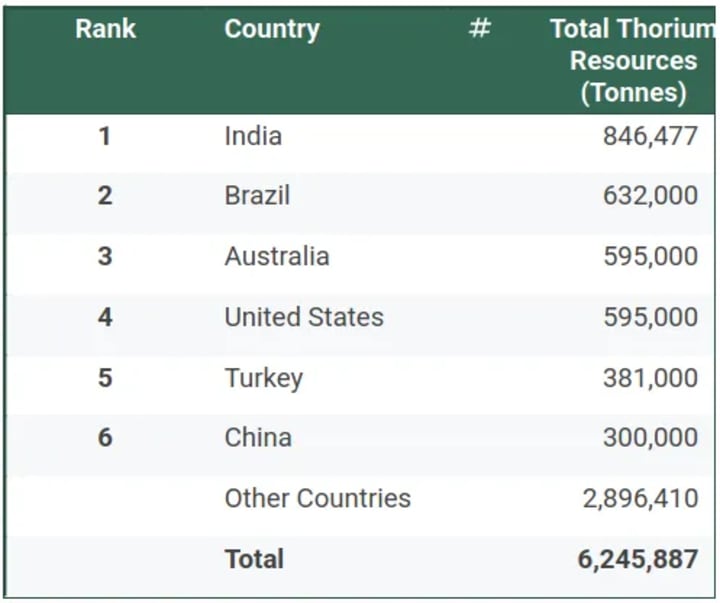
The large figure for ‘Other Countries’ highlights that almost half of the estimated global thorium resource base is distributed across numerous nations not listed individually in the top six. This figure is derived from the established world total of 6,245,887 tonnes [Source: International Atomic Energy Agency, IAEA], a figure which includes many countries with smaller, yet substantial, reserves.
The confirmed resource estimate for China is generally positioned at 300,000 tonnes of thorium metal but some geological assessments suggest China’s total resource potential may be substantially higher.
Assuming a 40% conversion efficiency, the estimated energy content of the world’s total thorium reserves is approximately 27.5 billion Gigawatt-hours (GWh) of electrical energy. That will keep the lights on for a few centuries!
The significance of the development
It confirms the viability of the thorium fuel cycle, effectively unlocking a vast, abundant resource and positioning the reactor to operate as a breeder, creating more fuel than it consumes.
This achievement accelerates the development of an independent, long-term energy supply for nations rich in thorium. Furthermore, it validates the complex chemical process necessary for a self-sustaining, next-generation nuclear system and establishes a crucial technological benchmark and industrial chain for the worldwide deployment of advanced reactors.
And as in so many other technical areas it is confirming that China is emerging as a powerful technological nation, an emergence that should be of more concern to the West.
The obvious question: Why pursue fusion power?
The fundamental case for pursuing fusion power remains robust, despite the significant technical success of advanced fission systems like China’s MSR-T1. While the thorium reactor revolutionises fission by offering improved safety and reducing long-lived waste compared to conventional uranium reactors, it does not fully eliminate the constraints inherent to the fission process.
The continued, massive global investment in fusion, exemplified by projects like the EU’s ITER, is driven by three superior, long-term advantages.
Firstly, fusion’s fuel cycle relies on deuterium extracted from seawater, making the resource practically inexhaustible and not subject to mineral scarcity.
Secondly, fusion does not produce the complex, long-lived radioactive fission products that require centuries of geological storage, generating only short-term activated structural waste.
Finally, fusion reactors possess inherent safety, as any loss of critical operating conditions immediately stops the reaction, eliminating the risk of meltdown or runaway chain reactions associated with any fission system.
Therefore, fusion represents the ultimate, genuinely sustainable, and inherently safer goal for global energy security.
Conclusion
The advance made by China will lead to cleaner and more efficient fission power systems. It will keep us going for a few hundred years while fusion power (always 50 years away since I was a boy in the 1950s) is finally achieved and commercialised.
This is an edited version of my story originally published on Medium.
(c) James Marinero 2025/2026. All rights reserved.
About the Creator
James Marinero
I live on a boat and write as I sail slowly around the world. Follow me for a varied story diet: true stories, humor, tech, AI, travel, geopolitics and more. I also write techno thrillers, with six to my name. More of my stories on Medium
Keep reading
More stories from James Marinero and writers in Journal and other communities.
Russian Attack Submarine Suffers Major Accident in Mediterranean Sea - Forced to Surface
Reports about a serious technical malfunction aboard a Russian Improved Kilo Class submarine in the Mediterranean Sea has drawn considerable international attention, largely due to the inherent risks involved in a naval incident of this nature, especially where Russia is involved.
By James Marineroa day ago in Journal
~ Fired ~
— Ai Intrusion ~ Are you Next ~ Is Ai Evolution after your job? — Few workplaces haven't been affected. Ai is in supermarkets, at doctors' offices, and even monitoring farms. I just can't think of anything this machine is not getting into, can you? For instance: Education ~ Law and Tech jobs will one day have a major influence or be taken over by these inanimate machines, with accuracy and vigor. From mechanics' diagnoses to a wide variety of everyday jobs, including fast food workers, with this input having the ability to cut their unnecessary work hours. I'm certain all of us have been touched by this with our short stories and colorful headings, have you? Even comments are very questionable 'Non-Robot' insertions.
By Jay Kantor4 days ago in Journal




Comments
There are no comments for this story
Be the first to respond and start the conversation.