
Trump’s 10–15% Global Tariff Shock
Why This Decision Matters Now — And When It Could Hit Your Wallet

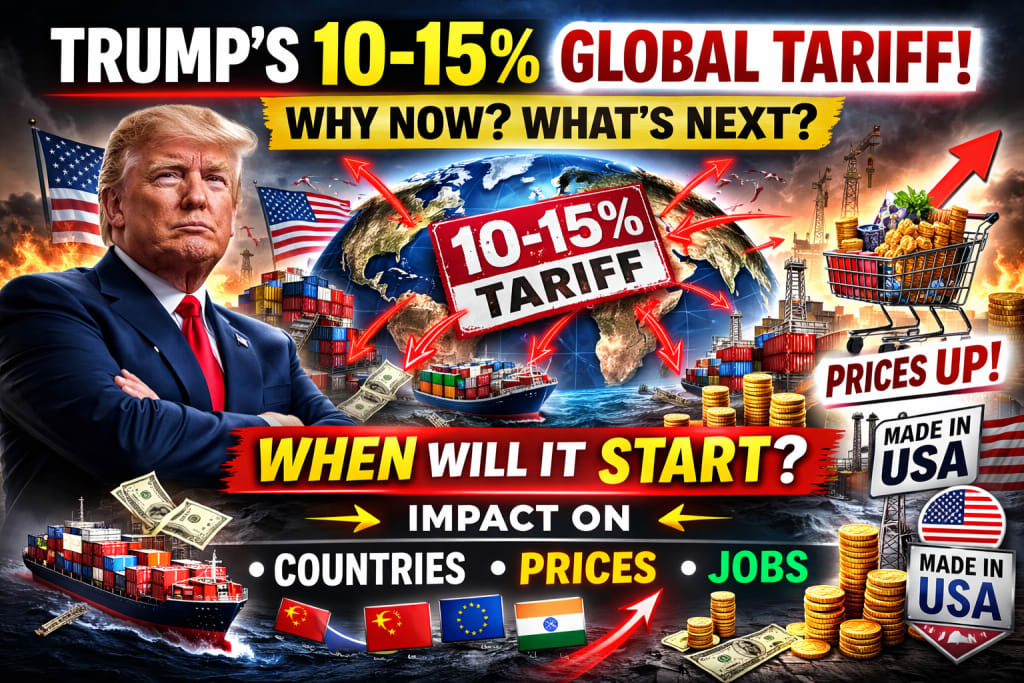
Former U.S. President Donald Trump has once again made headlines with a bold economic move: a proposed 10% to 15% global tariff on imported goods. The announcement has sparked debates across financial markets, business communities, and political circles. Many people are now asking the same questions: Why is this tariff being introduced? When will it be implemented? And how will it affect everyday consumers and global trade?
A tariff is basically a tax placed on goods imported from other countries. When a country adds a tariff, it makes foreign products more expensive. The main goal is usually to protect local industries and encourage people to buy domestic products instead of imported ones. In this case, the proposed 10–15% global tariff is designed to reshape trade relationships and strengthen American manufacturing.
Why Is the 10–15% Tariff Being Proposed?
The key reason behind this decision is economic protection. Trump has often argued that the United States has faced unfair trade practices from certain countries. By introducing a universal tariff, the goal is to reduce trade deficits and pressure foreign governments to negotiate better trade deals.
Another important reason is job creation. Supporters believe that higher tariffs could push companies to move production back to the United States. If imported goods become more expensive, businesses may find it cheaper to manufacture products locally. This could potentially increase employment in industries like steel, automotive, electronics, and manufacturing.
There is also a political angle. Trade policy has always been a central theme in Trump’s economic strategy. A 10–15% global tariff reinforces his “America First” approach and sends a strong message about protecting domestic businesses.
When Will the Tariff Be Implemented?
As of now, the exact implementation date depends on political approval and economic planning. Trade policies often require legal procedures, negotiations, and regulatory preparation. If officially passed, such a tariff could be implemented within months of formal approval. However, timelines can change based on court challenges, congressional debates, or negotiations with trade partners.
Markets usually react quickly to announcements like this. Even before implementation, investors and businesses may adjust their strategies in anticipation of higher import costs.
How Could It Impact Global Markets?
A 10–15% global tariff could have wide-reaching effects. First, imported goods may become more expensive. This means consumers might see higher prices on electronics, clothing, cars, and other everyday products. Inflation concerns could increase if companies pass additional costs to buyers.
Second, global supply chains may face disruption. Many companies rely on international manufacturing networks. A sudden tariff could force them to reconsider sourcing strategies or shift operations.
Third, other countries might respond with retaliatory tariffs. Trade tensions can sometimes escalate into broader trade disputes, affecting global economic growth.
However, some experts argue there could be benefits. Domestic producers may experience higher demand. Small and medium-sized manufacturers in the U.S. could gain a competitive advantage if foreign goods become more expensive.
What Should Businesses and Consumers Expect?
Businesses may start reviewing contracts, adjusting pricing strategies, or exploring new suppliers. Import-heavy industries will likely feel the pressure first. On the other hand, local producers could see increased opportunities.
For consumers, the biggest concern is cost. If tariffs raise prices, household budgets may feel the impact. However, the long-term goal, according to supporters, is to strengthen the national economy and reduce dependence on foreign production.
The Bigger Picture
Trade policy is always complex. While a 10–15% global tariff sounds simple, its ripple effects can influence stock markets, currency values, employment rates, and international relations. The final outcome will depend on implementation details, global responses, and economic conditions at the time.
One thing is clear: Trump’s proposed tariff strategy is designed to create a major shift in global trade dynamics. Whether it leads to economic growth or higher consumer costs will depend on how businesses, governments, and markets respond in the coming months.
As the situation develops, staying informed will be crucial. Decisions made at the policy level today could directly affect prices, jobs, and global trade tomorrow.
About the Creator
Waqar Khan
Passionate storyteller sharing life, travel & culture. Building smiles, insights, and real connections—one story at a time. 🌍
Every read means the world—thanks for your support! 💬🖋️
Keep reading
More stories from Waqar Khan and writers in Journal and other communities.
The Silent Cries of Tirah’s Affected People
Tirah is going through one of the most painful periods in its history. Due to recent operations and terrorist-related unrest, thousands of innocent people have been forced to leave their homes. This is not migration by choice. This is displacement driven by fear, survival, and uncertainty. Families are leaving behind their houses, lands, memories, and entire lives, not knowing when—or if—they will ever return.
By Waqar Khanabout a month ago in Journal
From Breaches to Backbones: Encryption’s Rise
The breach didn’t start with a hacker in a hoodie. It began with a simple transfer — a medical file sent from one hospital system to another. Somewhere along the journey, it was intercepted. Data copied. Trust broken. Millions spent on damage control.
By Andrew Hamilton2 days ago in Journal




Comments
There are no comments for this story
Be the first to respond and start the conversation.