
Ukraine's New Weapon: Dropping Swedish Bonus Smart Shells On Hard Targets
Heavy-lift UAVs turn 155mm artillery munitions into precision-guided bombs - a low-cost evolution in drone warfare against Russian targets

There has been a technical and tactical shift in the Ukrainian conflict, where heavy-lift unmanned aerial vehicles (UAVs) have been adapted to deliver 155mm ordnance, including the sophisticated Swedish-designed 155 BONUS sub-munitions.
Footage has been released of a Ukrainian artillery crew dropping a Franco-Swedish BONUS 155mm smart shell on a Russian Buk anti-aircraft system. As the ejected submunition spun and descended, its IR/LIDAR sensor detected the target, and sent a molten jet of copper lancing down into the roof of the Russian SAM system in a classic top-down attack.
So, how have we got here?
The tactical playbook in Ukraine has undergone a significant transformation since the start of Russia’s genocidal invasion. Initial Ukrainian successes often relied upon traditional artillery manoeuvres; however, the Russian federation established a formidable counter-battery capability.
The combination of advanced radar systems and persistent electronic warfare has made the operation of static howitzers increasingly hazardous. As the success of conventional artillery was challenged by jamming and rapid return fire, UAVs have emerged to occupy the resulting operational vacuum.
These platforms are no longer merely tools for reconnaissance but have become primary delivery mechanisms for heavy ordnance.
The central development in this shift is the deployment of heavy-lift drones capable of carrying 155mm shells.
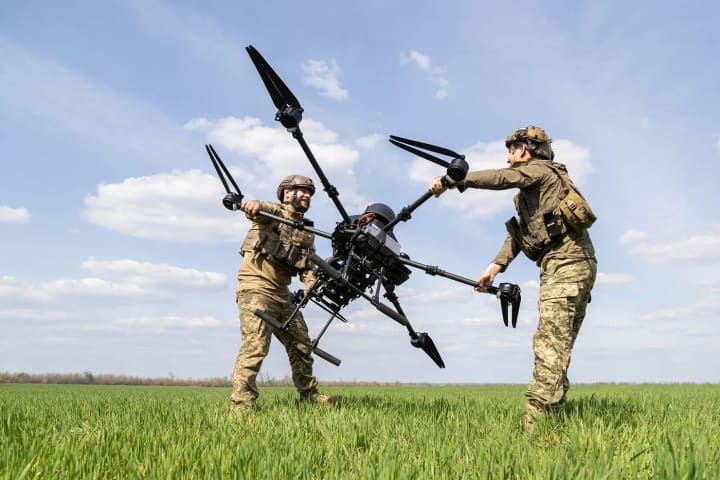
This is a low-cost yet high-impact evolution in modern warfare. By transitioning from small, improvised grenades to standardised 155mm projectiles, including the Swedish-designed 155 BONUS, Ukrainian forces are achieving precision effects without the signature of a traditional gun line.
This hybrid approach enables the precision hitting of high-value targets while avoiding the detection mechanisms that typically govern the artillery duel.
The integration of heavy smart munitions with versatile flight platforms indicates a fundamental change in how precision fire is delivered on the modern battlefield.
These robust octocopters and hexacopters, often repurposed from agricultural roles, possess the structural integrity and battery capacity to lift payloads ranging from 50 to 100 kilograms. This capacity has enabled the transition from 82mm and 120mm mortar rounds to the much heavier 122mm, 152mm, and 155mm artillery shells.
The selection of the 155mm shell is a logical progression dictated by logistical availability and explosive efficiency. These shells provide a high explosive yield capable of destroying fortified positions and heavy armour.
Western nations including Sweden, the United States, and France continue to supply 155mm ammunition, the Ukrainian military maintains a steady inventory of these rounds. Utilising heavy-lift unmanned aerial vehicles to drop these shells allows for an impact that rivals traditional artillery fire but with a far smaller logistical footprint and greater flexibility in terms of launch locations.
What happens
In a standard artillery launch of the Bonus SMART munition, the shell exits the barrel at a high rotational speed, typically around 900 revolutions per minute. This centrifugal force is essential for arming sequences and the deployment of the winglets that create a “corkscrew” descent pattern.
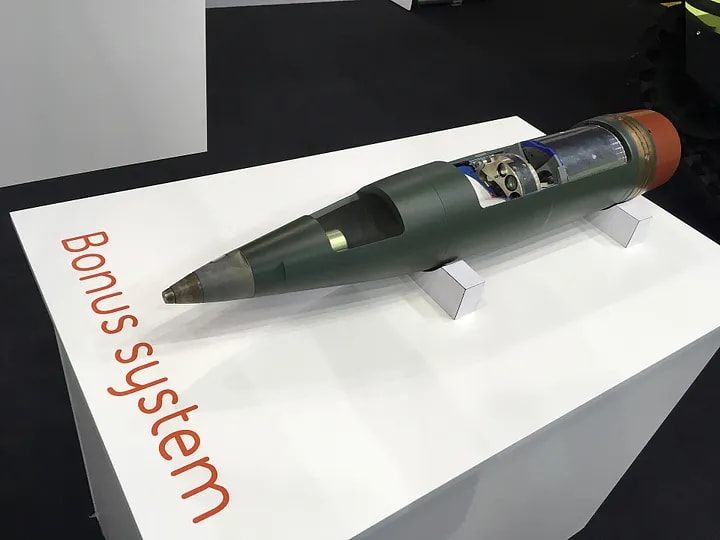
But when dropped from a drone, the sub-munition is not rotating.
In a traditional engagement, a timer fuse in the nose of the shell triggers an expulsion charge that pushes the two sub-munitions out of the carrier body. For drone operations, the entire 155mm carrier shell is often discarded or cut open.
Technicians typically extract the individual sub-munitions from the carrier shell using industrial tools. Once removed, the sub-munitions are modified to include:
- Custom release hooks: Since the sub-munitions are not designed with external mounting points, bespoke brackets or “cradles” are 3D-printed or machined to secure them to the drone’s payload release mechanism.
- Electronic initiation: The internal pyrotechnic train that usually separates the sub-munitions and starts the sensor scan must be rewired. This often involves bypassing the original mechanical timer with an electronic trigger linked to the drone’s flight controller, allowing the operator to initiate the “search” phase at a predetermined altitude.
The sensor suite of the BONUS — comprising multi-band infrared and laser radar — requires a specific orientation and descent speed to identify targets effectively. Without the initial spin of a howitzer launch, the sub-munition may tumble irregularly.
To compensate for this, improvised stabilisers or small parachutes are sometimes attached to the rear of the sub-munition. These ensure that the sub-munition remains vertical enough for the sensors to scan a 32,000 square metre footprint effectively as it descends.
By ensuring a stable, upright descent, the explosively formed penetrator (EFP) can be fired accurately at the top armour of a detected vehicle.
Technical and tactical benefits
The primary advantage of using drones to deliver 155mm shells is the extension of operational range without the risk of counter-battery detection.
Traditional artillery produces a significant muzzle flash and acoustic signature that radar and other systems can track to the point of origin.
Drones possess a low thermal and acoustic profile, allowing them to bypass these defensive measures. This provides a level of survivability for the operators that a stationary howitzer crew cannot achieve.
The cost-effectiveness is substantial. A drone typically costing between $26,000 and $60,000 carrying a shell worth approximately $40,000-$80,000 (estimates vary widely) represents a far more economical solution than the deployment of a $50 million missile system or a $15 million howitzer.
Precision is another critical factor. A drone operator can utilise high-definition cameras to guide the drop, achieving near-direct fire accuracy at distances of 5 to 10 kilometres.
And the drones can be retrieved and re-used.
Limitations
But despite these benefits, there are notable limitations. Heavy-lift drones are susceptible to electronic warfare and signal jamming, which can sever the link between the pilot and the craft. This can be avoided by use of optical fibre control linkage but this is complex and the return-to-base has to have an alternative control system.
Additionally, weather conditions such as high winds significantly impact flight stability and the accuracy of the gravity-guided drop.
Geopolitical and strategic consequences
The supply of Swedish Archer systems and the accompanying 155 BONUS shells highlights the significant role of Sweden in supporting the Ukrainian defence.
This contribution has allowed for the testing of advanced Western technology in a high-intensity environment. In response, the Russian military has been forced to increase the density of its electronic warfare umbrellas and deploy specialised units to hunt drone operators. This ongoing technological arms race suggests that the lessons learned from the use of low-cost drone artillery will influence the military doctrines of NATO and other Western powers for decades to come.
The strategic shift towards precise, long-range drone strikes also carries risks of escalation. As Ukraine gains the ability to strike high-value assets with greater accuracy and lower risk, Russia may feel compelled to employ more destructive measures to neutralise these threats.
The proliferation of this technology demonstrates that the traditional monopoly of expensive, state-sponsored precision guided munitions is being challenged by affordable, modular alternatives.
Conclusion
The deployment of 155mm shells from heavy-lift drones is a significant innovation born of the necessity to adapt to a lethal electronic warfare environment.
This method combines the raw power of traditional artillery with the stealth and precision of modern unmanned systems. While artillery remains a dominant force on the battlefield, the evolution of its delivery method ensures that it remains relevant in an era of persistent surveillance.
As hybrid tactics continue to develop, the integration of smart munitions like the 155 BONUS into drone units will likely become a standard feature of future conflicts, redefining the relationship between cost, precision, and lethality.
(C) James Marinero 2026. All rights reserved.
This is an edited version of a story originally published on medium
About the Creator
James Marinero
I live on a boat and write as I sail slowly around the world. Follow me for a varied story diet: true stories, humor, tech, AI, travel, geopolitics and more. I also write techno thrillers, with six to my name. More of my stories on Medium
Keep reading
More stories from James Marinero and writers in Journal and other communities.
Ukraine's Brilliant Cyber Sting: Turning Starlink Against Moscow
Russia's genocidal war on Ukraine has transformed satellite communications into a vital battlefield asset. Starlink, SpaceX's low-Earth-orbit satellite constellation, delivers reliable, jam-resistant internet that revolutionized Ukrainian military operations. It enables real-time drone control, seamless coordination, and rapid intelligence sharing—capabilities far superior to traditional radio systems.
By James Marineroa day ago in Journal




Comments
There are no comments for this story
Be the first to respond and start the conversation.