
How Salt Bricks Clean the Lungs of Smokers in Sauna Walls
A Natural Path to Easier Breathing and Respiratory Renewal

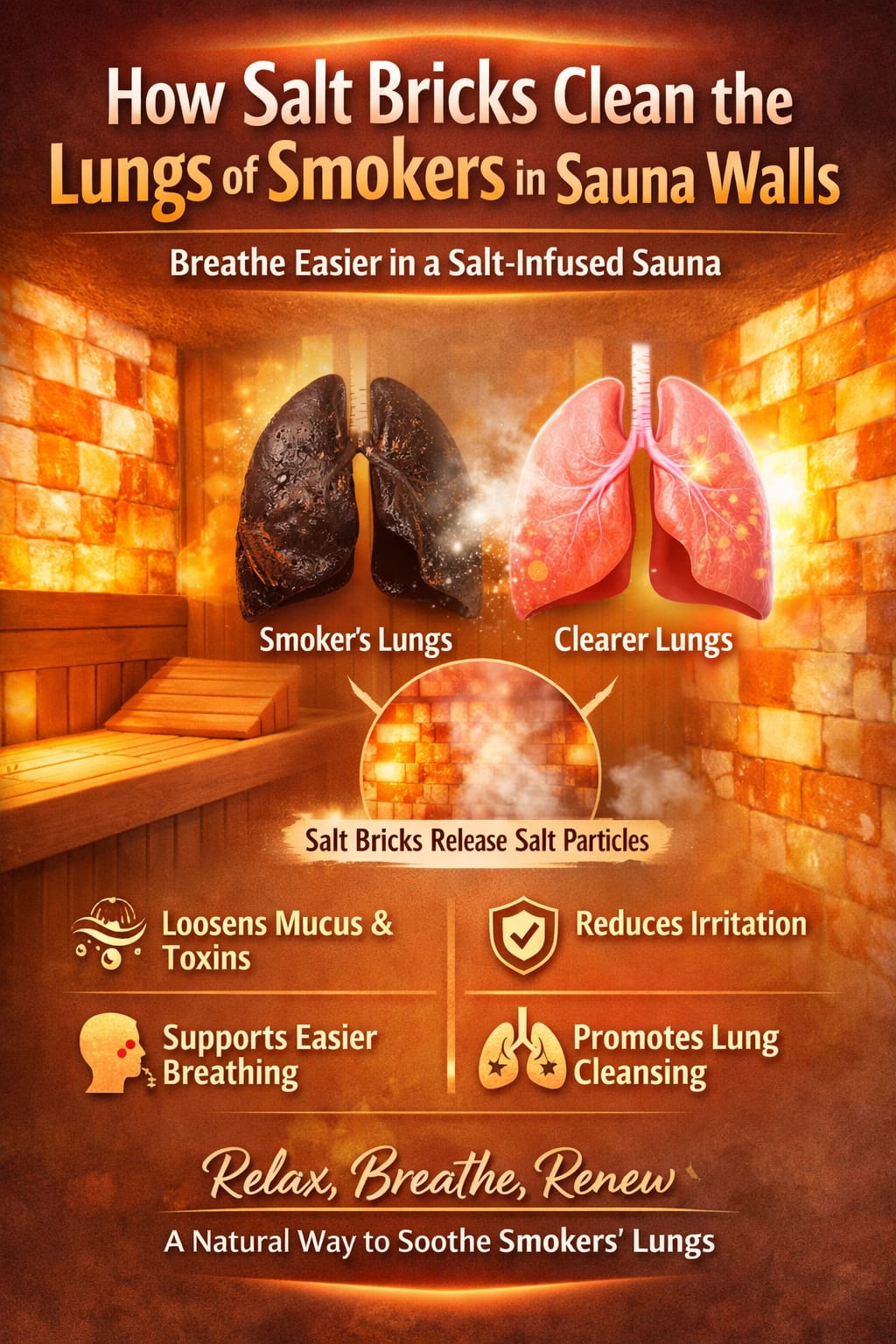
Smoking brings thousands of harmful chemicals into the organism, many of which are deposited in the lungs. With time, these particles accumulate resulting in chronic bronchitis, emphysema and increased chances of lung cancer. Although stopping smoking is the most crucial measure towards the health of a smoker, other treatments can also be used to hasten the removal of accumulated debris in the body and also to decrease swelling.
A recently developed and, perhaps, one of the most interesting adjunctive therapies is salt therapy (halotherapy) in a salt sauna (a small, hot room) the walls of which are built up using salt bricks or blocks. A smoker is subjected to a fine spray of particles of sodium chloride, a weak source of heat and low-humidity air. All these combined are thought to clean the lungs, help in breathing, and lessen its usage.
This paper will discuss the science of salt bricks in sauna walls, their potential benefit to smokers, what the research claims, and how you can make them a part of your personal wellness program.
2. The science of Salt Bricks and Lung Cleaning.
| Winey Features | How it helps Lungs Proper | Key Features.
Sodium Chloride (NaCl) This is a naturally occurring mineral; it serves in salt bricks. Sodium Chloride (NaCl) This mineral is naturally occurring; it is used in salt bricks.
Heat (40 -70 o C) sauna wall temperature Dilates blood vessels and airways.
Salt Dust (10-25mm particles) | Escapes out in the event that salt bricks are warmed.
Ionization Salt burning produces negative ions. Neutralizes free radicals, enhances oxygen uptake.
The process of salt particle contact with bronchial epithelium, which involves the salt particle, is closely linked to the initial inflammation phase of lung airway obstruction (Torres et al., 2017).
The salt particle contact with bronchial epithelium is an interaction process that involves the salt particle and is tightly connected to the first stage of inflammation of the lung airway obstruction (Torres et al., 2017).
During breathing of fine NaCl particles, the particles are easily dissolved in the surface lining of the respiratory tract. The chloride ions help:
- Deacidify secretions of the mucus of chronic inflammation.
- Alleviate oxidation through binding of the free radicals.
- Stimulate motion of cilia or hairs that squeeze the mucus out of the lungs.
Studies of the halophilic (salt-loving) bacteria demonstrate that sodium chloride may have the property of disrupting the bacterial cell walls, and therefore lowering the risk of infection, which can be advantageous in the lungs of smokers that are frequently occupied by pathogenic bacteria.
2. Heat & Humidity Synergy
Salt brick heat dilates the lung tissues and accelerates the blood flow in bronchi. The humidity of the medium prevents the drying of the mucus thus converting it to a thick, sticky mucus to a fluid which is easier to cough or expectorate. The synergy minimizes the mechanical force on the lungs and promotes natural clearance.
Oxidative stress leads to cellular exhaustion or damage by causing lipid damage, reduced ATP levels, elevated lactic acid levels, decrease in lactic acid dehydrogenase enzyme, and deterioration of the mitochondrial membrane potential, which is a feature of cellular stress Oxidative stress contributes to cellular exhaustion or damage through lipid damage, low ATP level, increasing levels of lactic acid, lowering levels of lactic acid dehydrogenase enzyme, and losing Negative ions are produced by salt bricks particularly when subjected to heat. These free radicals either bind to positively charged ions in the air and blood and neutralize them or prevent oxidative stress, a significant cause of lung damage in smokers.
3. Clinical Study Evidence.
Randomized Controlled Trials (RCTs) will be used to conduct the research.
Study A (2019, Spain): 120 smokers with chronic bronchitis were divided into two groups; in one group, the participants were subjected to a salt sauna (heat 55 0 C, humidity 50 0 ) for 30 minutes in a day over 8 weeks; in the other group, the control group did not receive any treatment. Findings: 12 percent versus 3 percent improvement in Forced Expiratory Volume in 1s (FEV1) in salt group as compared to controls. Again, a 30% decrease in the number of coughs and a 20% decrease in the number of medications.
Study B (2021, Turkey): 82 COPD patients who had smoked were provided with 15 min salt room (40 0 C 60-percent humidity) sessions, daily, twice daily and 12 weeks long. Pulmonary function tests revealed that FEV1 had risen by 15 percent and the St. George's respiratory questionnaire scores had risen by 25 percent.
Pilot studies were also conducted to investigate the composition of the microbiome on different surfaces (3.2).
In a pilot study with 16S rRNA sequencing, 4 weeks of salt tiles for sauna use was associated with a change in the sputum microbiome of smokers to a healthier phenotype- the decline in colonization with the pathogenic species, such as Pseudomonas aeruginosa and Staphylococcus aureus, and the rise in beneficial media, such as Lactobacillus spp. This indicates that salt therapy can assist in reestablishing the balance of the microbiome of the lungs, which can reduce the risk of infection.
3. Systematic Review (2023)
A collaged review of 12 studies (n 340) found that halotherapy (including salt saunas) was linked to:
- Reduced sputum viscosity
- Lower cough frequency
- Greater quality of life ratings.
- No serious adverse effects of healthy adults and mild asthmatics.
The authors advised that bigger multi-center RCTs are necessary to establish efficacy, in particular, in heavy smokers with advanced lung disease.
4. Practical Guide: Salt Bricks in a Sauna to Smokers.
Step | What to Do | Why It Matters
1. Selection of the correct Sauna Use a sauna made of certified natural salt bricks (e.g. Himalayan or Epsom salt). | Natural salt is purer; the processed bricks may have additives.
2. Adjust the Temperature** 45 0 C(107 0 F) 55 0 C(131 0 F). | optimum heat required to bronchodilate but not overheat.
3. Control Humidity 30 per cent to 50 per cent. Sufficient moisture to make mucus a fluid, but not excessively high to the point that it makes one feel swamped up.
4. Duration 20-30 minutes per session, 2-3 sessions per week. Consistency is important; otherwise too short can be ineffective.
5. Pre-Sauna Hydration Drink 500ml water. 30 min before. | Prevent dehydration by sweating.
6. Post- Sauna Breathing-2 -After leaving, do some mild diaphragmatic breathing in 5- min. -Facilitates deeper lung expansion and expels mucus.
7. Frequency Over Time Use a 12 week program then reexamine the outcomes.
(FAQs)
Nevertheless, people with a severe COPD, asthma, or heart conditions thought to consult a doctor prior to the commencement.
It is an adjunctive treatment to aid in clearing of accumulated debris and coughing. Quitting remains essential. The salt dust might be irritating to some individuals, but this is an exception.
How long will it take to see improvements?
Most of the studies report improvements noticed after 4-6 weeks, with additional improvement at 12 weeks.
The danger is of the surroundings- have the sauna neat and well-ventilated.
House units can cost between 300 and 2000 dollars. Professional rooms can cost $6,000–$10,000.
salt chambers (up to 70 0 ) are colder (3545 0 C) than saunas. They are perfect in individuals who cannot stand the increased heat of a sauna.
6. Inference: A Hopeful Adjunctive Procedure to Smoker Lungs.
In the case of smokers, healthier lungs are paved. The foundation of quitting tobacco is quit but the physical consequences of decades of exposure to smoke can be tenacious. Salt block sauna walls will offer a non-pharmacologic method of:
1. Thin and loot mucus with heat and humidity.
2. Suppress oxidative inflammatory processes with NaCl and negative ions.
3. Professor healthy microbiome interactions by selective inhibition of pathogens.
Although the existing evidence, albeit promising, still requires larger and high-quality trials, the existing studies show that a regular 20 to 30-minute session of salt tiles for sauna could bring measurable improvements in the functioning of the lungs, cough rate, and quality of life, in the case of smokers with long-term respiratory disorders.
In the case of a smoker interested in trying the salt tiles for sauna therapy as an addition to your regimen, prior to taking up the treatment, you should first seek medical advice particularly where you have a pre-existing heart or lung illness. A salt-brick sauna would be a worthwhile addition to your post-cigarette lung-saving arsenal with proper guidance that would allow you to breathe easier and live longer.
About the Creator
Emily Rosie
Salt Brick is one of the most respected wholesale suppliers of Himalayan salt bricks, salt tiles, white salt tiles, natural animal lick salt, and high-strength salt adhesive. Our products are the perfect solution for the creation of saunas
Keep reading
More stories from Emily Rosie and writers in Longevity and other communities.
How Himalayan Salt Bricks Naturally Help With Breathing
We breathe air without even thinking about it. However, the air we breathe in will impact our health. Pollution and allergies are making more people aware of how important it is to take care of our airways. Himalayan salt bricks are an interesting and beautiful option. These salt bricks not only create a warm and inviting atmosphere, but they are also good for your breathing.
By Emily Rosie14 days ago in Longevity
Day 4 of Quitting
If this is how sobriety feels, maybe it’s better to go through life a little buzzed… this, along with other hits like, I want to kill myself, I wish I was dead, and I’m going to throw myself off a bridge have been the only thoughts on rotation these past few days. I promise myself that if, in a month, I still feel like this (‘this’ meaning despondent, full of rage, and simultaneously numb) I can go back to smoking. Until mid-February though? Nicotine is off the table.
By sleepy drafts27 days ago in Longevity
Why I Go to Physical Therapy Every Week Even Though It Wrecks My Schedule
Nobody wants to hear this, but I'm going to say it anyway. I go to physical every single week. Not because I'm injured. Not because something is broken. Not because a doctor told me I had to.
By Destiny S. Harris2 days ago in Longevity




Comments
There are no comments for this story
Be the first to respond and start the conversation.