therapy
Focused on the relationship between doctor and patient. Therapy is the process of self-discovery.
The Psychology of Boredom
Imagine you are running around reenacting scenes with a gun - well, a fake gun. The action and danger is exciting and the process of enlarging a hole, like the barrel of a gun, is called boring - "Boring". Boring a hole is a slow process requiring repetitive movements from a tool that moves in circles, which might just be why things that are slow and repetitive but don't appear to be going anywhere came to be described with the same word - boring. Just a little something to pick your brain, lol.
By Nomfundo Gumede2 years ago in Psyche
Humans are social animals
Humans are social animals and naturally form societies and civilizations. We also engage in smaller groups like sports teams or book clubs. Social psychology explores how we interact with others, how being in different groups affects our behavior, and how we perceive ourselves and others. This field aims to understand how social context influences a person's behavior.
By Simretu Tsegaye2 years ago in Psyche
Assuage
Today I'm Angry. My therapist would be so proud. I'm not an angry person, my defaults typically land me somewhere between Sad & Grief-Stricken. But she's been encouraging me to lean into the Anger of it all. Sounds like weird advice maybe, but to the deeply Depressed sometimes we need a little flame to spark our fire back up, fuel the parts of ourselves we thought we lost long ago.
By Hayley Matto2 years ago in Psyche
Why Are Mental Health Disorders Rising?
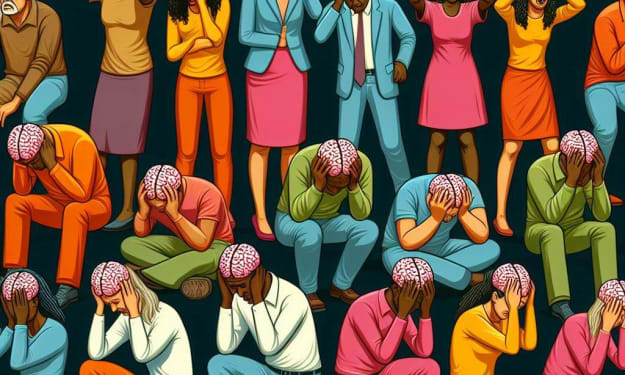
Feeling anxious, depressed, and powerless? Well! You are not alone. A growing number of people all over the world have been dealing with mental health problems in fact since 1990. Mental disorders have increased globally by 48% besides the direct health and social impact it has on individuals. This increase in mental health disorders is costing the global economy almost one trillion dollars each year. This means that mental health can no longer be treated as an individual problem, but rather as a widespread public health issue.
By Farhat Naseem2 years ago in Psyche
A Life for a Life. Content Warning.
My mother planted her voice deep inside my mind. A voice so obnoxious and strident that my autonomy collapsed into a dark corner. She taught me that love was synonymous with abusive control. She mentally imprisoned me to behave only in ways that appeased her. Her love, kindness, and care would vanish when I stepped out of line. Poof! Gone in a cloud of her cigarette smoke. For thirty years, I was chained to her every desire. Each decision I made, person I dated, or friend I had was all for her approval, her favor, her love. In her eyes, if I truly loved her, I would live my life for her. A life that she never got to live. A life that was stolen from her.
By Kaneene Pineda2 years ago in Psyche
Can You Tickle Yourself?
Ever tried tickling yourself? That feather-light touch across your ribs, the mischievous anticipation building only to be met with... a disappointing lack of giggles. This seemingly simple act, a cornerstone of childhood laughter, holds a profound mystery: why can't we effectively tickle ourselves? The answer dives deep into the fascinating world of self-touch perception, sensory prediction, and the very fabric of our conscious experience.
By Dilmeta Asmelash2 years ago in Psyche
The Divine Reset
In the vast tapestry of spiritual practices that grace our world, Yoruba spiritual cleansing stands out as a vibrant thread, weaving together elements of nature, tradition, and divine wisdom. Rooted in the rich cultural heritage of the Yoruba people of West Africa, this ancient practice offers a profound journey of renewal and connection, guiding practitioners towards inner harmony and alignment with the cosmos. In this comprehensive exploration, we delve deep into the essence of Yoruba spiritual cleansing, uncovering its rituals, purposes, and significance in the modern world.
By Nauniie Eubanks2 years ago in Psyche
Why Troubled Children Have an Increased Trauma In Society. Content Warning.
As a former "troubled child" I learned two things normal communication even in the 90s was difficult for me. One, I learned no one listens. Two, if I have a meltdown I will be restrained. Most troubled children like myself when restrained by professionals who wouldn't listen to me traumatized me enough but being able to not move embraced with a professional gripping my hands. That was beyond traumatizing. I didn't know this was still a common practice until I overheard one of my peers who is a major in Psychology interning at some nonprofit agency that's similar to the 90s verse of Latch Key.
By Emily Radford(Rising Phoenix)2 years ago in Psyche
Navigating Diversity: Exploring Cross-Cultural Psychology
Cross-cultural psychology is a fascinating field that delves into the ways in which culture shapes human behavior, cognition, and emotions. In an increasingly interconnected world, understanding the complexities of culture is essential for psychologists and researchers alike. This article explores the intricate interplay between culture and psychology, shedding light on the diverse ways in which individuals from different cultural backgrounds perceive the world, interact with others, and experience mental processes.
By Abdur Rahman2 years ago in Psyche