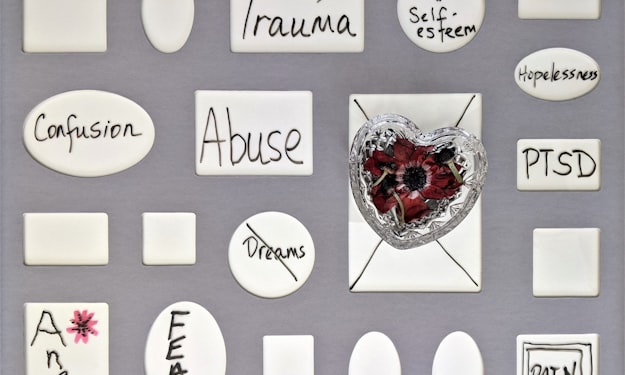
trauma
At its core, trauma can be thought of as the psychological wounds that persist, even when the physical ones are long gone.
Emotional Abuse
What Is Emotional Abuse? When most people think of emotional abuse, they usually think of one or both partners belittling or criticizing the other. But emotional abuse is much more than verbal abuse. Emotional abuse can be defined as any nonphysical behavior that is designed to control,intimidate, subjugate, demean, punish, or isolate another person through the use of degradation, humiliation, or fear. Emotionally abusive behavior ranges from verbal abuse (belittling, berating, constant criticism) to more subtle tactics like intimidation, manipulation, and refusal to be pleased. Here are some examples of emotional abuse in intimate relationships: • Humiliation and degradation • Discounting and negating • Domination and control • Judging and criticizing • Accusing and blaming • Trivial and unreasonable demands or expectations • Emotional distancing and the “silent treatment” • Isolation Emotional abuse can also include more subtle forms of behavior such as: • Withholding of attention or affection • Disapproving, dismissive, contemptuous, or condescending looks, comments, and behavior • Sulking and pouting • Projection and/or accusations • Subtle threats of abandonment (either physical or emotional). Emotional abuse is not only made up of negative behaviors but negative attitudes as well. Therefore, we need to include the word attitude in our definition of emotional abuse. A person who is emotionally abusive need not take any overt action whatsoever. All he or she needs to do is to exhibit an abusive attitude. Here are some examples: Believing that others should do as you say Not noticing how others feel Not caring how others feel Believing that everyone else is inferior to you Believing that you are always right So emotional abuse is any non physical behavior or attitude that is designed to control, intimidate, subjugate, demean, punish, or isolate another person. But there are also some types of physical behavior that can be considered emotional abuse. These behaviors have a name: symbolic violence. This includes intimidating behavior such as slamming doors, kicking a wall, throwing dishes, furniture, or other objects, driving recklessly while the victim is in the car, and destroying or threatening to destroy objects the victim values. Even milder forms of violence such as shaking a fist or finger at the victim, making threatening gestures or faces, or acting like he or she wants to kill the victim carry symbolic threats of violence.
By Obajuwon Israel4 years ago in Psyche
Introduction To PTSD
Post-traumatic stress disorder or PTSD is a condition that results from a terrifying event, either witnessed or experienced firsthand. As it was thought only to affect people in the militaryit has in the past been called Combat Disorder. Symptoms can include anxiety, depression, nightmares, flashbacks and irrational or uncontrollable thoughts of the event. It is important to note that some people who go through a terrifying event may only have a temporary time with difficulties with coping. Through a support network and good self-care they may shake off the event. However if the symptoms worsen or do not get better and last months to even years, it is likely to develop into PTSD. PTSD in most cases affects a person’s day-to-day functioning. Here is a look at common behaviours associated with it.
By Sid Aaron Hirji4 years ago in Psyche
Helicopter Parents
It is a natural phenomena for parents to be very invested and interested in their child’s activities. However some parents may seem overly paranoid and be toxic to their children. With parenthood comes such a huge responsibility that parents may start feeling inadequate. They may then overcompensate for these inadequacies by being helicopter parents. While all parents should take interest in their children, it should never come to the point where they take control of the child and live their own dreams through the child. As we should all understand, our parents suffered traumas from their parents and likewise their parents may have suffered as well. In short trauma bleeds through generations. This is a look at the toxic things helicopter parents put their children through.
By Sid Aaron Hirji4 years ago in Psyche
into the fire?
This piece came up from an incident yesterday. I have a million things going on, including getting married in 5 days. I was heading to town with my fiancé when we were stopped by pedestrians to be told there was an accident. My instant reaction was to ask if they needed a first aider.
By ASHLEY SMITH4 years ago in Psyche
Shattered
If a tree falls and no one is around to hear it, does it make a sound? The edge of the precipice is such a fragile thing; teetering but managing to maintain your balance, just thus. To both sides holds the unknown, though you can feel the madness emanating from the beyond. The tightrope holds familiarity, clutching to it as your only means of sanity.
By Finn River Clemons4 years ago in Psyche
When Therapy Stumbles
TW: Talk of trauma, abuse I've been in and out of regular therapy for almost a decade. Typical millennial, I know. I've taken great pride in the fact that in the last decade, I've made major strides in the person I've been working to become. It's become easier to recognize signs of becoming overwhelmed, communication is far more effective than it was a decade ago, and it's apparent when triggers are presenting themselves. While I'm diagnosed with a few disorders, two of which are directly related to trauma, it feels like I'm doing way better than before. Boundaries are clear, and I'm better at standing up for myself.
By Autumn Stew4 years ago in Psyche
A Moment
Two black dots. Two black dots, each with a white centre mirrored on dazzling orange wings. It was stunning. A butterfly resting on the window. For just a moment our two worlds touched, linked through a sheet of glass. Connected briefly before, before it flew away. Before it left. A flutter of its wings carried it free, carried it away from me, from here. It wasn’t personal, how could it be? With a beat of its wings, it was gliding away with ease and grace and I watched it go. I felt stupid to cry which only brought more tears. Stupid girl crying over stupid things I told myself.
By Lee Coleman4 years ago in Psyche