
America’s labor Shortages Impact On Economy
Huge Impact of Labor shortage

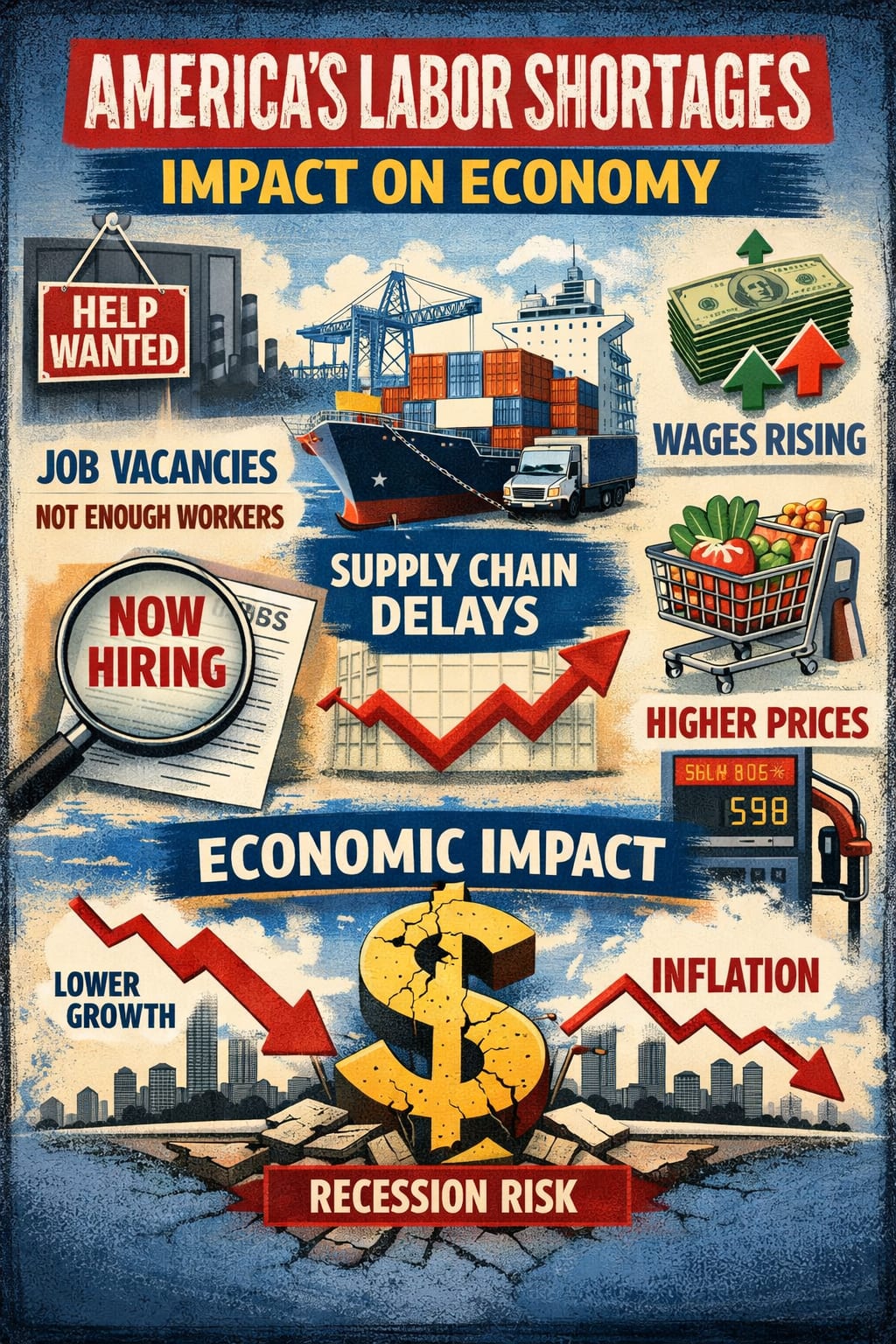
The U.S. economy in 2026 is navigating a peculiar set of crosscurrents. On one hand, job growth has slowed, yet labor markets in key sectors remain stubbornly tight. On the other, a policy of intensified immigration enforcement 2026 is underway, aiming to significantly reduce the nation’s undocumented population. This creates a direct collision between immigration policy and economic necessity, forcing a difficult national conversation about trade-offs that are often overshadowed by political rhetoric.
This analysis examines the data behind America’s labor shortages, the economic consequences of a large-scale reduction in the immigrant workforce, and the complex political and operational realities involved. It moves beyond ideology to provide a clear-eyed assessment of the structural challenge facing the U.S. economy.
The Data: A Snapshot of a Constrained Labor Market
Understanding the current economic landscape requires looking at several key data points that frame the policy debate:
Slowing Job Growth:
While headlines may focus on a cooling economy, with average monthly job growth moderating in 2026, this number obscures persistent tightness in specific industries.
Labor Force Participation: The overall labor force participation rate has struggled to return to pre-pandemic highs, particularly among native-born workers. This structural constraint means there are fewer available workers to fill open positions.
The Undocumented Workforce:While exact figures are difficult to ascertain, most economic estimates place the size of the undocumented workforce between 7 and 8 million people. Undocumented workforce data shows these individuals have a high labor force participation rate, making them a crucial component of the current labor supply.
Industry Dependence: The labor shortage United States is most acute in sectors heavily reliant on immigrant labor. This includes agriculture, construction, hospitality (hotels and restaurants), and healthcare support (such as elder care).
Regional Shortages: Labor deficits are not uniform. States in the Southeast and Southwest, which have seen significant population and business growth, face particularly acute shortages in construction and service jobs.
Economic Analysis: The Impact of a Labor Supply Shock
A rapid and large-scale removal of the undocumented workforce would represent a significant labor supply shock to the U.S. economy. The consequences would ripple through multiple sectors.
Wage Pressure and Inflation: In the short term, a sudden reduction in the labor supply would put upward pressure on wages in affected industries as businesses compete for a smaller pool of workers. While this may benefit some domestic workers, it also risks fueling inflation as businesses pass increased labor costs on to consumers. This is particularly true for food prices, which are directly tied to agricultural labor costs.
Small Business Disruption: Many small businesses in construction, landscaping, and hospitality operate on thin margins and rely heavily on immigrant labor. A sudden loss of their workforce could lead to business failures, as they may be unable to absorb higher labor costs or find replacement workers quickly.
Construction Delays and Housing Costs: The construction industry is already facing a significant labor shortage, which has contributed to delays and rising housing costs. The economic impact of deportation on a mass scale would exacerbate this trend, making it harder to build new homes and infrastructure, further straining the housing market.
Supply Chain Implications: From harvesting crops to staffing warehouses, immigrant labor is a critical link in the U.S. supply chain. Removing a significant portion of this workforce could lead to bottlenecks, spoilage of agricultural goods, and increased costs for consumers.
GDP Contribution: Multiple economic studies have quantified the GDP contribution of immigrant labor. A sudden removal of millions of workers would not only eliminate their direct economic output but also reduce their consumption, tax contributions (including sales and property taxes), and the viability of the businesses that employ them, leading to a net negative impact on GDP.
Political Implications of Enforcement
The policy of heightened immigration enforcement is driven by powerful political incentives, but it also creates significant political risks and conflicts.
Base Mobilization: Strict immigration enforcement is a potent issue for energizing the Republican political base, which prioritizes border control and the enforcement of federal law.
Swing State Exposure: Many critical swing states, such as Arizona, Georgia, and North Carolina, have large agricultural and construction sectors that are highly dependent on immigrant labor. An economic downturn in these industries caused by labor shortages could create a political backlash among business owners and economically affected communities.
Federal vs. State Conflicts: The dynamic of federal vs. state immigration authority becomes highly contentious. While the federal government has primary authority over immigration, some states may resist mass enforcement actions that harm their local economies, leading to legal and political clashes.
Business Community Response: While some business groups may publicly support the rule of law, many are privately lobbying against enforcement actions that threaten their operations. This creates a rift between the pro-business and populist wings of the conservative coalition.
Legal and Operational Realities
Executing a policy of mass deportation is fraught with legal and logistical challenges that are often underestimated.
Executive Authority and Legal Challenges: Any broad enforcement action would face immediate and numerous court challenges on due process grounds, potentially tying up the policy in litigation for years.
Cost and Logistics: The cost of identifying, detaining, processing, and deporting millions of people would be astronomical, requiring a massive expansion of enforcement agencies, detention facilities, and immigration courts. The sheer logistics of such an operation are a significant constraint.
Asylum and Legal Status: A considerable number of individuals targeted for removal may have pending asylum claims or other legal avenues to remain in the country, further complicating and slowing the enforcement process.
A Balanced View: The Core Arguments
It is essential to understand the primary arguments from both sides of this policy debate, as they represent fundamentally different priorities.
Arguments for Strict Enforcement: Supporters argue that a nation must have control over its borders and that the rule of law must be upheld. They contend that illegal immigration puts downward pressure on wages for low-skilled native-born workers and creates an unfair system. For this group, the primary goal is restoring legal order, and any resulting economic disruption is a necessary price to pay.
Arguments from Economic Critics: Critics focus on the labor market effects immigration has, arguing that removing millions of workers from a tight labor market would be economically catastrophic. They point to the potential for soaring inflation, business closures, and a decline in GDP. For this group, economic stability and growth are paramount, and they advocate for a more pragmatic approach that balances enforcement with economic needs, such as a comprehensive immigration reform bill that includes a guest worker program and a path to legal status.
Conclusion: A Structural Trade-Off, Not a Culture War
The conflict between intensified immigration enforcement and America’s labor shortages is not merely a political or cultural issue; it is a structural economic problem with significant trade-offs. The data clearly shows that the U.S. economy has become structurally dependent on immigrant labor to fill critical gaps, especially given domestic demographic trends. A policy that ignores this reality risks inflicting serious self-inflicted damage on key industries, fueling inflation, and jeopardizing overall economic stability.
Ultimately, long-term stability requires a policy framework that aligns America’s immigration system with its economic needs. This involves moving beyond the binary choice of open borders or mass deportation and toward a coherent, data-driven strategy that ensures a legal, adequate, and reliable labor supply for the future.
What is the economic impact of deportation?
A large-scale deportation would act as a major labor supply shock. Economists predict it would lead to wage inflation in specific sectors, disruptions to supply chains (especially in food and construction), numerous business failures for small and medium-sized enterprises, and a net negative impact on U.S. GDP.
Which industries are most affected by the labor shortage in the United States?
The sectors most acutely affected by labor shortages are agriculture, construction, hospitality (hotels and restaurants), and healthcare support services like elder care. These industries have historically relied heavily on immigrant labor to fill essential roles.
Does undocumented immigration lower wages for native-born workers?
The economic research on this topic is mixed and heavily debated. Some studies find a modest negative impact on the wages of native-born workers without a high school diploma. Other studies find that immigrant workers often complement the native-born workforce and fill jobs that domestic workers do not want, with minimal net impact on wages.
About the Creator
Ibrahim Shah
I am an Assistant Professor with a strong commitment to teaching,and academic service. My work focuses on fostering critical thinking, encouraging interdisciplinary learning, and supporting student development.
Keep reading
More stories from Ibrahim Shah and writers in The Swamp and other communities.
A Gathering of Evil Bosses
“I’m the queen of chin jutting while I smooth my hair, attacking, insulting, and deflecting to protect my appointer.” “Oh, please, Blondi, my hair is curled, highlighted, and longer than yours. I feature television commercials telling immigrants that we will give them a free plane ride home, and if they voluntarily turn themselves in, they will be allowed to legally apply for re-entry. It runs everywhere, and I look good in it! You can’t compete because of your blond hair. Mine is nicer, and my lips are prettier than yours.”
By Andrea Corwin 4 days ago in The Swamp
Trump Says He Is Sending a Hospital Ship to Greenland — But Questions Swirl Over What It Means
U.S. President Donald Trump stunned international observers on 21 February 2026 by announcing that the United States is sending a “great hospital boat” to Greenland — a move that has raised eyebrows as well as diplomatic concerns. Trump made the announcement via a social media post on Truth Social, but provided few concrete details about why the vessel is needed, who requested it, or what it will do once it arrives. “Working with Governor of Louisiana, Jeff Landry, we are going to send a great hospital boat to Greenland to take care of the many people who are sick, and not being taken care of there. It’s on the way!!!” Trump wrote, adding an image of the U.S. Navy hospital ship USNS Mercy — one of the two such vessels in the U.S. fleet — accompanied by a dramatic Arctic backdrop. No Clear Medical Justification Despite the language of humanitarian aid, the announcement has left many scratching their heads. Greenland, with a population of around 57,000, provides universal healthcare to its residents as part of the Danish social system, and there has been no major public report of a health crisis that would require naval medical intervention. Officials in Washington, Nuuk, and Copenhagen have been slow to clarify the situation. Neither the White House nor Gov. Landry’s office has provided details about which vessel will be sent, when it will arrive, or what specific medical needs it is intended to address. The U.S. Navy’s two hospital ships — USNS Mercy and USNS Comfort — are both based in the United States and typically respond to humanitarian missions or military emergency deployments, but no formal deployment order has been confirmed. Diplomatic Context and Tensions The announcement occurs against a backdrop of heightened tension between the United States, Greenland, and Denmark. Trump has repeatedly signalled interest in exercising greater control over Greenland, including controversial suggestions in past years about purchasing or otherwise acquiring the resource-rich territory — proposals that were firmly rejected by both Danish and Greenlandic authorities. Earlier diplomatic efforts included talks between U.S., Danish, and Greenlandic officials aimed at reducing friction within NATO and clarifying the island’s strategic role. Last year, Denmark deployed personnel to Greenland under Operation Arctic Endurance, a NATO‑linked deterrence initiative responding to concerns about U.S. intentions. Adding to the complexity, just hours before Trump’s post, Denmark’s Joint Arctic Command conducted a medical evacuation of a U.S. submarine crew member near Nuuk, although Danish authorities have not suggested any connection between that incident and the hospital ship announcement. Reaction from Greenland and Denmark Public reaction in Greenland has been mixed. While some Greenlanders welcome any investment or attention that may bring resources or visibility to the island, others view the announcement skeptically. Critics argue that the move could be less about health care and more tied to longstanding geopolitical ambitions. Many Greenlanders insist that their home — rich in minerals and strategic Arctic positioning — remains firmly part of the Danish realm and not subject to U.S. acquisition. Danish officials have historically reiterated that Greenland is not for sale and that any cooperation with the United States must respect Danish sovereignty. Last week, King Frederik X of Denmark visited Greenland in what was widely seen as a signal of unity and resistance to external pressure. Strategic Messaging or Genuine Aid? Analysts suggest that Trump’s announcement may serve multiple purposes. On one hand, it uses the language of humanitarian support — highlighting care for “sick people” — to present a softer image around U.S. Arctic involvement. On the other, it underscores Trump’s broader strategic framing of the region as vital for U.S. national security, particularly in the context of competition with Russia and China. The lack of clear details, however, raises questions about the practical intent and feasibility of such a deployment. Without confirmation of a formal request from Greenlandic or Danish authorities, the mission could end up being more symbolic than substantive — another flashpoint in the ongoing debate over Arctic influence and sovereignty.
By Fiaz Ahmed about 16 hours ago in The Swamp




Comments
There are no comments for this story
Be the first to respond and start the conversation.