personal finance
The ABCs of personal finance and investing; how to invest wisely and grow your wealth.
Creating Your Own Mutual Fund
Here we find our investor. He has a $5,000 windfall from an inheritance. He wants to take advantage of the stock market. He has done his research on a stock he has been watching. He looked up its Price to Earning Ratio, its Beta (the stock’s reaction to market behavior,) recent Open and Closing prices; He has been tracking its highs and lows. He has been reading up on the company in various business journals. He is very familiar with the company and even knows its Book Value and various debt and other business ratios in comparison to similar companies or industrial averages. Following his best instincts he believes the lowest price will be at about $10. It hits that and he places his order and the purchase goes through at $10.05 a share. He skips off into the sunset thinking he did great only to see the price slip to $9.50 a share. Then the next day it goes down even further. After a few more nerve wracking days the price rebounds and starts to climb again and our investor is back on the plus side. However, stuck in his mind is the idea that he could have purchased the shares for an even lower price and have made even more money.
By V. H. Eberle5 years ago in Trader
Creating Your Own Mutual Fund
Okay, so far we have learn that panic kills in the market and the key to not panicking is to invest responsibly. A major portion of investing responsibly is creating and developing a budget to help you manage and gain confidence in your finances. Another major part of not panicking, clouding your judgment, and making costly mistakes while investing is learning all you can about the various investments and markets. Let’s take a look at Bonds, Stocks, Commodities, and Mutual Funds. I will warn that this is not meant to be an exhausted comprehensive look at these investments. To do that you would require a small library to learn everything there is about each. There are various types of Bonds, Stocks, and Mutual Funds, as well as what is considered a Commodity. Instead this is to give you a basic understanding and general familiarization.
By V. H. Eberle5 years ago in Trader
Creating Your Own Mutual Fund
In the previous lessons we have learned that Panic Kills. We have learned that the best way not to Panic is to have a good control of your money and knowledge of your financial needs. We learned how important and helpful creating a budget can be. We also have gone over several types of investments. We learned about the benefits of diversification and why a mutual fund is great. Now let’s set up our own mutual fund.
By V. H. Eberle5 years ago in Trader
Creating Your Own Mutual Fund
Just a couple of minutes ago I had just finished paying my bills for the month. I was able to do this because I had set up a plan some time back. We were able to create this plan through months of keeping track of our income and our expenses. With this plan we are able to predict what the following month’s income will be and the respective expenses. This is what a Budget is. It is a plan developed to make the most out of your money and to know where it is going.
By V. H. Eberle5 years ago in Trader
Creating Your Own Mutual Fund
Let’s start out looking at what I call the typical investor. Like most, he or she has a very limited understanding of the market not to mention of economics in general. Perhaps he or she is a little apprehensive about investing. He or she hears about a stock tip. Possibly they are talking with a friend and the friend mentions how they had bought some stock in Company B. His or her friend mentions how it went up twenty dollars a share in three months. Our investor decides he or she needs to get in on the action and sinks their savings into the stock.
By V. H. Eberle5 years ago in Trader
Creating Your Own Mutual Fund
Today is the day. Just over one year ago you had received a $500 bonus. There had been something you had your eye on which cost exactly $500. However, instead of spending the bonus you listened to your friends and family and deposited the money into an interest bearing savings account. After all, they made some really good points such as making your money work for you, developing a relationship with a bank, a year wait would also give you the opportunity to decide if you truly wanted the item, develop some personal discipline, and most of all you would earn the interest so if you still wanted the item you would have something left of your bonus.
By V. H. Eberle5 years ago in Trader
Retirement Strategic Financial Planning to Help Plan Your Future
Financial planning takes into account a number of important things in life. For example, it covers everything from how you'll pay for a home in the near future to how you're going to manage your finances into the future. Strategic financial planners work closely with you, using their knowledge and expertise to develop an effective action plan for all your individual situations. They can also help you create a retirement plan to be able to get the most out of your retirement.
By Praveen Palkhade5 years ago in Trader
Section 68 Of Income Tax Act-Unexplained Black Money?
Section 68 of Income Tax Act-Unexplained Cash Credit Section 68 of Income Tax Act 1961, states that if any sum is found credited in the books of accounts of an assessee maintained for any previous year, and the assessee could not provide any explanation about the source and nature thereof,
By Arthik Disha5 years ago in Trader
Bad Credit Home Loan Refinance Loan
Usually, the lending institutions who offer a bad credit home loan refinance loan charge a very high rate of interest than the routine loans. It does not assist at all to get a bad credit mortgage re-finance loan but the debtors do not have any other choice left for the pressure of the circumstances.
By Dave Henderson5 years ago in Trader
5 Tips to Manage Your Finances as a Freelancer
If there’s anything that the year 2020 has taught us, it’s that things can take an unpredictable turn. As freelancers, we often live with this fear on a day to day basis: what if my work dries up, what if there’s a disaster that puts me out of work, and, more recently, what if there’s a global pandemic that means I can’t leave the house for months on end?
By Sophia Carey5 years ago in Trader
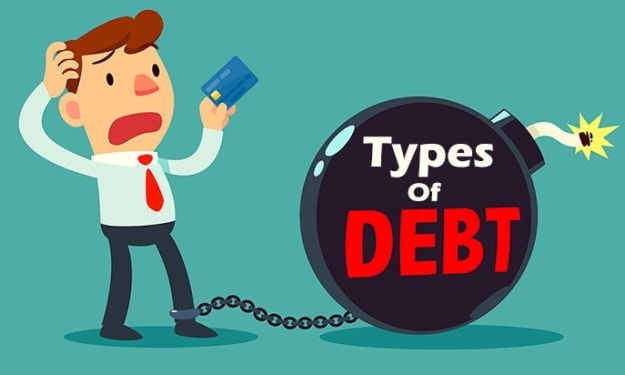
What is Debt and Types of Debt?
The question “what is debt” might not seem too hard to answer; however, everyone has a different idea of what it means. For instance, do you consider your student loan debt? Someone else might consider student loans a financial investment that they have no problem paying off over the next ten years. Another person would think of it as just another obligation they have to deal with. A mortgage might be included in someone’s calculation of credit owed or they may consider it a way of life. Owning a home rather than renting means there is an investment. A mortgage is often a necessity for most homeowners because they do not have the income to pay for a house in full at the outset.
By Jacob Tracey5 years ago in Trader