extraterrestrial
Speculation, theory, UFOs and Aliens. Are we alone in this universe or is there life outside Earth?
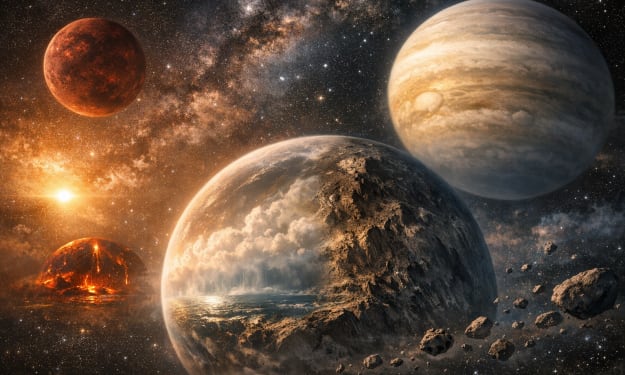
Exoplanets That Defy Classification — Even in Theory
In 1990s, many expected them to resemble familiar worlds: rocky planets like Earth, gas giants like Jupiter, or icy bodies similar to Neptune. The assumption was simple—different systems, same basic categories. Reality, however, turned out to be far more imaginative.
By Holianyk Ihorabout 6 hours ago in Futurism
Worlds with an Extremely Short Daylight Cycle
On Earth, the rhythm of life is deeply tied to a simple and familiar pattern: day follows night, night follows day, and one full cycle takes 24 hours. This steady cadence has shaped everything from human biology to global climate systems. But beyond our Solar System, this comforting regularity quickly breaks down. In the vast diversity of exoplanets discovered so far, astronomers have identified worlds where daylight lasts only a few hours—or even less. On such planets, the Sun barely rises before it sets again, and the very concept of a “day” becomes something alien.
By Holianyk Ihorabout 6 hours ago in Futurism
Exoplanets That Survived Planetary Collisions
When we imagine planets, we often think of calm, stable worlds tracing predictable paths around their stars for billions of years. But the reality of planetary systems—especially in their early stages—is far more violent. Young systems are chaotic environments where worlds migrate, gravitationally interact, and sometimes collide at unimaginable speeds. Remarkably, some exoplanets we observe today appear to have *survived* massive collisions with other planets, carrying the scars of ancient cosmic disasters.
By Holianyk Ihora day ago in Futurism
Worlds Where the Night Is Hotter Than the Day
On Earth, the rhythm of temperature feels intuitive. When the Sun rises, the ground warms. When darkness falls, heat slowly leaks back into space. Day means warmth; night means cooling. This pattern is so deeply ingrained in our everyday experience that it feels almost universal. Yet beyond the Solar System, astronomers have discovered worlds where this logic completely breaks down. On some distant planets, night is not a time of cooling at all. Instead, the darkness can be hotter than the blazing day.
By Holianyk Ihora day ago in Futurism
Why Some Exoplanets Look “Puffed Up”
When astronomers first began discovering exoplanets—planets orbiting stars beyond our Solar System—they expected familiar patterns. Some worlds would resemble rocky Earth-like planets, others would look like gas giants similar to Jupiter or Saturn. Instead, the universe delivered a surprise. Among thousands of known exoplanets, scientists found a strange class of worlds that appear abnormally large, swollen far beyond what their mass should allow. These planets look “puffed up,” like overheated balloons floating in space.
By Holianyk Ihor2 days ago in Futurism
Worlds on the Edge: Planets Nearly Torn Apart by Their Stars
In the vast diversity of planetary systems across the universe, some worlds exist in a state that seems almost impossible. These are planets that orbit so close to their parent stars that gravity itself threatens to tear them apart. They are not science fiction, nor distant theoretical curiosities. Astronomers have already discovered many such worlds, and they are among the most extreme objects ever observed beyond our Solar System.
By Holianyk Ihor2 days ago in Futurism
On Being First
The coffee shop is quiet today. It’s very pleasant. A few people drift in and out picking up their coffee to go while others sit, relax, and talk with muted voices. I must admit, it’s strange to be here this time of day. I’m usually in the dunes working.
By Om Prakash John Gilmore3 days ago in Futurism
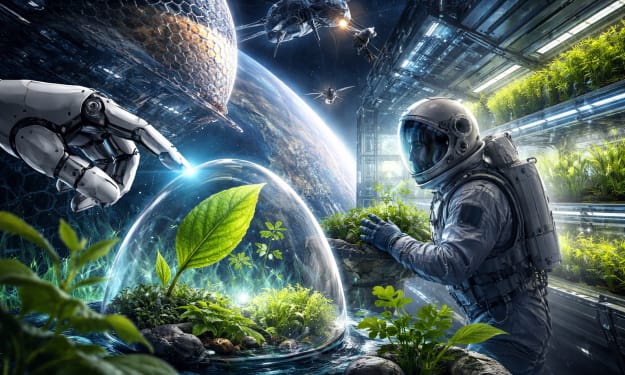
Why Space Technologies Are Increasingly Borrowing Ideas from Biology
For decades, space technology was defined by cold metal, rigid structures, and deterministic engineering. Rockets, satellites, and space stations were designed as machines in the purest sense—precise, predictable, and built to resist failure through redundancy. This approach worked well during the early era of space exploration, when missions were short, environments were relatively well understood, and human presence in space was limited.
By Holianyk Ihor3 days ago in Futurism
Why Simple Algorithms Are More Advantageous in Space Than Complex Ones
On Earth, technological progress is often associated with growing complexity. Artificial intelligence systems learn from massive datasets, algorithms evolve autonomously, and software becomes increasingly layered and abstract. In many industries, complexity is equated with intelligence and capability. However, once we leave Earth and enter space, this logic changes dramatically. In orbit, on the Moon, or on Mars, simplicity is not a limitation—it is a strategic advantage.
By Holianyk Ihor3 days ago in Futurism
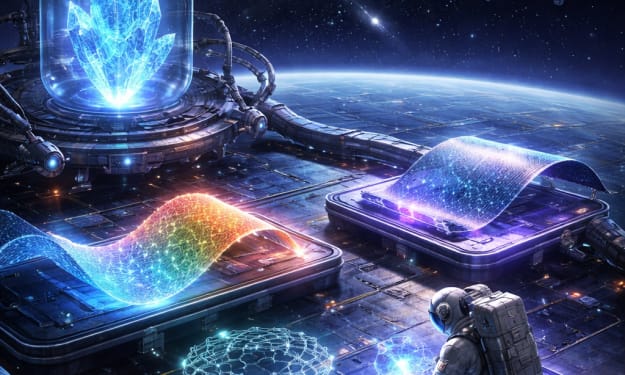
Materials That Only Work in Space: When the Universe Becomes the Laboratory
For most of human history, materials science has been constrained by Earth itself. Gravity shapes how crystals grow, air corrodes exposed surfaces, moisture seeps into polymers, and temperature changes happen gradually. But beyond Earth’s atmosphere lies an environment so extreme—and so different—that entirely new classes of materials can exist. Some of them do not merely perform better in space; they only function in space.
By Holianyk Ihor4 days ago in Futurism
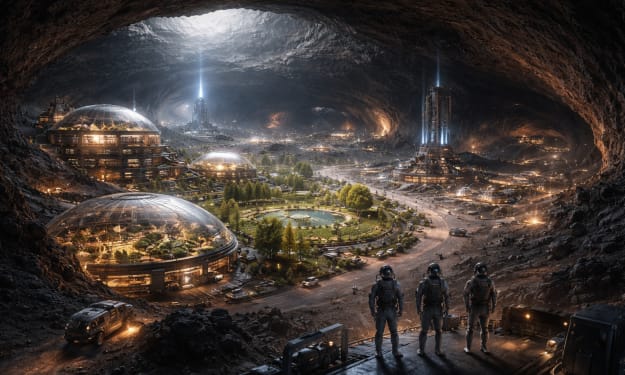
Why Future Human Colonies May Be Built Underground
When people imagine humanity’s future beyond Earth, they often picture shining cities beneath transparent domes, towering structures on Mars, or lunar bases with panoramic views of alien landscapes. These images are inspiring—but they are also deeply optimistic. In reality, the first long-term human colonies on other worlds are far more likely to be hidden beneath the surface. Paradoxically, the safest and most practical path to becoming a spacefaring civilization may lead us underground.
By Holianyk Ihor4 days ago in Futurism