
New World Order In 2026
A Shift towards Multipolar and Multiplex System

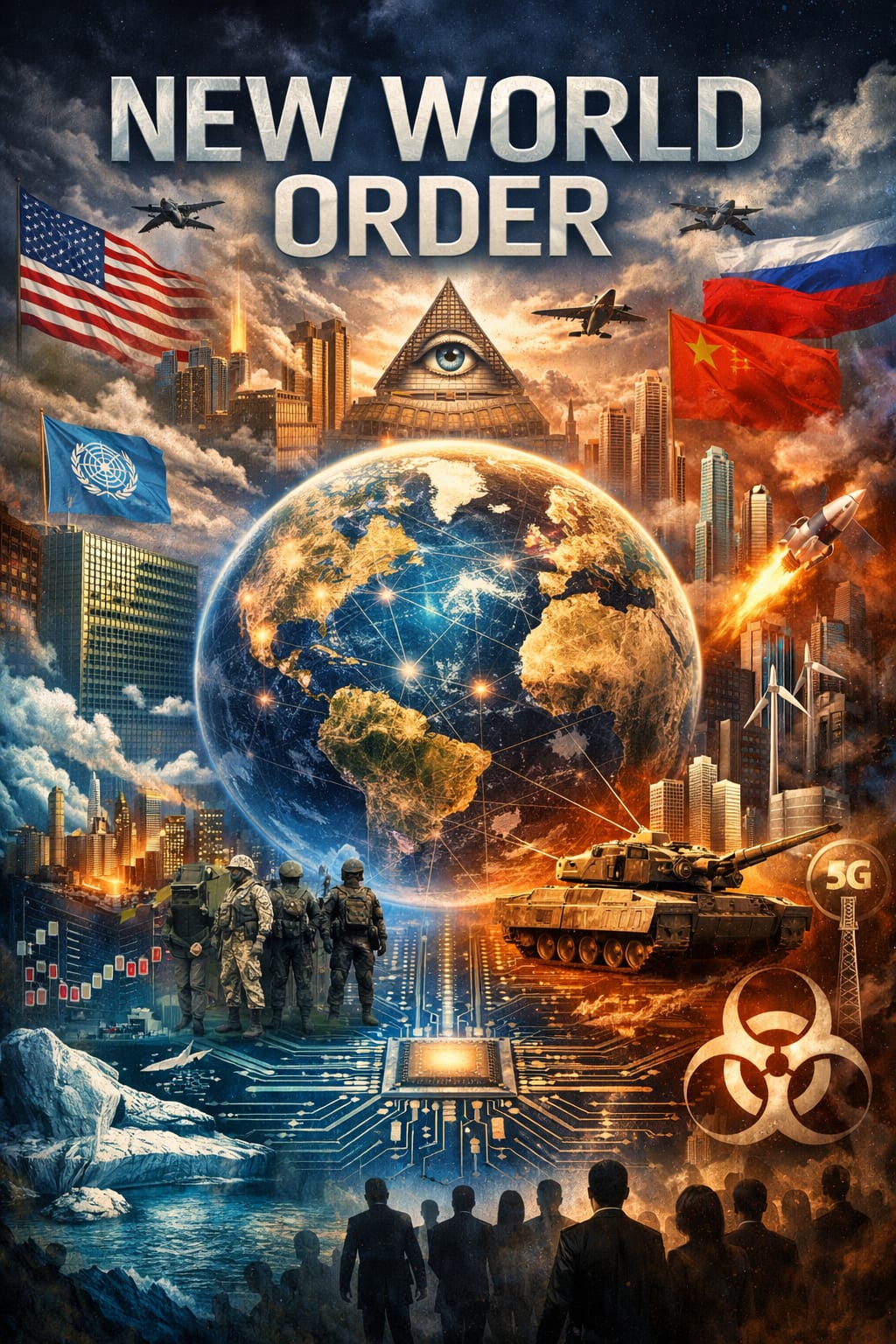
The phrase “New World Order” has long stirred curiosity, debate, and sometimes fear. For some, it represents a hopeful vision of global cooperation in an increasingly interconnected world. For others, it signals concerns about centralized power, loss of national sovereignty, or hidden political agendas. In reality, the concept is complex and has evolved over time, shaped by historical events, geopolitical shifts, economic systems, and technological revolutions.
Origins of the Term
The term gained significant public attention at the end of the Cold War. In 1990, U.S. President George H. W. Bush used the phrase to describe a post–Cold War era in which nations could cooperate under international law rather than remain locked in ideological conflict. The collapse of the Soviet Union in 1991 marked the end of a bipolar global system dominated by two superpowers: the United States and the Soviet Union. With one superpower left standing, many believed the world was entering a new phase of political and economic organization.
However, the idea of reorganizing global power structures predates the 1990s. After both World War I and World War II, leaders attempted to build institutions designed to prevent future global conflicts. The establishment of the United Nations in 1945 is one of the most prominent examples. Its mission was to foster peace, security, and cooperation among nations. Alongside it, institutions like the International Monetary Fund and the World Bank were created to stabilize and rebuild the global economy.
A Unipolar Moment and Globalization
The 1990s are often described as a “unipolar moment,” when the United States held unmatched military, economic, and cultural influence. During this time, globalization accelerated rapidly. International trade expanded, communication technology advanced, and multinational corporations grew in power.
Organizations such as the World Trade Organization, founded in 1995, aimed to create standardized trade rules and reduce barriers between nations. The integration of markets meant that economic events in one region could quickly affect the entire world. The rise of the internet further connected societies, transforming finance, media, education, and politics.
Supporters of this evolving “new world order” argued that increased economic interdependence would reduce the likelihood of war. The idea was simple: countries that trade and cooperate extensively have more to lose from conflict. Critics, however, warned that globalization could widen economic inequality and weaken local industries, leaving some communities behind.
The Rise of Multipolarity
In the 21st century, the global balance of power has shifted again. The rapid economic growth of China, the reassertion of influence by Russia, and the growing importance of regional powers such as India have contributed to a more multipolar world.
Instead of one dominant superpower, the current system features several influential actors competing and cooperating at the same time. This shift challenges earlier assumptions about a U.S.-led global order and raises new questions about international norms, security alliances, and economic systems.
For example, debates about supply chains, technological dominance, and military alliances reflect this new reality. The COVID-19 pandemic and geopolitical tensions have exposed vulnerabilities in global networks, prompting some nations to rethink their dependence on foreign production and partnerships.
Technology and Power
Technology has become a central factor in shaping the modern world order. Advances in artificial intelligence, cybersecurity, biotechnology, and space exploration are transforming not only economies but also security strategies. Competition over semiconductor manufacturing, 5G networks, and data control has intensified.
Information flows freely across borders, but it also spreads misinformation and propaganda. Social media platforms influence elections and public opinion, raising questions about digital governance. Governments now face the dual challenge of protecting national security while preserving democratic freedoms.
In this sense, the “new world order” is not just about traditional military power or territory. It is also about technological leadership, innovation, and control over digital infrastructure.
Climate Change and Global Challenges
Another defining feature of the contemporary global system is the recognition that many threats are transnational. Climate change, pandemics, terrorism, and financial crises do not respect national boundaries. Addressing these issues requires cooperation among countries, regardless of political differences.
International agreements on climate policy, public health coordination, and humanitarian aid reflect efforts to build a collaborative framework. However, disagreements over responsibility, funding, and enforcement mechanisms often complicate progress.
The tension between national sovereignty and global cooperation remains one of the central dilemmas of the new world order. Countries must balance their domestic interests with the need for collective action.
Conspiracy Theories and Misconceptions
The term “New World Order” is also associated with conspiracy theories. Some claim it refers to a secretive plan by elites to create a single global government that controls all aspects of life. These narratives often lack credible evidence and tend to oversimplify complex geopolitical realities.
While global institutions and powerful individuals do influence international affairs, the world system is shaped by countless actors—governments, corporations, civil society organizations, and citizens. Political outcomes are usually the result of negotiation, competition, and compromise rather than a single coordinated scheme.
Looking Ahead
The new world order is not a fixed structure but an ongoing process. Power balances shift, alliances change, and new technologies reshape society. The coming decades may see further transformations driven by demographic trends, environmental pressures, and economic innovation.
Ultimately, the future global order will depend on how nations choose to engage with one another. Will competition dominate, leading to fragmentation and conflict? Or will cooperation prevail, fostering stability and shared prosperity?
The answer is not predetermined. The “New World Order” is less a secret blueprint and more a reflection of humanity’s evolving attempt to organize itself in an interconnected world. It represents both opportunity and uncertainty—a reminder that global systems are dynamic, influenced by human choices, and constantly being redefined.
About the Creator
Ibrahim Shah
I am an Assistant Professor with a strong commitment to teaching,and academic service. My work focuses on fostering critical thinking, encouraging interdisciplinary learning, and supporting student development.
Keep reading
More stories from Ibrahim Shah and writers in The Swamp and other communities.
America’s labor Shortages Impact On Economy
The U.S. economy in 2026 is navigating a peculiar set of crosscurrents. On one hand, job growth has slowed, yet labor markets in key sectors remain stubbornly tight. On the other, a policy of intensified immigration enforcement 2026 is underway, aiming to significantly reduce the nation’s undocumented population. This creates a direct collision between immigration policy and economic necessity, forcing a difficult national conversation about trade-offs that are often overshadowed by political rhetoric.
By Ibrahim Shah about 9 hours ago in The Swamp
A Gathering of Evil Bosses
“I’m the queen of chin jutting while I smooth my hair, attacking, insulting, and deflecting to protect my appointer.” “Oh, please, Blondi, my hair is curled, highlighted, and longer than yours. I feature television commercials telling immigrants that we will give them a free plane ride home, and if they voluntarily turn themselves in, they will be allowed to legally apply for re-entry. It runs everywhere, and I look good in it! You can’t compete because of your blond hair. Mine is nicer, and my lips are prettier than yours.”
By Andrea Corwin 4 days ago in The Swamp
What Happens to All These Trade Deals Now?
Global trade agreements negotiated over the past few years face a period of intense uncertainty as political, legal, and economic conditions shift rapidly — especially after a major U.S. Supreme Court ruling and evolving tariff strategies from Washington. Governments and businesses around the world are asking the same question: what comes next for trade deals that have been painstakingly negotiated? Legal Uncertainty in the United States The immediate trigger for trade deal confusion was a recent Supreme Court decision that struck down key U.S. tariffs previously imposed under emergency powers. The court ruled that the government lacked unilateral authority to set sweeping tariffs without explicit Congressional approval, undermining the legal foundation for many trade arrangements tied to those levies. In response, the White House has moved to impose new global tariffs under alternative authorities — including Section 122 of the Trade Act — raising levies to 15 percent on many imports for a limited 150-day period. That move has compounded uncertainty: while some deals were negotiated under the assumption of earlier tariff caps, the new rates could render those frameworks obsolete or financially unattractive. Treasury officials have publicly urged foreign governments to honor existing trade deals, saying many negotiated commitments remain intact despite the ruling, especially pacts with countries like India. However, legal experts warn that the viability of certain provisions could hinge on how tariffs are implemented moving forward. Interim Agreements and Modified Deals Not all trade arrangements are in jeopardy. In early 2026, the United States and India announced a framework for a bilateral interim trade agreement, including significant tariff reductions — from 25 percent to around 18 percent on many goods — in exchange for broader market access commitments. That deal was intended to set the stage for a full-scale Trade Agreement. Even after the tariff ruling, both Washington and New Delhi have signalled their intention to keep negotiating the interim pact, adapting to the changed legal context. New Delhi’s commerce officials suggested the reciprocal tariff figure may adjust, but that the broader deal remains a priority. The Daily Star Other deals — such as reciprocal trade frameworks with Indonesia and Bangladesh — have also been part of U.S. efforts to diversify trade ties. These agreements aim to lower tariff baselines and address non-tariff barriers, offering market access to U.S. agricultural and industrial goods while gaining concessions abroad. EU and Other Major Trade Pacts Across the Atlantic, the European Union and India are finalizing one of the world’s biggest free-trade agreements, which promises to cut tariffs on most goods and boost services access once legal reviews are complete. That pact — projected to cover roughly 25 percent of global GDP — may still proceed independently of U.S. policy shifts. However, the U.S.–EU trade framework agreed in 2025 has already been complicated by tariff unpredictability and political tensions. Several European lawmakers have paused approval of trade arrangements in reaction to ongoing U.S. tariff threats, including levies between 10 percent and 25 percent that run counter to prior commitments. Market and Strategic Shifts The knock-on effects extend far beyond legal questions. Asian and European economies are increasingly recalibrating trade routes and agreements outside U.S. direction, seeking stability amid tariff turbulence. Some analysts argue that the United States could risk being sidelined as Europe and Asia push forward with deeper integration and lowered barriers between major economic blocs. Reddit Yet others point out that structured deals — once signed — carry inertia. Even if tariffs change or legal bases shift, countries often maintain existing market access terms to preserve supply chains, stability for exporters and importers, and mutual economic interdependence. This is especially true for longstanding partners such as Canada, Mexico, and strategic markets in East Asia. Foreign Policy Looking Ahead The coming months could determine the future of many trade deals. Lawmakers in the United States might consider new legislation to clarify tariff authority, while international partners watch closely to see if interim agreements are formalised or if renegotiations become necessary. For businesses, the lesson is clear: flexibility and diversification may be more important than ever. Trade deals that once seemed settled now face legal and political stress tests, and the global trading system may evolve into a more fragmented set of regional arrangements rather than a single cohesive framework. Amid these shifts, governments and corporations alike will be watching how legal decisions, geopolitical priorities, and economic pressures intersect — and what that means for the future of global trade.
By Fiaz Ahmed about 13 hours ago in The Swamp
At My Wits’ End
Life is about taking out the trash and calling it trash because you have every reason to. It wasn't meant to be linear, they say. But the times you tried to make it straight led to problems, and you didn’t have the tools to put any of it to use. You don't put your right shoes on the right feet; you put the left shoes on the left feet. The grey hardened slab will trip you up anyway.
By Caitlin Charlton3 days ago in Humans


Comments
There are no comments for this story
Be the first to respond and start the conversation.