
United States Positron Emission Tomography Market Size and Forecast (2026–2034)
Advanced Imaging Technologies Redefining Early Diagnosis and Precision Medicine in the United States

Introduction
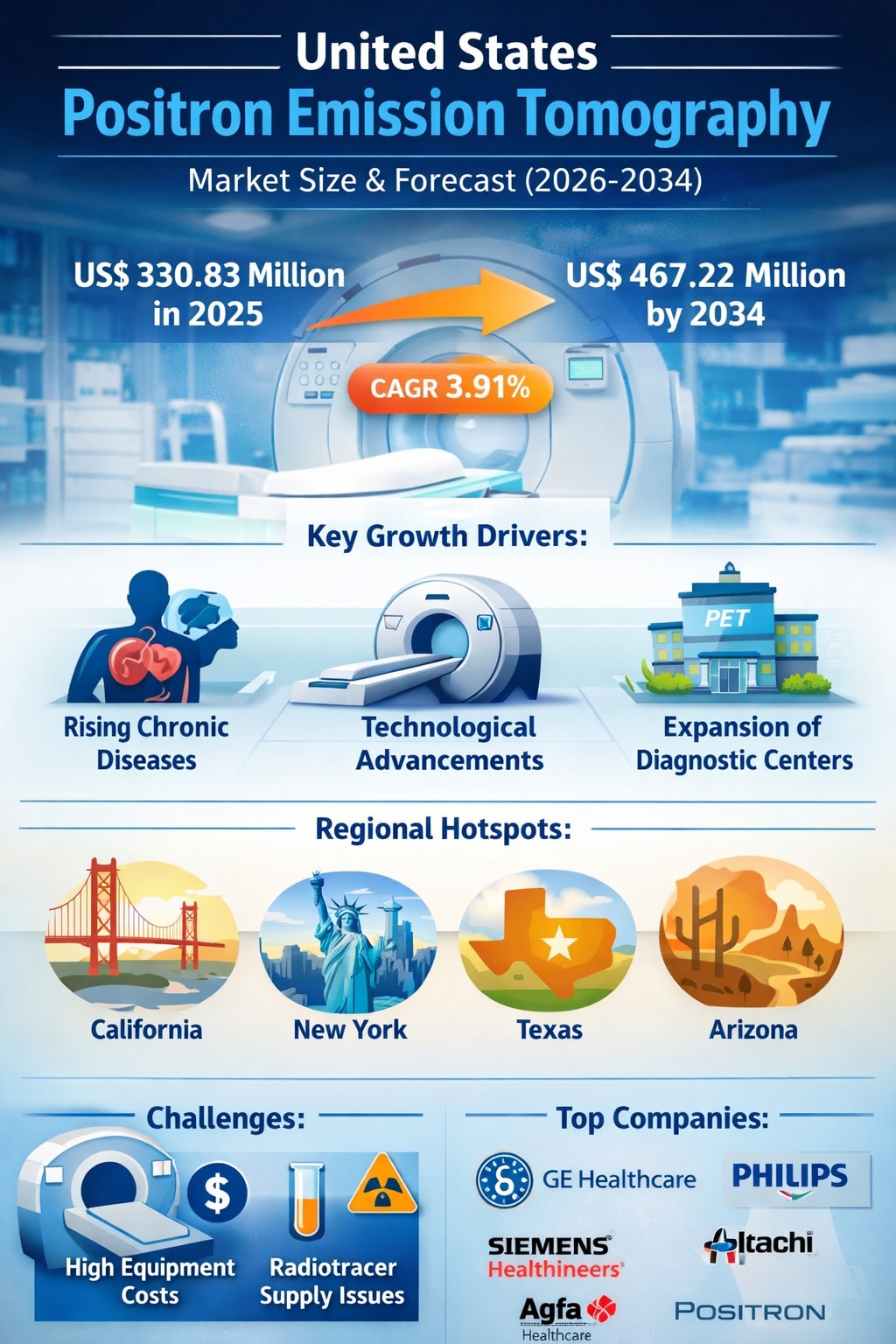
The United States Positron Emission Tomography (PET) market is undergoing steady and transformative growth as healthcare providers increasingly prioritize early disease detection, precision diagnostics, and personalized treatment strategies. According to Renub Research, the U.S. PET market is expected to grow from US$ 330.83 million in 2025 to US$ 467.22 million by 2034, expanding at a compound annual growth rate (CAGR) of 3.91% between 2026 and 2034.
This sustained expansion is primarily driven by the rising prevalence of chronic diseases, continued technological innovation in PET scanner systems, and the growing demand for highly accurate, non-invasive diagnostic tools. PET imaging has become indispensable in oncology, cardiology, and neurology, positioning it as a cornerstone of modern diagnostic infrastructure across the United States.
United States Positron Emission Tomography Market Outlook
Positron Emission Tomography is an advanced molecular imaging technique that enables visualization of metabolic and biochemical activity within the human body. The procedure involves the injection of a radiopharmaceutical that emits positrons. When these positrons interact with electrons in the body, gamma rays are produced and detected by the PET scanner, creating highly detailed three-dimensional images.
Unlike conventional imaging modalities that focus on anatomical structures, PET imaging reveals functional abnormalities at an early stage—often before structural damage becomes visible. This capability makes PET particularly valuable in cancer staging, neurological disorder diagnosis, and cardiovascular assessments.
In the United States, PET imaging has seen widespread adoption due to its critical role in cancer management, where it assists clinicians in tumor detection, treatment planning, therapy monitoring, and recurrence evaluation. The country’s robust healthcare infrastructure, combined with high awareness among physicians and patients, has accelerated PET adoption across hospitals, research institutions, and diagnostic centers. Furthermore, advancements in hybrid imaging systems such as PET/CT and PET/MRI continue to enhance diagnostic accuracy and clinical confidence.
Growth Drivers of the United States PET Market
Rising Incidence of Cancer and Chronic Diseases
One of the most significant drivers of PET market growth in the United States is the increasing burden of chronic diseases, including cancer, cardiovascular conditions, diabetes, and neurological disorders. PET imaging plays a crucial role in diagnosing, staging, and monitoring cancer, making it an essential tool in oncology care pathways.
An estimated 129 million Americans live with at least one serious chronic illness, and a growing proportion of the population is affected by multiple chronic conditions. PET’s ability to assess metabolic and functional changes allows clinicians to detect disease progression earlier and tailor treatment strategies more effectively. As healthcare systems increasingly focus on preventive care and early diagnosis, PET imaging continues to gain clinical relevance.
Technological Advancements and Hybrid Imaging Evolution
Rapid advancements in PET technology have significantly improved image quality, scanning speed, and patient safety. The integration of PET with CT and MRI systems has enabled clinicians to combine functional and anatomical imaging, resulting in more accurate diagnoses.
Improvements in detector materials, time-of-flight technology, and digital PET systems have enhanced resolution while reducing radiation exposure. Additionally, the development of new radiopharmaceuticals has expanded PET applications beyond oncology into neurology and cardiology. The emergence of theranostics—where PET imaging guides targeted radiopharmaceutical therapy—further strengthens PET’s clinical value and long-term growth potential in the U.S. healthcare landscape.
Expansion of Diagnostic Centers and Reimbursement Support
The rapid growth of freestanding diagnostic imaging centers across the United States has significantly improved patient access to PET scans. These centers offer shorter wait times, higher throughput, and specialized imaging services outside traditional hospital settings.
Favorable reimbursement policies, particularly for oncology and cardiology PET procedures, have made investments in PET technology financially viable for providers. As insurers increasingly recognize PET’s ability to reduce misdiagnosis and unnecessary treatments, reimbursement coverage continues to expand, reinforcing market growth.
Challenges Facing the U.S. PET Industry
High Equipment and Operational Costs
Despite its clinical benefits, PET imaging involves substantial capital investment. Advanced systems such as PET/CT and PET/MRI require high upfront costs, specialized shielding, and ongoing maintenance. Operational expenses, including radiotracer procurement, staff training, and regulatory compliance, further increase financial burdens.
These costs can limit adoption among smaller hospitals and rural healthcare facilities, resulting in market concentration among large urban centers and established diagnostic networks.
Radiotracer Supply Constraints and Regulatory Complexity
PET imaging relies on radiotracers with short half-lives, requiring precise production and timely distribution. Limited cyclotron availability in certain regions, coupled with stringent handling regulations, can disrupt supply chains and delay scanning schedules.
Additionally, the regulatory approval process for new radiopharmaceuticals is lengthy and complex, potentially slowing innovation and market expansion in specialized PET applications.
Market Segmentation Insights
Full-Ring PET Scanners
Full-ring PET scanners dominate the U.S. market due to their superior sensitivity, higher photon detection rates, and faster acquisition times. These systems are widely installed in hospitals, cancer centers, and high-volume diagnostic facilities, where diagnostic accuracy and efficiency are critical.
Bismuth Germanium Oxide (BGO) PET Market
BGO-based PET scanners remain relevant due to their cost-effectiveness and reliable performance. While newer detector materials offer faster response times, BGO systems continue to serve budget-conscious facilities and community hospitals.
Lutetium Fine Silicate (LFS) PET Market
LFS-based PET scanners represent next-generation imaging technology, offering improved timing resolution, lower noise, and enhanced image clarity. These systems are increasingly adopted by advanced diagnostic centers focused on precision imaging and reduced radiation exposure.
Application-Based Market Analysis
Cardiology PET Market
Cardiac PET imaging is gaining momentum due to its superior accuracy in assessing myocardial perfusion and blood flow. PET’s quantitative capabilities support personalized treatment planning and early detection of coronary artery disease.
Neurology PET Market
The neurology segment is expanding rapidly as PET imaging enables early detection of neurodegenerative diseases such as Alzheimer’s and Parkinson’s. Novel tracers targeting amyloid and tau proteins are strengthening PET’s role in brain health diagnostics.
Regional Market Highlights
California
California leads the U.S. PET market due to its advanced healthcare systems, strong research ecosystem, and high concentration of specialized cancer centers. The state is a frontrunner in adopting hybrid and digital PET technologies.
New York
New York’s dense population and world-class academic medical centers support high PET utilization. Strong research initiatives and early technology adoption sustain consistent market demand.
Texas
Texas is one of the fastest-growing PET markets, driven by population growth, expanding healthcare networks, and lower operational costs compared to coastal states.
Arizona
Arizona’s aging population and rising chronic disease prevalence are driving PET demand, particularly in oncology and cardiology applications.
Competitive Landscape
The United States PET market is highly competitive, with key players focusing on innovation, system upgrades, and strategic collaborations. Major companies include GE Healthcare, Koninklijke Philips NV, Siemens Healthineers AG, Hitachi Ltd., Agfa Healthcare, Mediso Medical Imaging Systems Ltd., and Positron Corporation. These companies compete through product innovation, digital integration, and expanded service offerings.
Final Thoughts
The United States Positron Emission Tomography market is positioned for stable and sustainable growth through 2034. Rising chronic disease prevalence, continuous technological advancements, and expanding diagnostic infrastructure are reinforcing PET’s role as a critical diagnostic modality. While high costs and regulatory complexities pose challenges, ongoing innovation and supportive reimbursement frameworks are expected to drive long-term market resilience.
As healthcare systems increasingly emphasize early detection, precision medicine, and value-based care, PET imaging will remain a vital component of the U.S. diagnostic ecosystem—bridging advanced technology with improved patient outcomes.
About the Creator
Sakshi Sharma
Content Writer with 7+ years of experience crafting SEO-driven blogs, web copy & research reports. Skilled in creating engaging, audience-focused content across diverse industries.
Keep reading
More stories from Sakshi Sharma and writers in Longevity and other communities.
United States In Situ Hybridization Market Size and Forecast 2026–2034
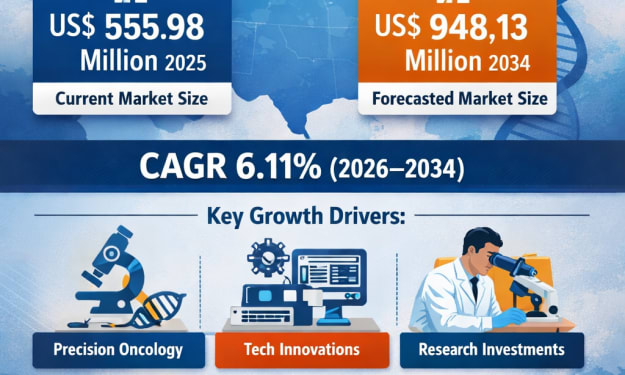
United States In Situ Hybridization Market Overview The United States In Situ Hybridization (ISH) market is witnessing steady and structurally strong expansion, driven by the rapid adoption of advanced molecular diagnostic techniques across clinical and research settings. According to Renub Research, the U.S. ISH market is projected to increase from US$ 555.98 million in 2025 to US$ 948.13 million by 2034, growing at a compound annual growth rate (CAGR) of 6.11% during 2026–2034.
By Sakshi Sharmaabout 13 hours ago in Longevity
Day 4 of Quitting
If this is how sobriety feels, maybe it’s better to go through life a little buzzed… this, along with other hits like, I want to kill myself, I wish I was dead, and I’m going to throw myself off a bridge have been the only thoughts on rotation these past few days. I promise myself that if, in a month, I still feel like this (‘this’ meaning despondent, full of rage, and simultaneously numb) I can go back to smoking. Until mid-February though? Nicotine is off the table.
By sleepy drafts26 days ago in Longevity
Finding Balance in an Unbalanced World
I had a panic attack in the grocery store checkout line. Nothing triggered it. No dramatic event. Just me, standing there with a cart full of organic vegetables and Pinterest-worthy meal prep ingredients, when suddenly I couldn't breathe.
By Fazal Hadi2 days ago in Longevity


Comments
There are no comments for this story
Be the first to respond and start the conversation.